Top 5: Thermal Scopes

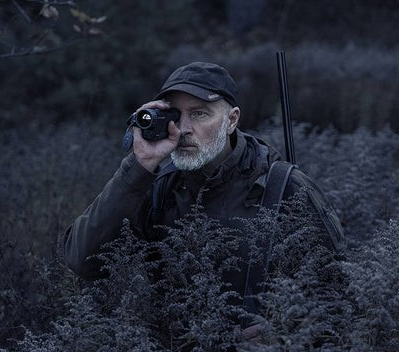
Thermal scopes detect and display temperature variations and can use the infrared energy (heat) emitted by warm-blooded animals to create a distinct thermal profile. They produce an image that displays different temperatures in different colours which can be used to visibly detect the location of animals that may not otherwise be seen due to lack of light.  

Thermal scopes are typically used to survey nocturnal or elusive species. Particularly useful when used in bat surveys, they can be used to identify roost access points with greater accuracy and can provide improved-quality images of animals in flight. Thermal scopes are also used in surveys for other wildlife, including bird ringing programmes and nest box monitoring, particularly for Pine Martens. This non-invasive technology allows ecologists to monitor wildlife whilst minimising disturbance, allowing for more accurate data reporting on wildlife behaviour. They can be used during both the day and night and offer different colour palettes to improve visibility in different environmental conditions.  

Thermal scopes are designed with varied capabilities and are suitable for a range of users, from naturalists to ecologists. Here we explore a range of thermal scopes available on our website, including both affordable and more advanced options, and highlight the benefits and features of each.  


Pulsar Telos XP50 Thermal Imaging Monocular
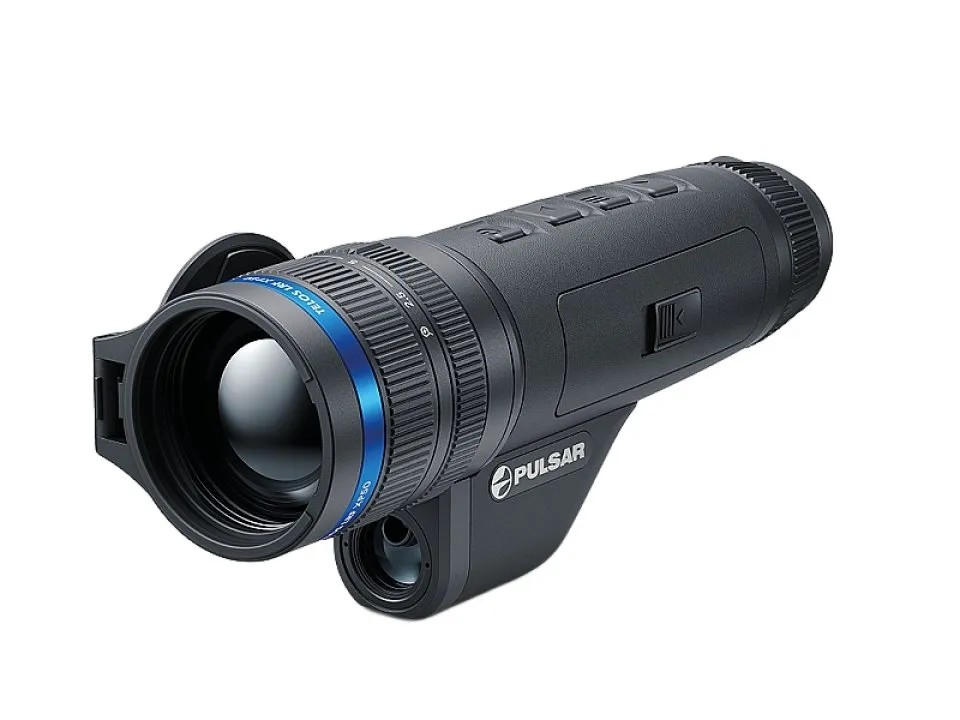
Featuring an industry-leading thermal sensor, this high performance monocular provides high resolution imagery in all conditions and has a built-in laser range finder (LRF) capable of long-distance measurements. Durable and userfriendly, these waterproof optics are suitable for all weather conditions and are designed with a wear-resistant rubberised body to maximise longevity.  

  • Sensor: 640 × 480, 17µm, <18mK NETD 
  • Lens:  50mm/F1.0 Germanium lens  
  • Magnification: 2.5-10.0× (and 4× digital zoom) 
  • Frame rate: 50Hz 
  • Detection range: 1,800m 
  • Video/photo resolution: 1024 × 768 
  • Rating: IPX7 
  • Operating time: Up to 8.5hrs 
  • Weight: 720g with battery 


Pixfra Sirius S650 Thermal Imaging Monocular
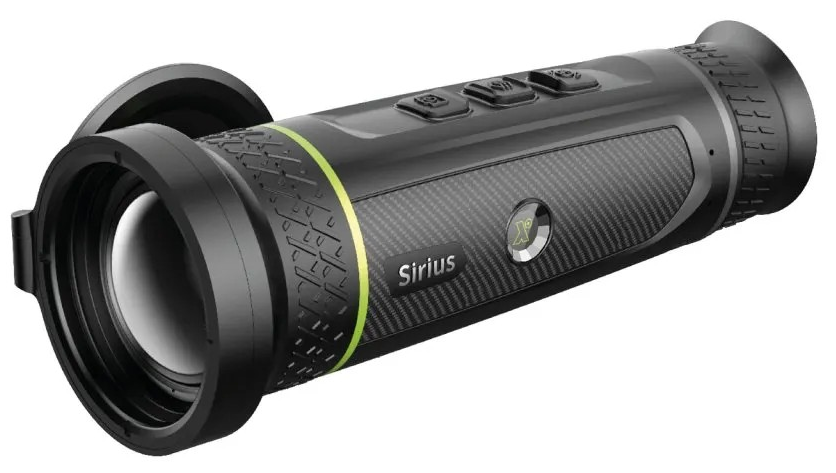
Pixfra Sirius S650 Thermal Imaging Monocular

A compact, powerful monocular offering an incredible optical performance. This monocular has an impressive magnification and detection range, making it ideal for wildlife observation and recording thermal images at a distance. And with 64GB built-in storage, still images or video can be recorded at the push of a button. 

  • Sensor: 640 × 512, 12µm, <18mK NETD 
  • Lens: 50mm/F0.9 
  • Magnification: 3.45 × 
  • Frame rate: 50Hz 
  • Detection range: Up to 2,600m 
  • Rating: IP67 
  • Operating time: Up to 6 hours 
  • Weight: 537g 


Pixfra Arc 600 Series Thermal Imaging MonocularsPixfra Arc 600 Series Thermal Imaging Monoculars

A great all-round choice at a competitive price point, this thermal monocular is compact, lightweight and has the widest field of view in the Pixfra range making it ideal for emergence surveys. A highly robust chassis and an IP67 rating mean that this monocular is incredibly durable and is built to withstand poor weather conditions, drops and scrapes in the field.  

  • Sensor: 640 × 512, 12µm, NETD <30mK  
  • Lens: 13mm/F1.0 
  • Magnification: 0.875× 
  • Frame rate: 50Hz 
  • Detection range: 670m 
  • Rating: IP67 
  • Operating time: Up to 6.5h  
  • Weight: 304g (excluding battery) 


Pulsar Merger LRF XP50 Thermal Imaging Binoculars
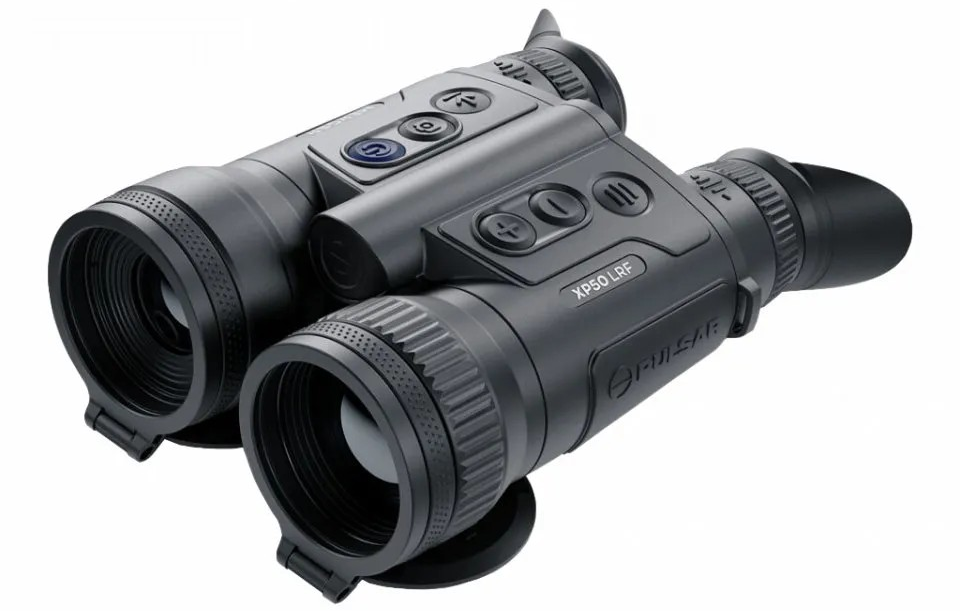
High-spec, professional-level thermal binoculars, this device features a built-in laser range finder and a highly sensitive thermal sensor operating across a long detection range. Lightweight and durable, these advanced thermal optics are highly resistant to harsh environmental conditions and can be submerged in up to one meter of water for up to 30 minutes.  

  • Sensor: 640 × 480, 17 µm, NETD <25mK 
  • Lens: Fast aperture F50/1.0 germanium lens 
  • Magnification: 2.5×-20× (and digital 8× zoom) 
  • Frame rate: 50Hz 
  • Detection range: 1,800m 
  • Video/photo resolution: 1024p × 768p 
  • Rating: IPX7 
  • Operating time: Approx 10hrs 
  • Weight: 800g 


Pulsar Axion 2 XQ35 Pro Thermal Imaging Monocular

A lightweight and highly portable mid-range monocular, this thermal scope features an industry-leading sensor and a high-quality aperture objective lens to ensure clear, distinguished viewing. Innovative in design, this monocular allows for still image and video recording to internal memory, and is Wi-Fi enabled to allow for easy downloads to a mobile device.  

  • Sensor: 384 × 288, 17 µm, NETD <25mK 
  • Lens: Fast aperture Germanium 35mm/F1.0 objective lens  
  • Magnification: 2-8×,  
  • Detection range:1,300m @ 1.8m 
  • Video/photo resolution: 528 x 400p 
  • Rating: IPX7 
  • Operating time: Up to 11 hours 
  • Weight: 380g 


Recommended Reading: 

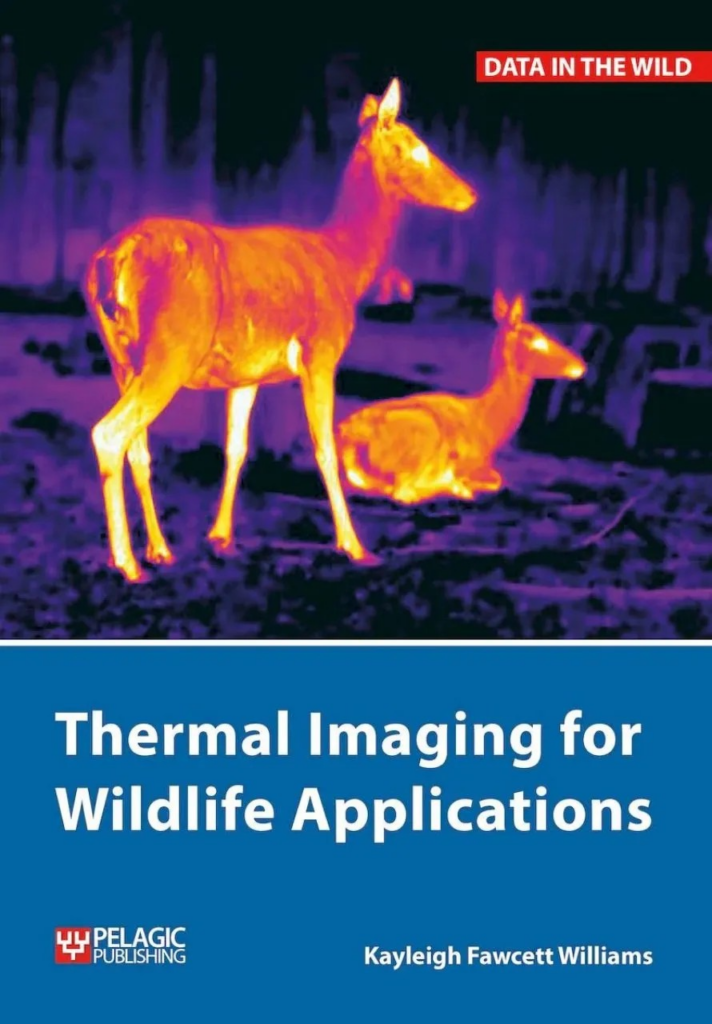
Thermal Imaging for Wildlife Applications

Paperback & Hardback | Oct 2023

A practical guide that collects findings from academic research and applied field protocols to inform readers on the fundamentals of the technology, its methods, equipment and applications. 
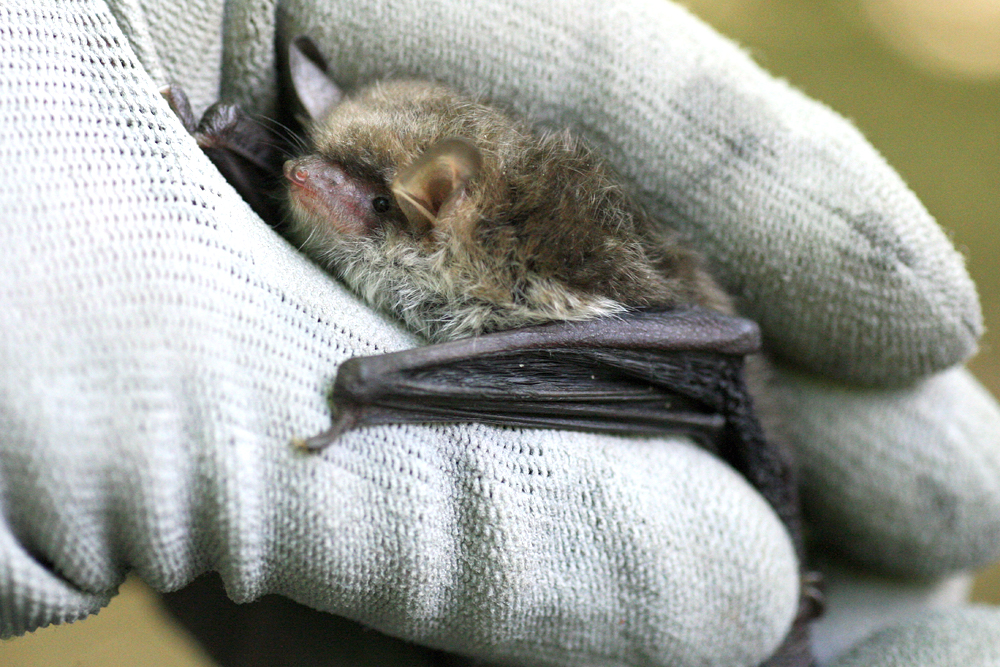


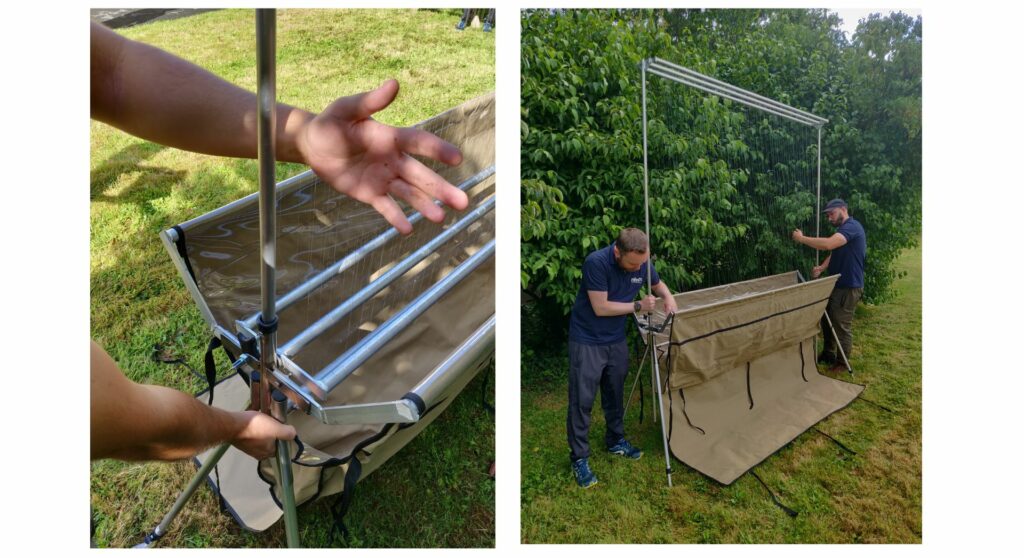
The NHBS Harp Trap: New Model Assembly Instructions

This blog provides a step-by-step guide on to how to set up and disassemble the latest model of the NHBS manufactured Harp Trap.

Please note that the NHBS Harp Trap is a made-to-order item, contact us at customer.services@nhbs.com for enquiries and we will be happy to advise on the current lead time.


Handling your trap

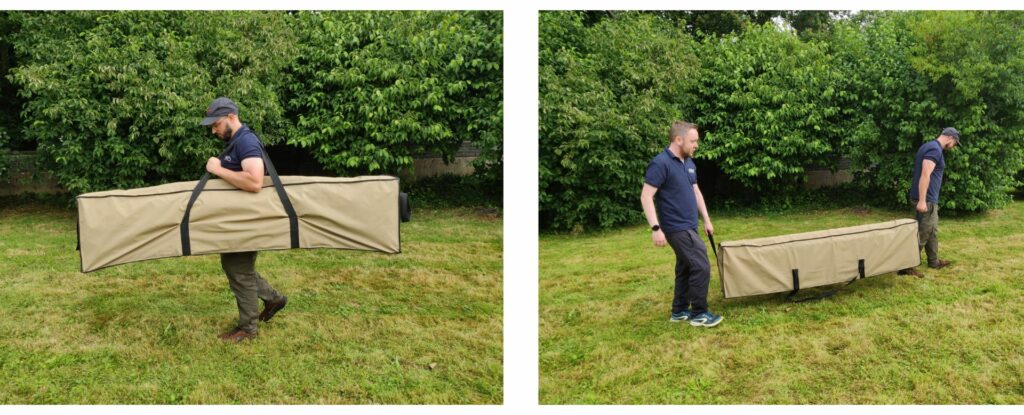
The trap carry bag has been designed to allow handling/carrying by either one or two people.


What’s in the bag?

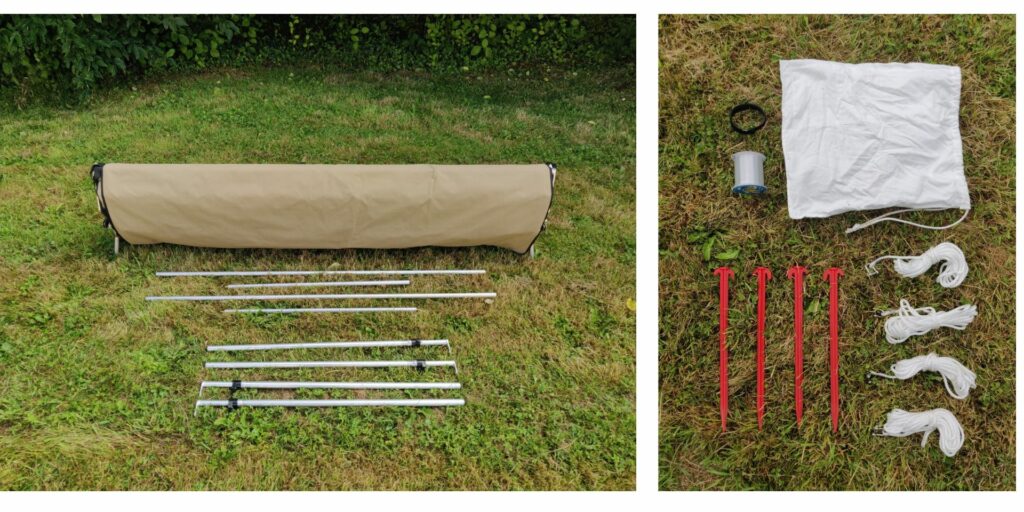
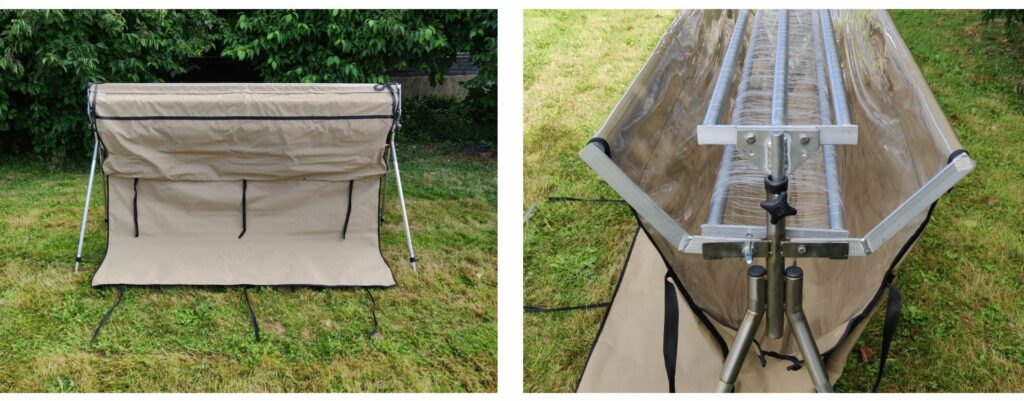
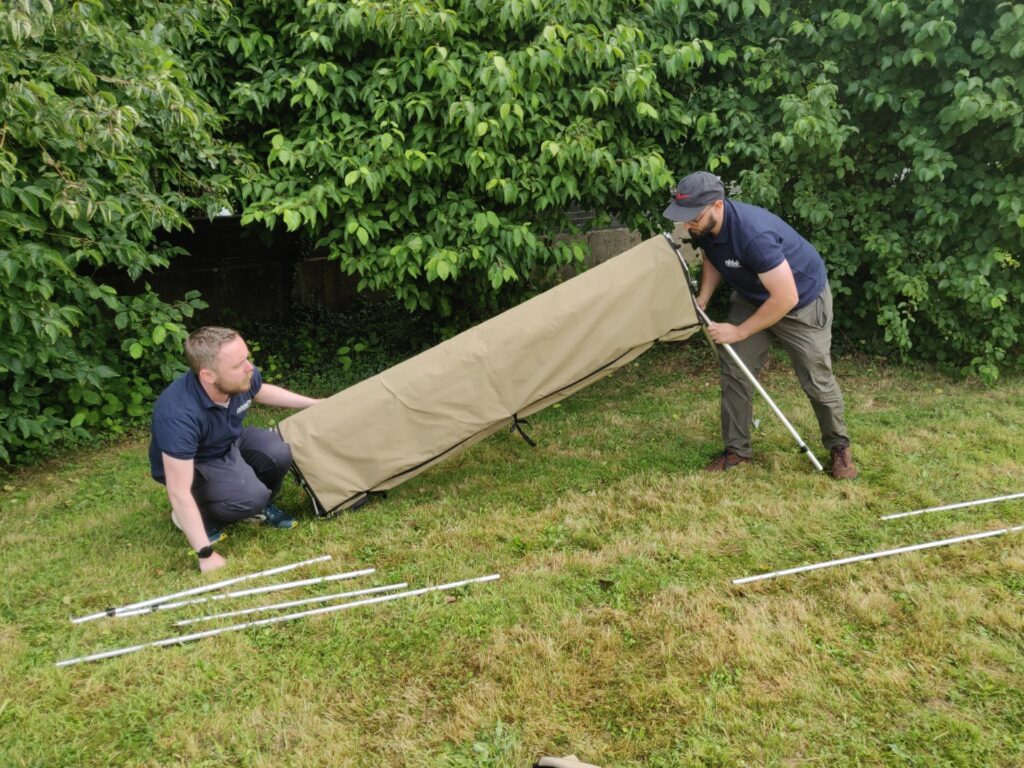
1 × Harp Trap, 4 × legs, 2 × support poles (in two parts), 1 × accessories pack (including instructions, 4 × pegs, 4 × guy ropes and spare line)

The contents of the harp trap


Please follow these instructions for correct assembly and disassembly. We recommend that this is carried out by two people.  

Setting Up

1 . Carefully remove the harp trap from its carry bag and place the frame upright on the floor.

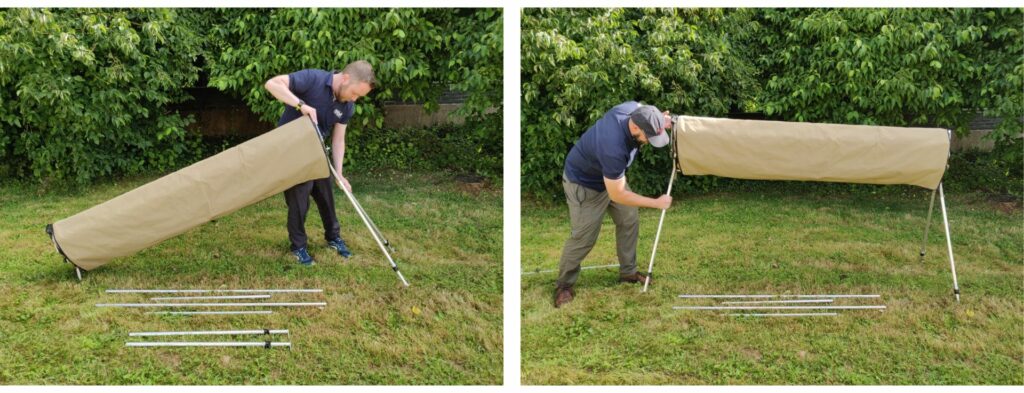
Remove the harp trap from the frame and place upright

2 . Take the legs out of the carry bag and insert them into the holes on the underside of the frame – it is easiest to do this one end at a time. When required, all legs can be individually adjusted to raise the trap or to level out when setting up on uneven ground.

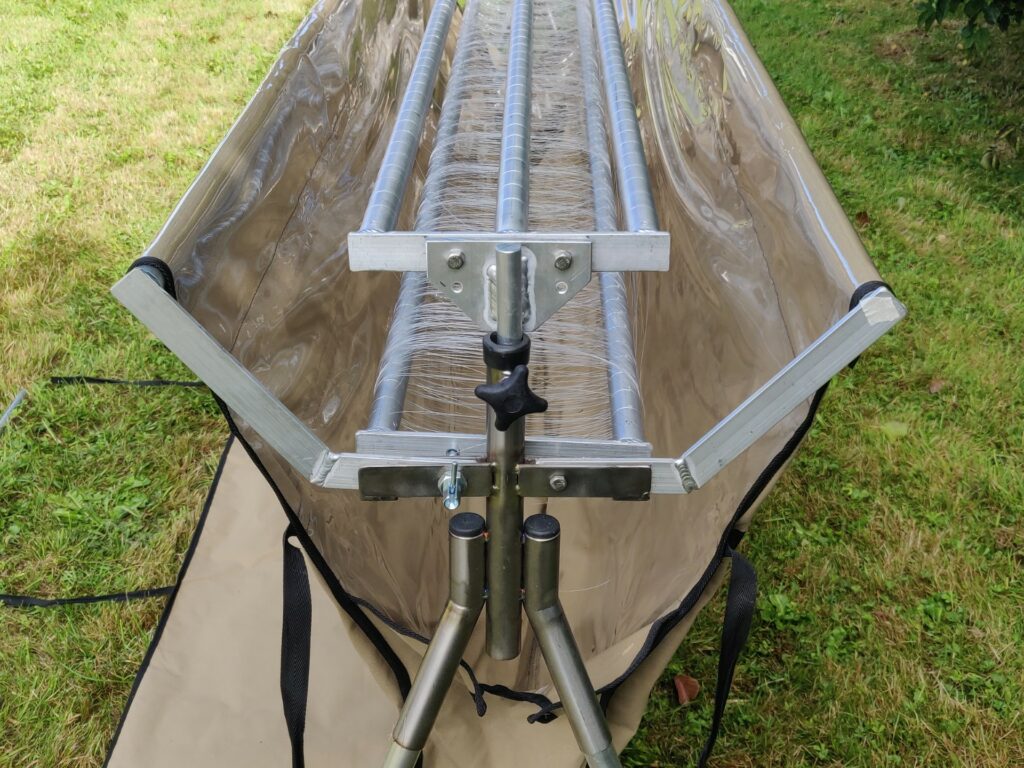
3 . Undo the straps and allow the collecting bag to settle by opening the arms of the frame out fully. If using guy ropes, attach them to the upper carriage now.

Undo the straps and allow the collecting bag to settle by opening the arms of the frame out fully. If using the guy ropes, attach them to the upper carriage now.

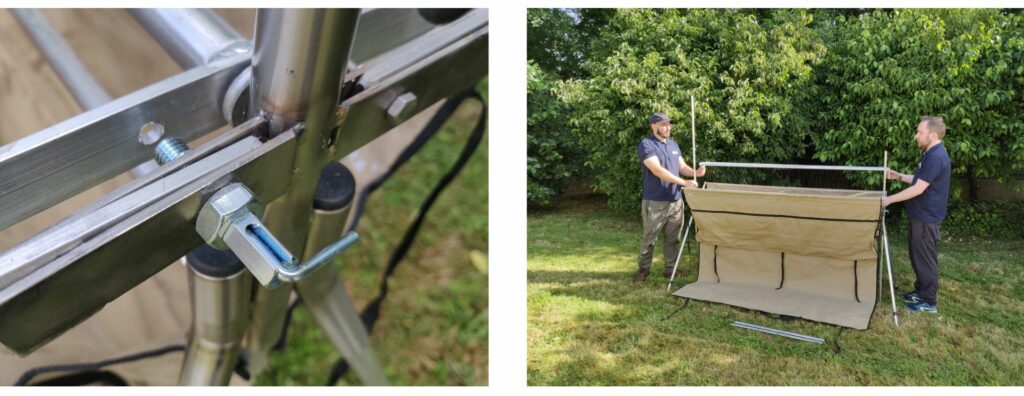
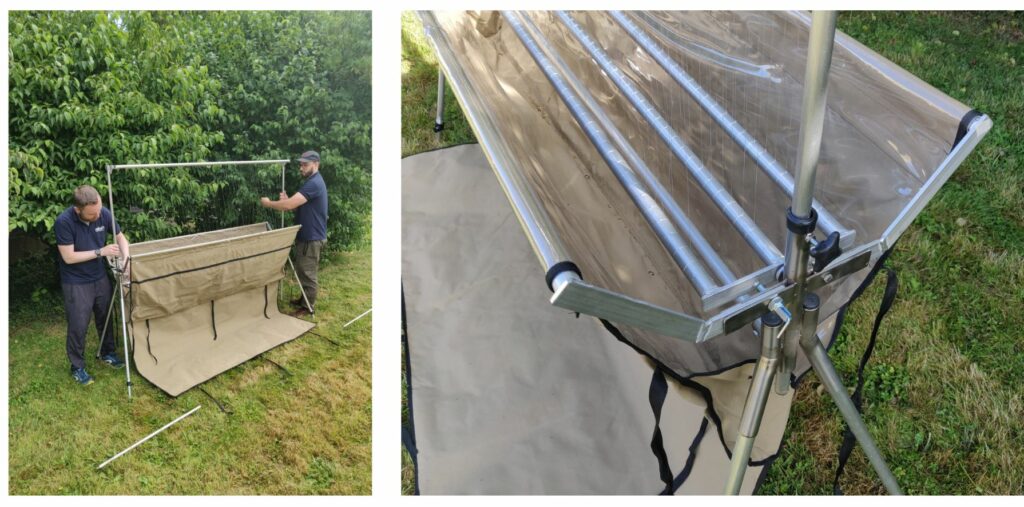
4 . Release the spring locking pins at both ends of the trap by pulling the lever out and rotating 90° to lock in the open position. Grab the longer piece of the support poles and hold upright with the connector facing down. Now, loosen the star handled screw and carefully lift the top carriage, raising it away from the main frame. Insert the support pole through the hole, where you removed the upper carriage from, and allow the poles to sit on the floor. Then insert the top carriage locating pins into the open end of the support poles.

5 . If using guy ropes, untie and allow to hang.

6. Working at the same pace, slowly raise the support pole so that the bottom of the pole is just below the lower part of the main frame, watching closely to ensure no strings get tangled. Once you reach this height, tighten the star handled screw to secure the support pole in position.  

7 . Take the shorter parts of the support poles and attach them to the bottom of the longer parts by screwing together.

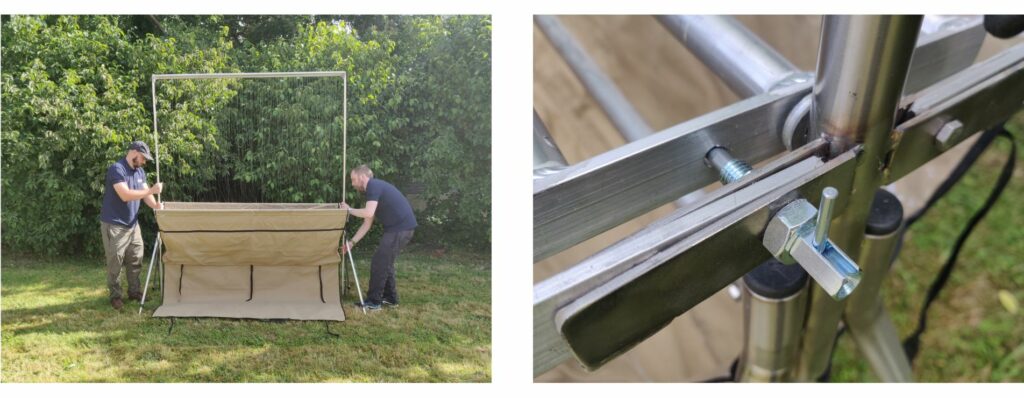
8 . With the support poles now at their full length, while holding on to them, loosen the star handled screw and continue to raise them, still working together and checking for any string snagging. Raise until the bottom of the pole is level (or as near as possible) with the bottom of the frame and tighten star handled screws. 

9 . Engage both spring locking pins to secure the lower carriage.

10 . If you are using them for stability, you can now peg out the guy ropes and your trap is ready for use.


Disassembly

1 . If used, pull out the pegs and store them carefully.  

2 . Release the spring locking pins from both ends of the trap. Hold the support poles (one person at each end) and loosen the star handled screws to lower the poles 

3 . Continue to slowly lower the poles and as you do so, carefully start winding the bottom line carrier, taking great care to ensure no lines get tangled. Guiding the lines with your hand/arm is key. Keep lowering the support poles slowly and evenly while winding the line carrier until the support poles rest on the floor.  

4 . With the support poles resting on the ground, tighten the star handled screw to hold the pole in position, unscrew the lower/short part of the support pole and safely place to one side.  

5 . Hold onto the support pole, loosen the thumb screw, and continue to lower until the pole sits on the ground. If used, gather up the guy ropes, tie them up, detach from the frame and place safely to one side.  

6 .  Now lift the top carriage off from the top of the support pole, slide the pole out from the frame and place to one side. Continue to lower the top carriage, whilst winding the bottom carriage, until the top carriage sits on the main frame.  

7 . Once the top carriage has been lowered fully, engage the spring locking pins and tighten the star handled screw to secure it in place, fold the arms of the catch bag assembly inwards until they meet, wrap the bag around the trap and tie the straps to secure.  

8 . Remove the legs from the frame, working on one end of the frame at a time is easiest. If you have extended the legs, to aid storage, reduce them to their shortest length. 

9 . Place the guy ropes and pegs back in the accessories bag. Put the legs and the support poles in the bottom of the carry bag and finally, carefully place the trap and accessories bag back into the carry bag, safe and sound, ready for next time.  

Author interview with Susan Young: Night Vision and Daylight Camera Systems for Wildlife

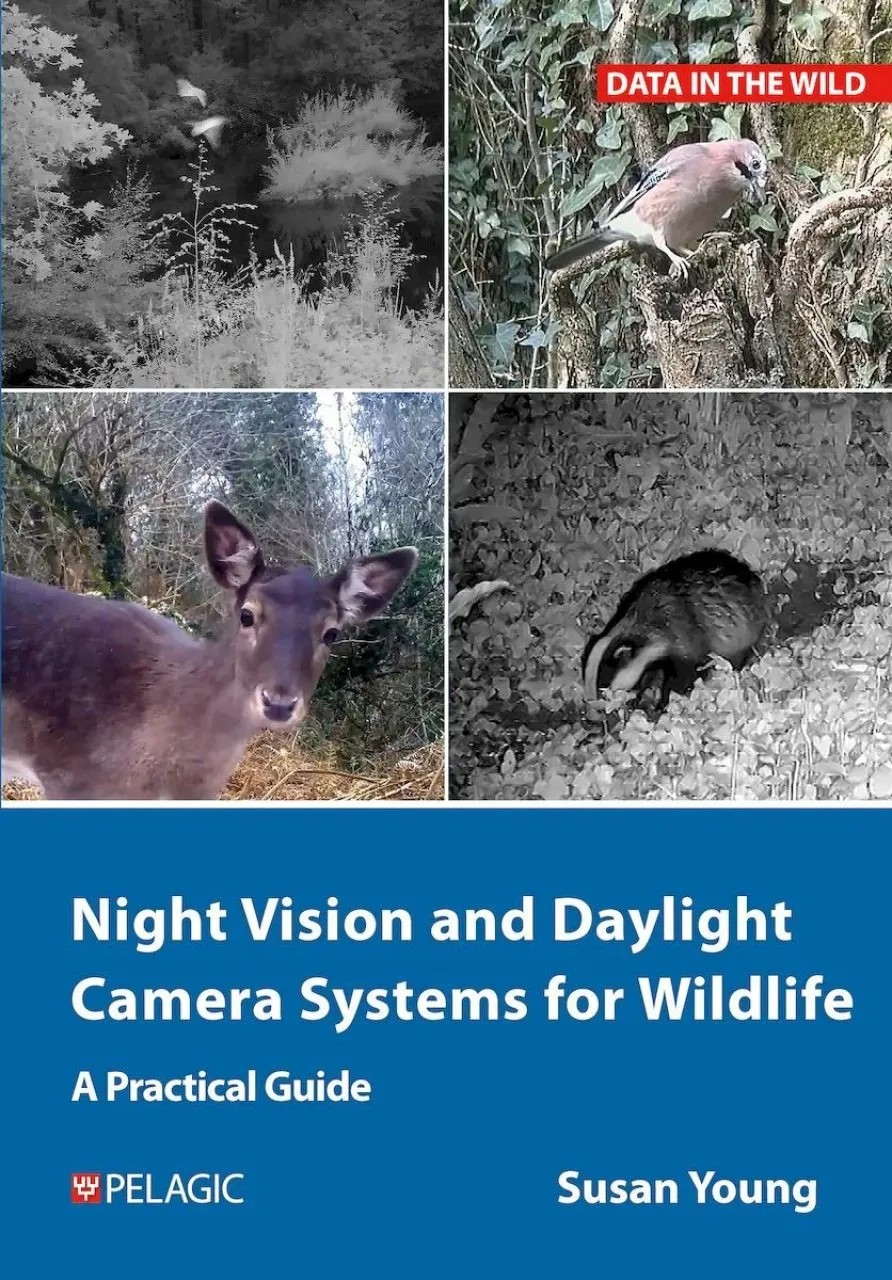
Night Vision and Daylight Camera Systems for Wildlife book cover.This comprehensive guide describes how wildlife can be monitored and recorded in a non-intrusive way using well-developed and reliable technology. Detailing key techniques for capturing high-quality footage of a range of species, from nocturnal mammals to elusive birds, this practical resource is ideal for both professional ecologists and amateur naturalists alike who are seeking to enhance their understanding of the natural world.

Susan Young.Susan Young is a photographer and writer based in South Devon, who has a wealth of experience in wildlife photography. She has authored several books, including  CCTV for Wildlife Monitoring and Wildlife Photography Fieldcraft, and is currently carrying out research with Natural England, the Woodland Trust and Mammal Society on the use of remote cameras for wildlife monitoring.
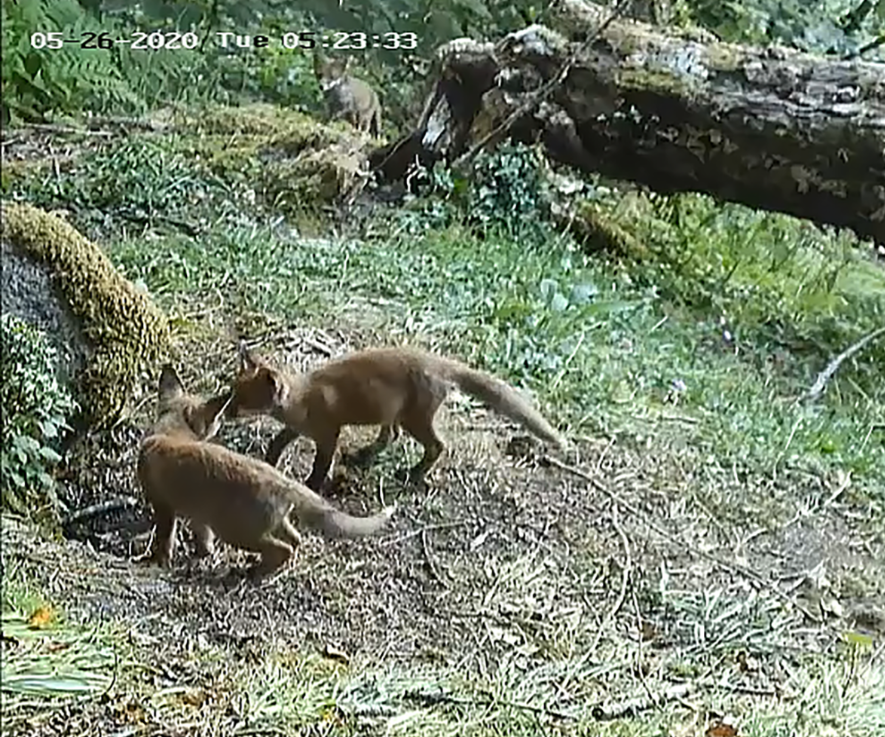
We recently spoke to Susan about her latest book, where she explained how she first started working with visual systems, how ecological and wildlife-watching camera systems differentiate, and more.


Firstly, could you share a little bit about yourself and your background working with visual systems? 

My background is in physics and engineering, but I have had a keen interest in wildlife from a very early age. Since moving to Devon some years ago, I developed my interest in photography and wrote several books on various technical topics. I used trail cameras before they became ‘famous’ and finding some aspects frustrating, moved to bird box cameras – I then became interested in using security cameras with separate recorders as they had more useful features.  

In 2015/2016 I started as a volunteer with Natural England and the Woodland Trust where I was encouraged to develop my ideas for portable CCTV systems, which led to the discovery of three calls of Barbastelle Bats not previously recognised. Further work with dormice, otters, deer, small mammals and birds showed just how well the systems performed, being much richer in features than trail cameras and much less expensive than thermal systems.


Fox cubs in woodland.

Your previous book, CCTV for Wildlife Monitoring was published in 2016. What inspired you to revisit the topic for a second book, and what advancements or changes does your latest title encompass? 

My book in 2016 was more of an introduction to CCTV technology, which was just taking off and becoming more readily available. Since then, the technology has advanced dramatically, with HD cameras giving very high-quality images, and recorders becoming available with solid state drives making them very portable. 

There are many other features not found in other visual systems – in particular, security recorders have inbuilt video analysis which can be controlled by the user, greatly reducing the amount of video data to analyse. My book has detailed step-by-step instructions for all aspects of the night vision camera systems with the aim of flattening the learning curve. 

Night Vision systems are commonly associated with ecological research and wildlife watching, how do the camera systems you describe differentiate from them?

The systems I describe have a raft of features, as described above, making analysis much easier. They can also be left outside unattended and are particularly useful for remote areas. They are also relatively low cost and portable.

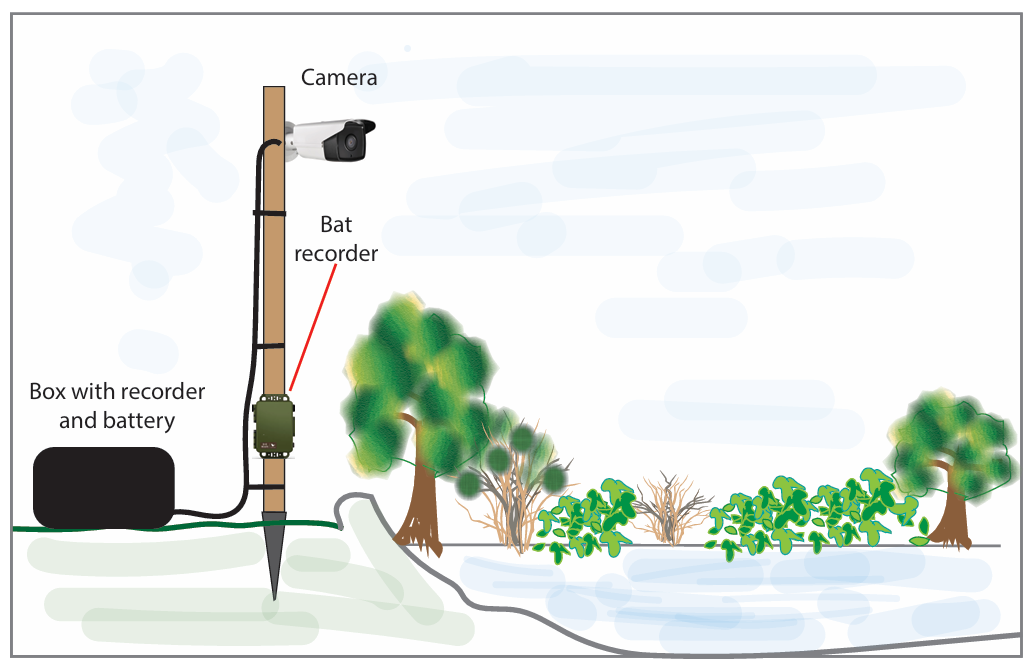
Reservoir camera setup.

Why did you feel that it was important to include a section on public engagement and education in this book? 

Public engagement is important for raising awareness of the plight of our wildlife, as well as for attracting funding. High-quality videos from security camera systems, particularly of protected or rarely seen species, have proven successful. My book gives step-by-step instructions to encourage the use of this technology without the need for costly specialists. 

Regarding schools, introducing children to technology at an early age makes use of the systems less daunting in later life. 

Have you come across any emerging or under-utilised applications for this technology that you believe hold potential? 

Many of the applications I have developed using my camera systems are new and I believe hold great potential. Because the systems can be set up and left for long periods, it means little or no disturbance to wildlife – for example monitoring breeding birds of prey in remote habitats, observing dormice behaviour in dormouse boxes, or surveying bats in hazardous environments.

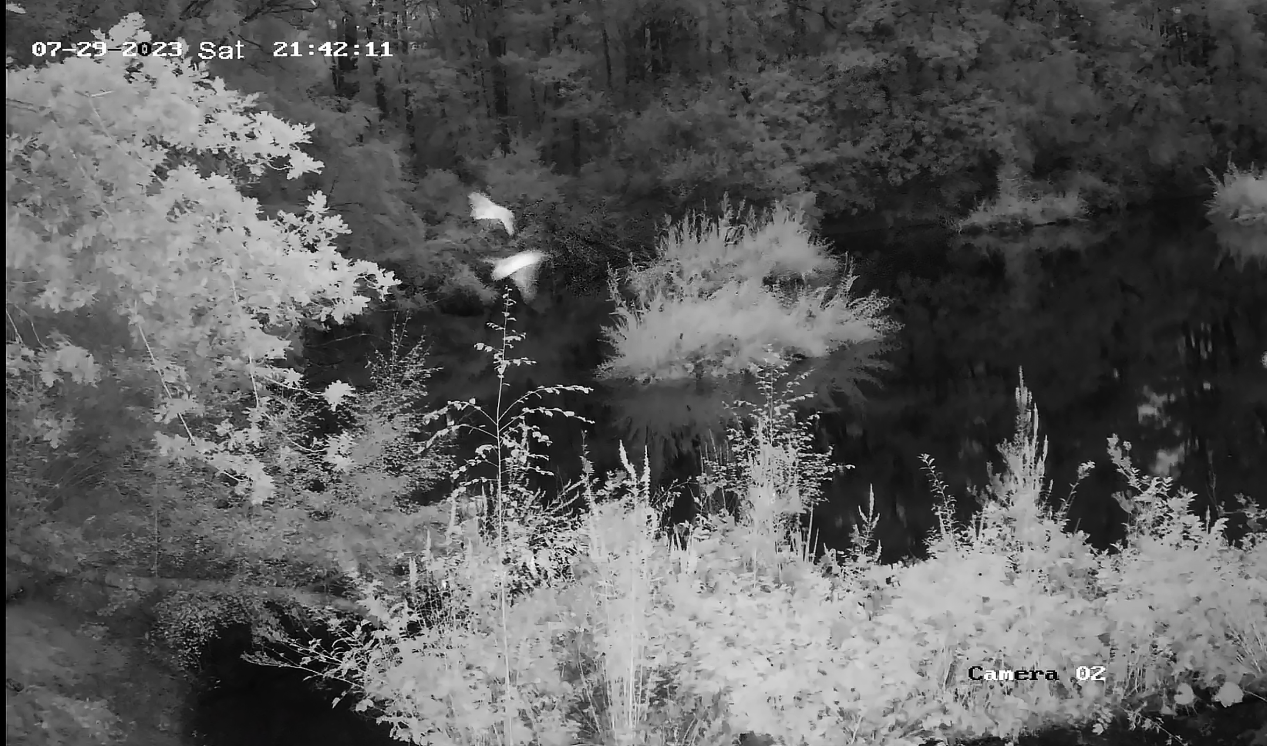
High res reservoir.
High res reservoir.

Have you encountered any particularly memorable or exciting wildlife captures? Can you share any highlights from your experience? 

On the conservation front, discovering new Barbastelle calls was very exciting, as was viewing previously unseen dormouse behaviour. On the naturalist level, filming four young Fallow Deer running round and round my rural garden in play was very heart-warming. 

Finally, what’s next for you? 

I am planning some research using my systems for small mammals which are often under-recorded. I am also producing educational material for the Mammal Society. 

Night Vision and Daylight Camera Systems for Wildlife book cover.

Night Vision and Daylight Camera Systems for Wildlife is available here.

NHBS In the Field – Song Meter Mini 2 and Micro 2

The second-generation Song Meter Mini 2 and Micro 2 are the latest additions to the Wildlife Acoustics acoustic recorder range, with the Song Meter Mini 2 available in both AA and Li-Ion powered versions.  

I was eager to test the new Li-Ion version of the Song Meter Mini 2, which I set up alongside the Song Meter Micro 2 in early December. The aim of this deployment was to compare the performance of the two models, and as a self-described ‘bird nerd’, I was also very excited to capture recordings of the incredible birdlife that resides on Dartmoor.  

Deployment  

The Song Meter Mini 2 Li-Ion model holds six rechargeable 18650 lithium-ion batteries with a minimum of one required for deployment. In this case, I used four batteries in both devices which provided ample runtime for this short field test, and I inserted a 32GB SDHC card – unfortunately, I did not have access to a battery charger so the Song Meter Mini 2 began the deployment at 57% battery life. I set up the recorders in a rural Dartmoor village hoping for clear recordings. 


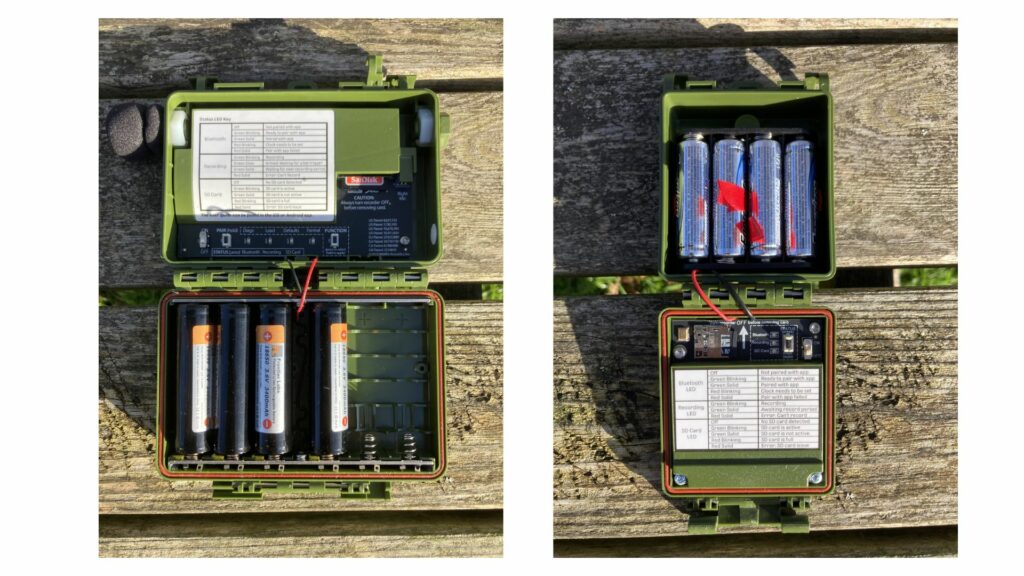
Song Meter Mini 2 Li-Ion (right) and Song Meter Micro 2 (left) set up with batteries and SD cards.
Song Meter Mini 2 Li-Ion (left) and Song Meter Micro 2 (right) set up with batteries and SD cards.

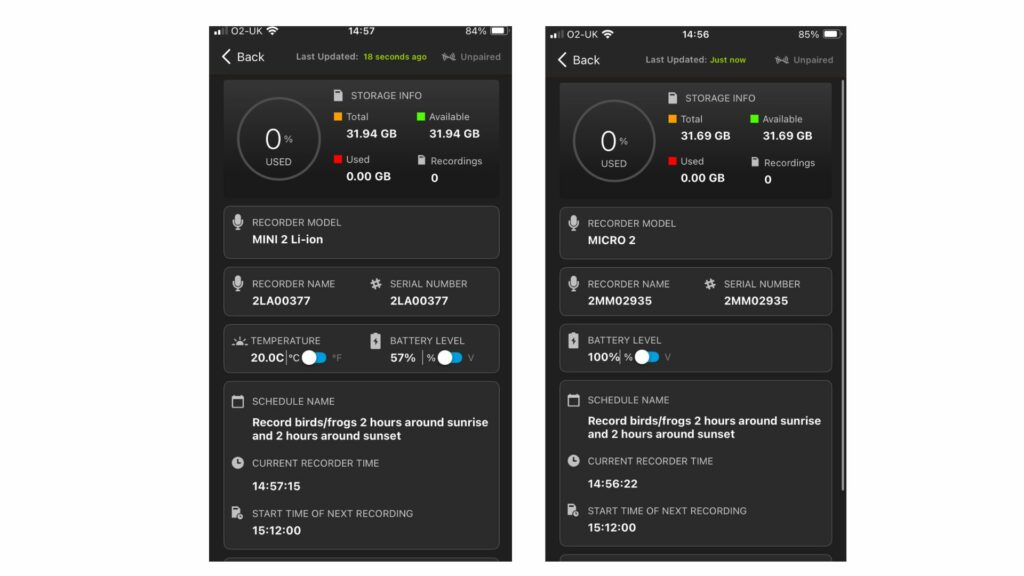
One of the main strengths of Wildlife Acoustic’s recorders is their simple deployment and configuration using the free Song Meter app. Here you can select your preferred recording schedule and check the status of your recorder at any time while in Bluetooth range this provides information on SDHC card capacity, battery life, recording mode, and number of recordings taken. For this deployment, I used a pre-set recording schedule to record birds for two hours around sunrise and sunset.  

Song Meter Mini 2 Li-Ion (right) and Micro 2 (left) status before deployment.
Song Meter Mini 2 Li-Ion (left) and Micro 2 (right) status before deployment.

Both models now feature cable lock holes so that they can be safely secured during deployment – using a Python Lock, I fixed the device to a tree and left it to record for two days. 


Results

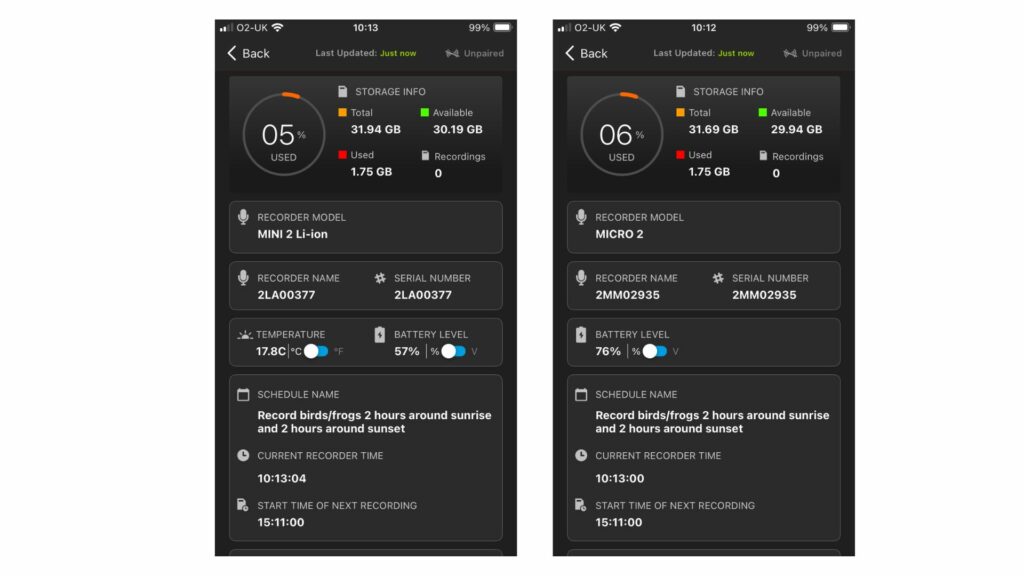
Over 2 days, I had collected 33 recordings on each device. Both devices had ample battery life remaining and had used just 1.75GB of storage.  

Song Meter Mini 2 Li-Ion (right) and Micro 2 (left) status after deployment.
Song Meter Mini 2 Li-Ion (left) and Micro 2 (right) status after deployment.

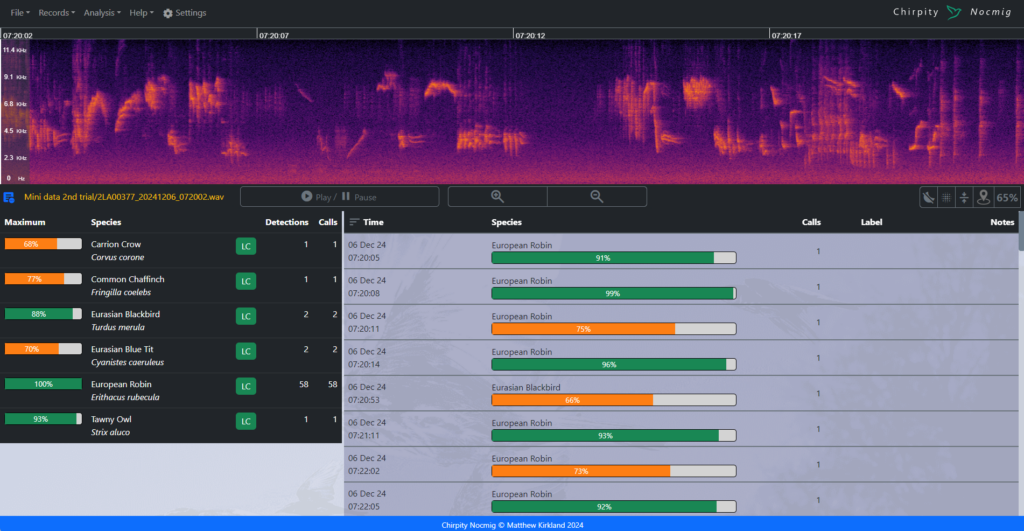
I analysed the recordings with a fantastic free desktop software called Chirpity. Using the BirdNET model, this software has an auto ID feature which simplifies analysis of sound recordings, particularly for large data sets.  Using this software, I was able to identify a wide variety of garden bird calls including Robins, Blue Tits, Tawny Owls and many more. Examples of the dawn chorus from each device can be heard below.

Dawn chorus recording on Song Meter Mini 2 Li-Ion.

Dawn chorus recording on Song Meter Micro 2.

Spectrogram analysis of dawn chorus in Chirpity


Product Comparison 

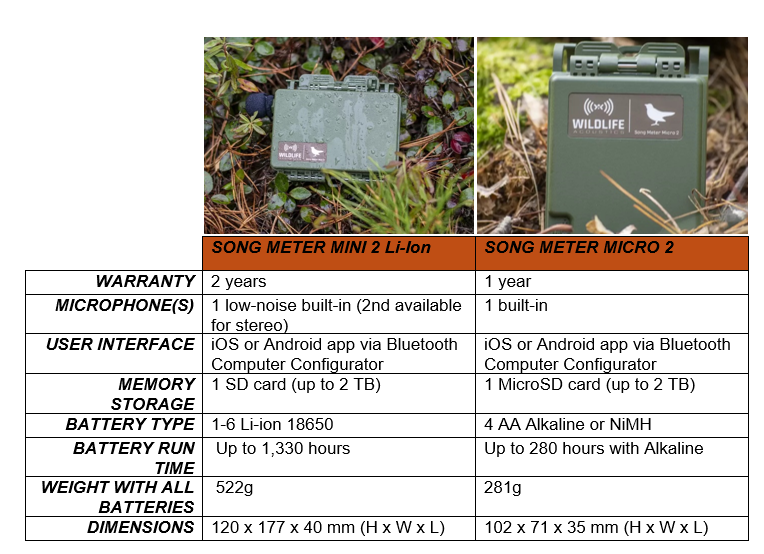
Both devices are impressive recorders in their own right – they produced clear and extensive recordings that captured a fantastic snapshot of the surrounding soundscape. On paper, the most obvious difference between these two recorders is the price, with the Micro 2 being much more affordable than the Mini 2-Li-Ion (@less than 1/3 of the price). 

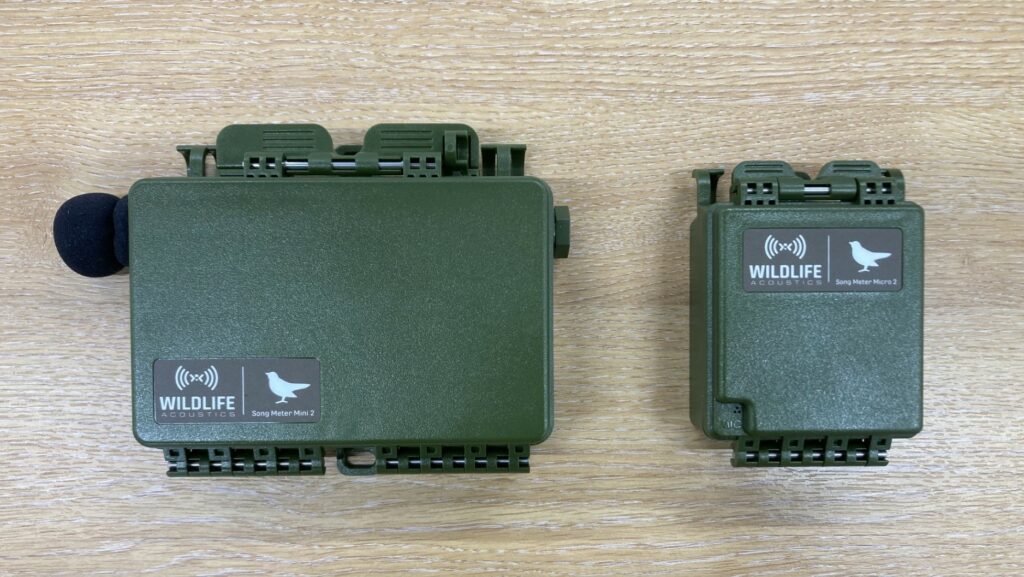
Furthermore, the Micro 2 is around half the size of the Mini 2-Li-Ion, its compact design is hard not to be impressed by, and it can fit easily into a pocket.  Despite its small size, the Micro 2 features an incredible sample rate of 256kHz which allows you to capture good-quality high frequency recordings.  

However, what you gain in compactness you lose in battery life. The Micro 2 has an estimated runtime of 280 hours compared to the Mini 2-Li-Ion which has a whopping 1,330-hour run time. The Micro 2 was deployed with a fully charged battery and finished with 76% battery life. Comparatively, the Mini 2-Li-Ion started and finished at 57%, an impressive feat.

Song Meter Mini 2 Li-Ion (right) and Micro 2 (left)
Song Meter Mini 2 Li-Ion (left) and Micro 2 (right)

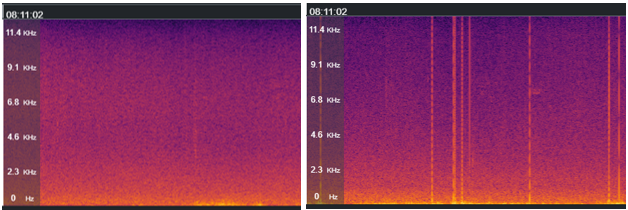
Another key difference between these recorders lies within environmental noise. These devices were deployed in the run-up to Storm Darragh, and some of the recordings experienced a good deal of wind distortion. Although this is an extreme case, it served to highlight the difference a windshield makes. The Micro 2 has no windshield over the microphone and as a result, experienced markedly more distortion when compared to the shielded Mini 2-Li-Ion. This can be seen in the spectrograms below, which were taken simultaneously. The Mini 2-Li-Ion also has the advantage of a low-noise microphone which, to my ear, produces slightly clearer recordings compared to the Micro 2. 

Song Meter Mini 2 Li-Ion (right) and Micro 2 (left) wind distortion
Song Meter Mini 2 Li-Ion (left) and Micro 2 (right) wind distortion
Comparison table of Song Meter Mini 2 Li-Ion (right) and Micro 2 (left)
Comparison table of Song Meter Mini 2 Li-Ion (left) and Micro 2 (right)

Summary 

While both recorders allow you to experience the surrounding soundscape in new ways, they each offer distinct functionalities to achieve this goal.  

The compact design of the Song Meter Micro 2, along with a recent price drop, makes this recorder a fantastic choice for enthusiasts who want to delve into bioacoustics. It has an excellent sample rate, good battery life and produces crisp recordings that are a joy to listen back to.  

In comparison, the Song Meter Mini 2-Li-Ion is perfect for researchers. Its improved battery life makes it an excellent choice for both short and long-term deployments, and the low-noise microphone and windshield are ideal at producing clear recordings for subsequent analysis.  

Interview with WILDGuides Publisher Rob Still 

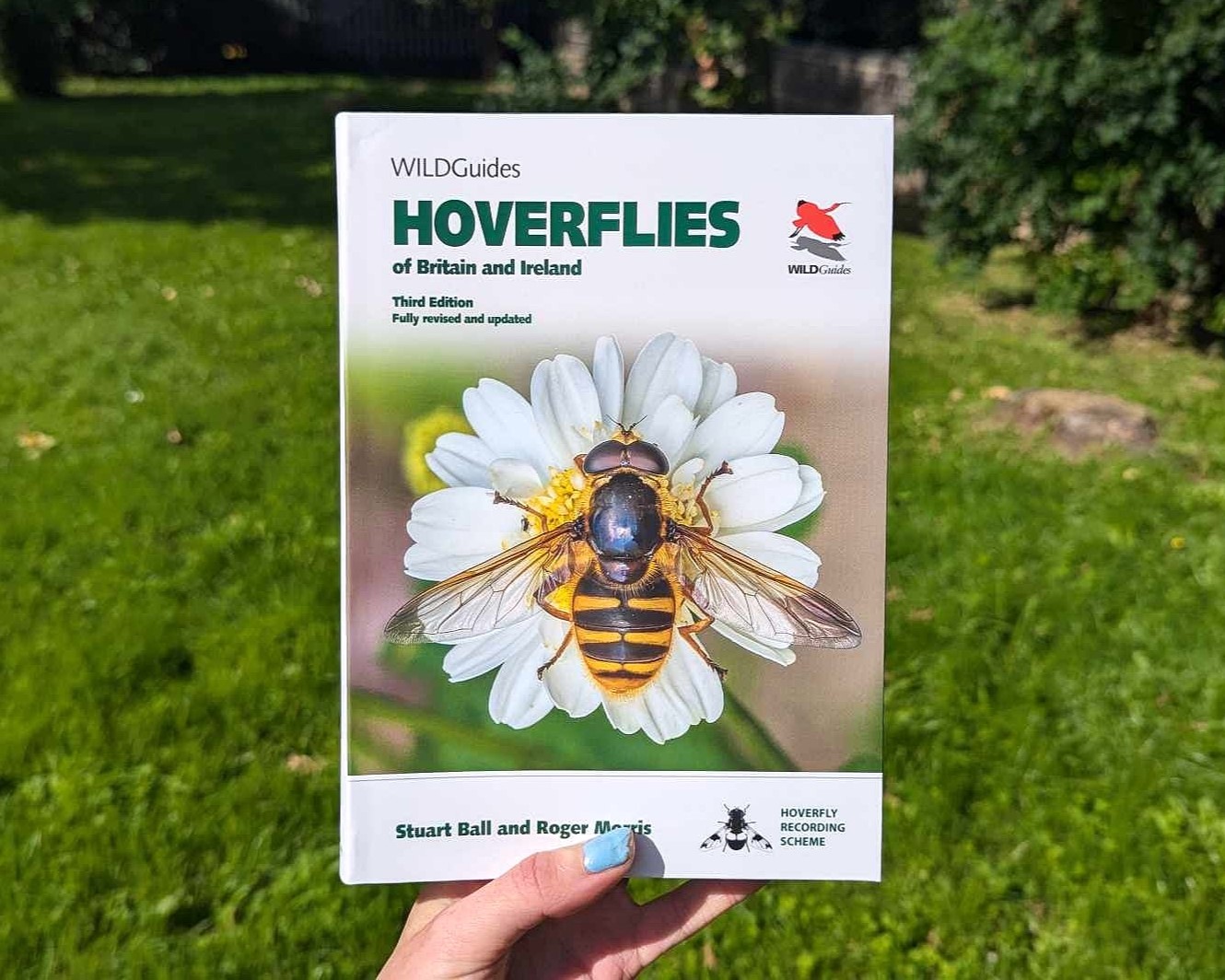
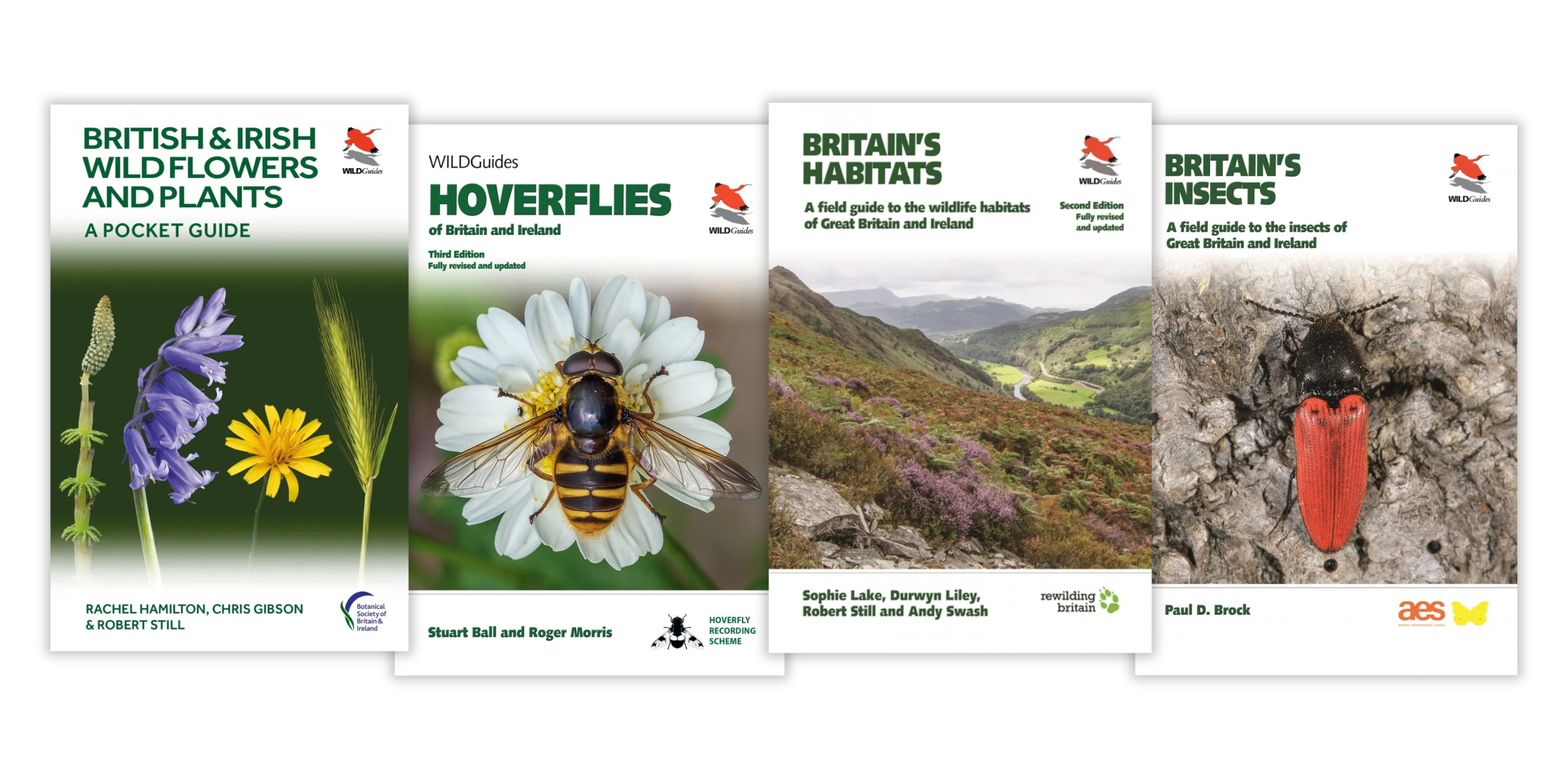
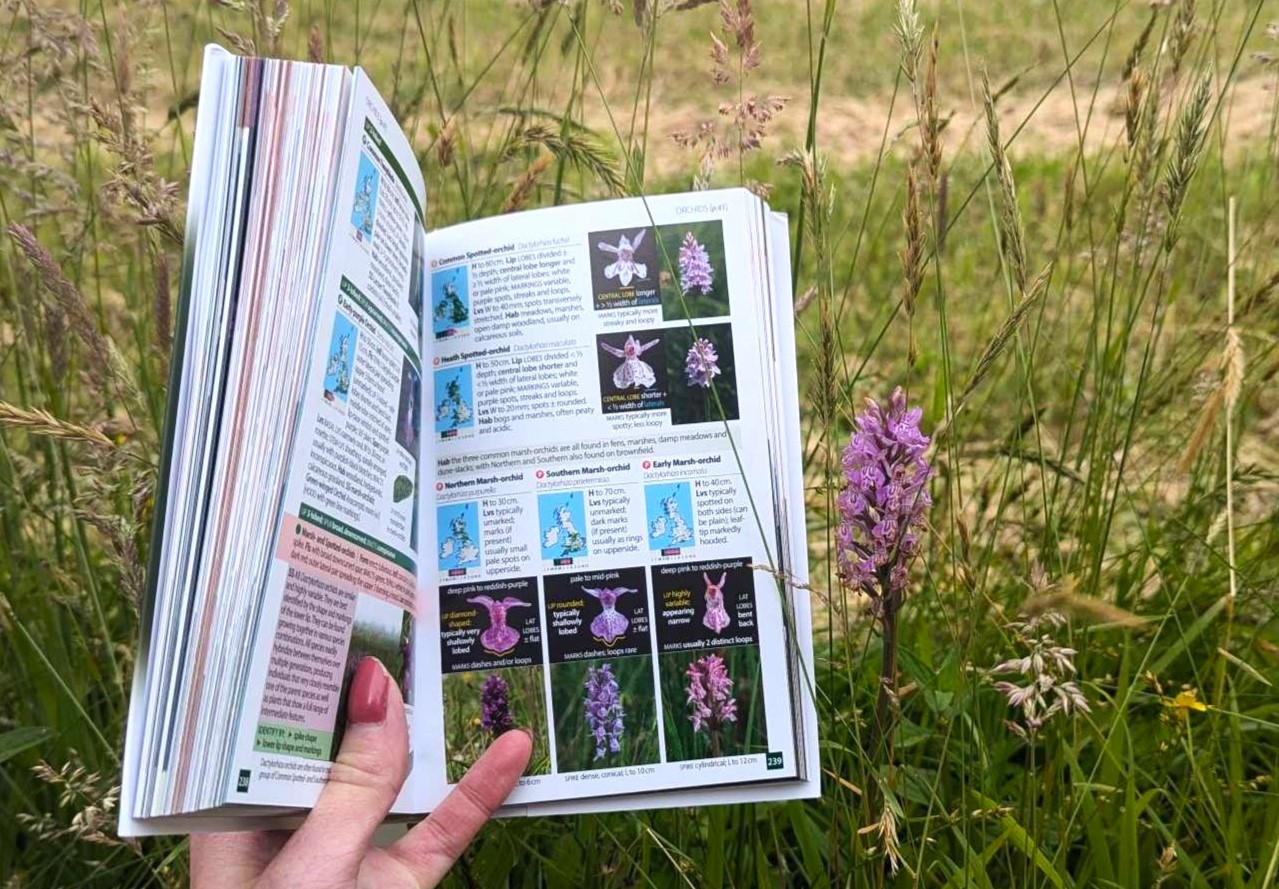
The award-winning WILDGuides collection is a series of comprehensive and practical natural history titles. Ranging from photographic field guides covering the wildlife of Britain, Ireland and Europe, to visitor guides and reference works on wildlife across the world, this authoritative, easy-to-use series contains some of the best identification guides to date.

Robert Still is the co-founder and publishing director of WILDGuides, and has contributed to more than sixty titles in the series. In his spare time, he is a prolific natural history author, ecologist and graphic artist. We recently had the opportunity to speak to Rob about the WILDGuides collection, including how each volume is produced, which titles are due to be published over the next few years and more.


Wildguides logo.

Firstly, can you tell us about the history of WILDGuides and how the collection came to be?  

I (Rob) had been working as a designer, using photoshop and producing somewhat rudimentary montages and cutouts for adverts since 1991. When the programme’s features really took off in the late 90s, my thought was whether these new capabilities could be used to produce ‘best birding’ moments, such as idealised scenes of multiple tanagers in the same tree, or a Sueda bush chock full of vagrant Phylloscopus.  

From there, it was a short transition to figuring out if the technology could be used for field guides – hence the birth of WILDGuides, which started with a guide to Galápagos wildlife by Andy Swash published in 2000, followed relatively quickly by Whales and Dolphins of the European Atlantic (2001) and Britain’s Butterflies (2002) – this covered a relatively small number of species and all were easy to cut out. Britain’s Dragonflies (2004) followed and was the first book written by Andy prior to the expansion into the other taxa groups as seen today, alongside multiple evolutions/editions of the first titles.

For anyone unfamiliar with the collection, how would you describe them, and who are they intended for?  

The books are intended for anyone who wants to put a name to something they encounter in the field. I would describe them as a guided, primarily photographic pathway that hopefully helps in that process. 

Each work in the collection is a passion project of dedicated scientists, conservationists, and researchers. How long does it take to produce a title from start to finish and what kind of work goes into creating them?   

It varies a great deal. Some have taken a good 10 years from concept to fruition, others have taken just a couple of years. However, a title typically requires a couple of photography seasons, as a significant number of the images in each book are commissioned and the specific image requirements often don’t come to light until the design process is underway.

Wildguides book spread.

How do you decide what makes a good subject for WILDGuides? What are you looking for when creating new volumes?  

A good subject is really any group or taxa within a defined region – WILDGuides is looking to work with any experienced specialists to present that group in the WILDGuides way. 

One of the strengths of the WILDGuide collection is the use of a unique ‘roadmap’ for each published topic, allowing users to navigate identification, and the book itself. Can you elaborate on the process of these roadmaps, and why you feel they are so important for these guides?   

Sure, it is a relatively straightforward process insofar as it is simply the production of an identification pathway from start to finish. This is slightly disingenuous, as on occasion, it can be harder than one might think to unequivocally achieve this. It requires a team that really knows the subject being prepared, who is able to combine their field experience to focus on what really matters in the identification. 

Their importance to the guide, I believe, is that they are an amalgamation of this ‘hands-on’ experience and so the pathway is both realistic and pragmatic. 

British and Irish Wildflowers and Plants.

Can you speak on the process of updating editions in the collection?  

Obviously, nature is dynamic and lists of taxa within a region change. New, reliable field identification features come to light, improvements are suggested by our users and the exponential rise in available images means that there is now a good chance that better pictures (in terms of quality and showing the key identification points) become available. Consequently, we keep an update file covering all of these areas, and will update these editions when the time is right to do so. 

What can we expect from the collection over the next couple of years? Are you able to share any new titles that are on the way? 

Yes, the existing collection should improve over the coming years with the feedback and new images mentioned. WILDGuides is also looking to expand the series into other taxa not already covered to match the increasing diversity of species groups that people are looking at, with the hope that more accurate records are sent to organisations managing citizen science databases. 

On the near horizon are updates to Britain’s Spiders and, at some stage, Britain’s Birds as well as new titles covering Britain’s Trees, Birds of East Africa and Birds of Madagascar, each in the style of Europe’s Birds. Further down the track we are looking at gaps, particularly in Britain’s series, that are relatively obvious to spot – so if any reader of this piece wants to be a potential part of that expansion, we’d love to hear from you! 

Explore the full WILDGuide collection here

This Week in Biodiversity News – 3rd February

Pollution 

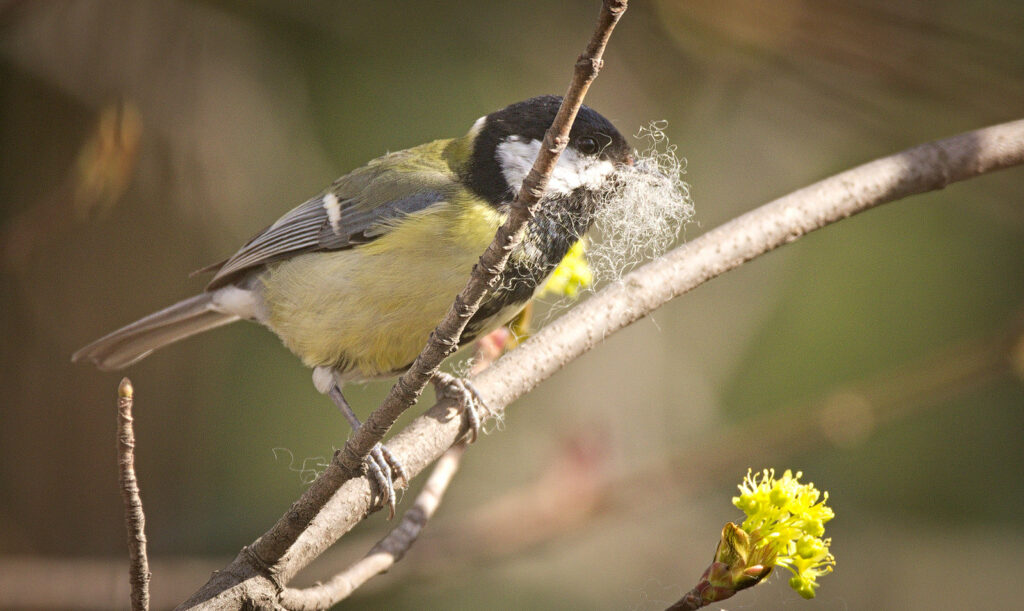
Flea and tick treatments are contaminating songbird nests. A recent study surveyed 103 tit nests that utilised pet fur in construction, and found that 100% were contaminated with fipronil, a chemical component of pet flea and tick treatments that is banned for agricultural use in the UK and the EU. Contaminated nests were found to have an increased number of unhatched eggs and dead chicks, placing significant pressure on breeding bird populations. The findings have led to calls for a thorough environmental risk assessment of veterinary treatments, and to consider restricting their use as a preventative measure to an active treatment. 

Great tit with nesting material
Image by hedera.baltica via Flickr

The Arctic carbon sink is now a source of emissions, a new study concludes. Rising temperatures in the Arctic landscape are facilitating the release of vast amounts of carbon dioxide, which is currently stored in the region’s permafrost, and over 40% of this is now significantly contributing to greenhouse gas emissions in the context of global warming. The effects of rising temperatures are also reflected by visual changes in the landscape – ground collapse, increased plant growth, microbial domination – and changes in the carbon cycle in the region. 


Environment 

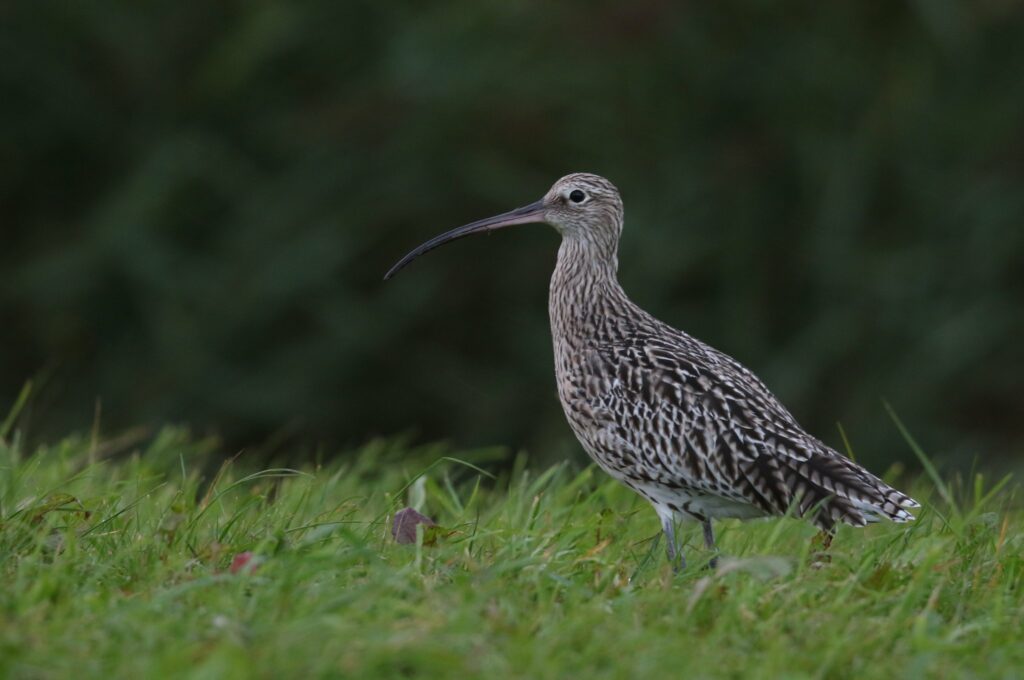
Wales’ plan to reverse wildlife decline lacks plan, action and investment according to Senedd’s cross-party environment committee. A recent report identified several shortcomings that have impacted the Welsh government’s ability to tackle nature loss and boost biodiversity. These include legislation that failed to deliver, outdated key policy documents, a broken promise to update the Nature Recovery Action Plan, and a history of delays, undelivered commitments, and missed deadlines. With 1 in 6 species at risk of local extinction in Wales, and a 20% decrease in wildlife over the last three decades, the committee urged the Welsh government to prioritise setting targets to address biodiversity loss by 2030, bringing Wales in-line with previously agreed biodiversity commitments. 

eurasian curlew
One in six Welsh species are threatened with local extinction. Image by Antje Schultner via Flickr

The Office for Environmental Protection (OEP) has published a report on the prospect of the UK meeting its environmental targets and commitments. The third OEP assessment analysed the government’s current progress towards improving the country’s natural environment between April 2023 and March 2024, and determined that the UK remains off track in meeting legal commitments due to slow progress and a loss of momentum. Key issues identified were as follows: policy or regulatory frameworks are not adequately developed or delivered; actions do not address all major pressures; inadequate resource provision and a lack of urgency. To tackle this, the report concluded that the UK government should speed up, scale up, stack up and catch-up actions to make adequate progress.  


Wildlife and Conservation 

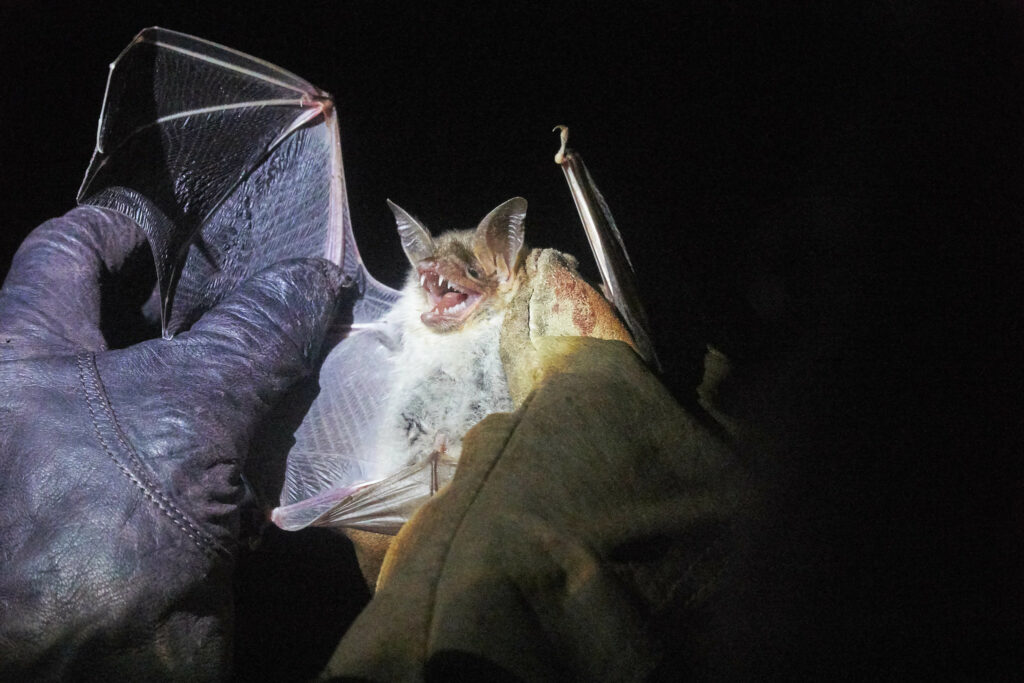
A Greater Mouse-eared Bat (Mytosis mytosis) has been discovered in Sussex. In mid-January 2025, a breeding female Greater Mouse-eared Bat was found hibernating in the South Downs National Park, marking the first identification of a new female since the 1980s. This species was declared extinct in the UK in 1992 following decades of species decline, however two male sightings, one in 2002 and one in 2023 suggested the potential for their return in the future. Conservationists have ringed the newly discovered female to allow for future identification, monitoring and research, with the hope of discovering an established breeding population in Britain. 

Greater Mouse-eared Bat
Image by Tim Ellis via Flickr

Galicia’s shellfish stocks are declining at an alarming rate. Europe’s primary source of mussels, and the world’s second largest producer of shellfish, has seen a dramatic fall in cockles, clams and mussels. In 2023, cockles crop fell by as much as 80% and last year, mussel production was at its lowest for the last 25 years with some stocks falling by 90%. It is thought that the climate crisis and pollution from agriculture and local industry are at the root cause of this catastrophic decline, with increased rainfall reducing the salinity of the water and invasive species attracted to rising water temperatures. 

Brown Trout survival is at serious risk as English rivers warm with climate change. A Government report suggests that these native fish are at risk of extinction in large parts of England within decades. The first national temperature projections by the Environment Agency forecast an unliveable environment at the height of summer by 2030. Brown Trout have a temperature threshold of around 12°C, above which there is a significant risk of egg mortality, small hatching sizes and development defects. For adult fish, this increased temperature could also amplify the impact of pollutants and an individual’s susceptibility to pathogens.  

This Week in Biodiversity News – 13th January

Wildlife 

Water Vole populations are undergoing a national decline in the UK. A new report from the Wildlife Trusts, The National Water Vole Database Project Report, was released last month to document the findings of a nationwide investigation examining Water Vole distribution over the past ten years. Although the report documented a 39% decrease in the number of occupied areas across the UK, it also identified a further 11 new regional key areas of increasing local populations, including several in East Anglia and Yorkshire. The report reveals a bleak national picture with declines across the country due to habitat loss and deterioration, but shows that in the right conditions, and with the help of conservation practitioners, it is possible to reverse their historic decline. 
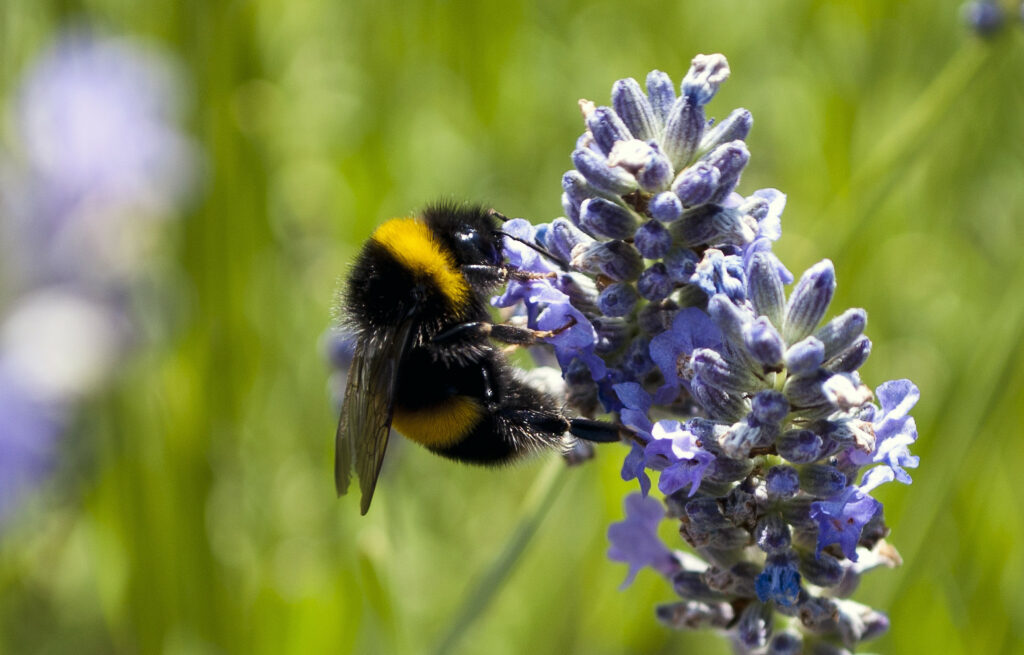
Bumblebee on a lavender flower
Image by Indy via Flickr

Conservationists have observed active worker bumblebees nest-building in Scotland during the winter months. Unusually mild weather during the Christmas period has led to early awakening from hibernation, and at least two species have started to build new nests early in the winter season. However, the subsequent return of cold weather and the scarcity of winter food sources pose a significant threat to these early nests, risking their collapse. In this instance, fewer queens would be available to build nests in the spring and could contribute to the national decline of bumblebees.

Conservation 

The National Trust has announced plans to create 250,000 hectares of biodiverse landscape. Equivalent to 1.5 times the size of Greater London, these nature-rich landscapes across England, Wales and Northern Ireland will address a current national need and are estimated to provide habitat for 1 billion earthworms. Labelled audacious yet achievable, this goal will be actioned on Trust properties, but also in partnership with other organisations, farmers and communities, to create larger tracts of landscape to tackle the climate and nature crises.

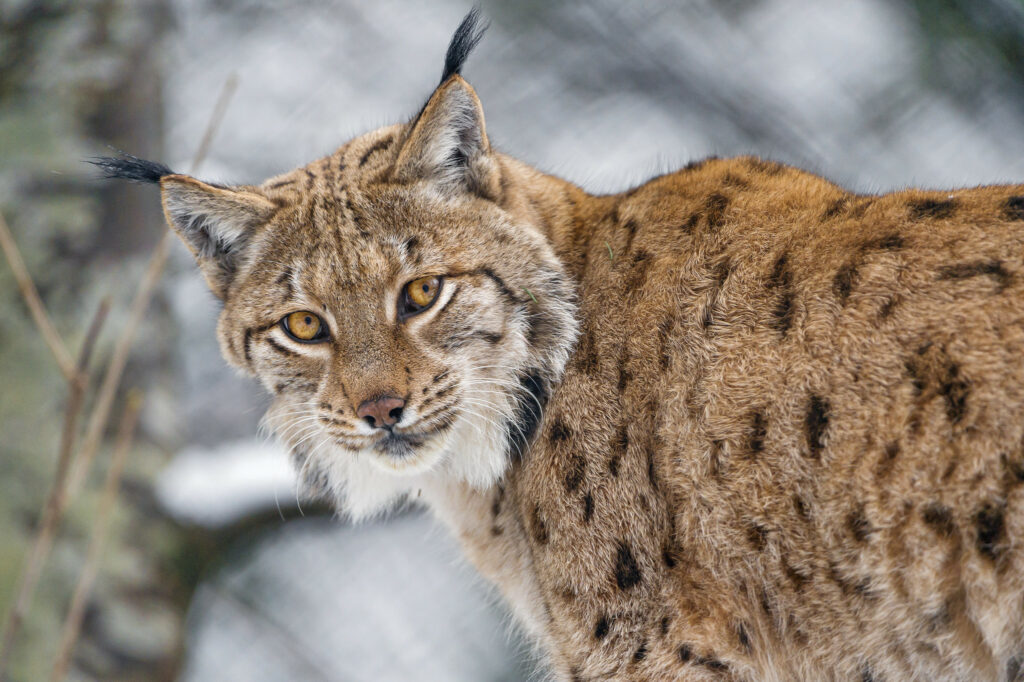
Male Lynx in the snow
Image by Tambako the Jaguar via Flickr

Last week, Lynx were reported in the Cairngorms National Park. A total of four animals were illegally released and subsequently captured by the Royal Zoological Society of Scotland (RSS), where they were taken to be quarantined at Highland Wildlife Park (later one sadly died). The source of these animals remains unknown, but experts have raised concerns about the nature of their release – these animals were released in sub-zero temperatures within areas of logging activity, which has been deemed a highly irresponsible action that has drawn criticism from conservationists.

Climate Crisis 

2024 marks the first calendar year to surpass the 1.5°C warming limit. Now thought to be the world’s hottest year on record, 2024 has brought the world closer to breaking the international warming target of 1.5°C – although this target is based on long-term temperature averages, last year’s trends signify an upturn in global temperature, with the last decade being the warmest on record. Predominantly due to harmful greenhouse gas emissions, which are still at record highs, this record is met with calls for cuts in emissions over this calendar year.

Wind turbines at sunset
Image by Michael Mueller via Flickr

The UK generated its cleanest electricity ever in 2024, with 58% from low-carbon sources. The amount of electricity generated from fossil fuels has halved in the past decade, with the UK having seen an upturn in the use of renewable energy sources. In the past twelve months, renewables have generated 45% of the UK’s power, and when including nuclear sources, this number totals to 58%. Despite this, fossil fuels are still generating approximately 29% of electricity in the UK, and in order to meet climate and emission targets experts are urging for an accelerated phase out.

Finance 

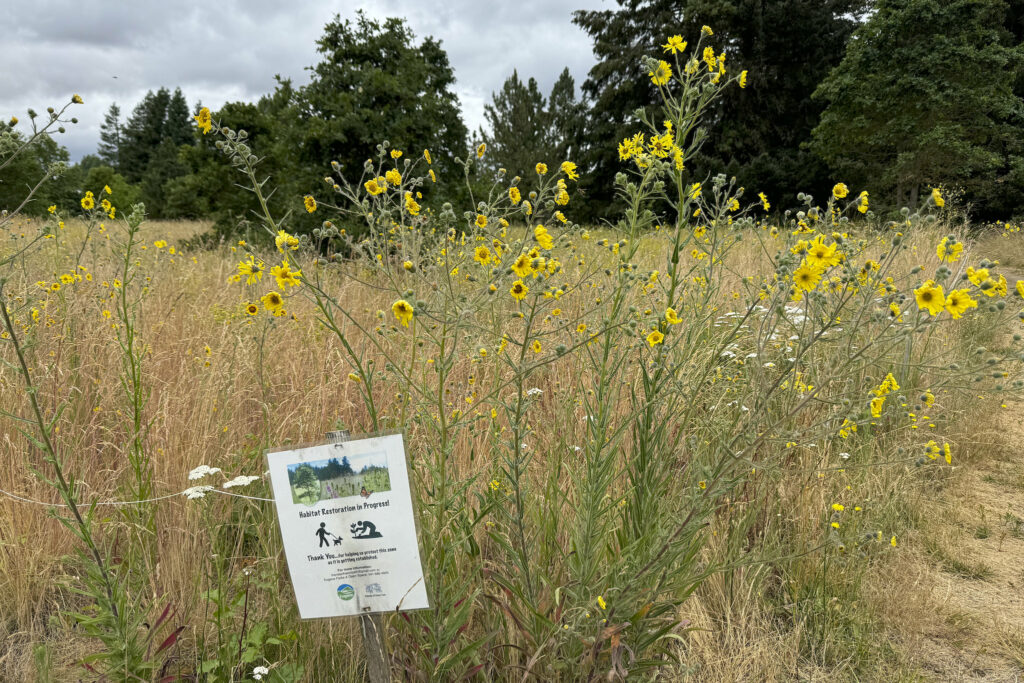
In a ‘landmark’ deal, the world’s first private sector loan based on biodiversity net gain unit models has been granted. Triodos Bank UK has loaned £3.85m to environmental consultancy Nature Impact – the money will be used to purchase a total of 122 acres over two sites, unlocking degraded farmland for biodiversity net gain. These degraded sites will undergo restoration and habitat creation, including native wildflower meadows and wetlands, to enhance their support of British wildlife and climate goals.
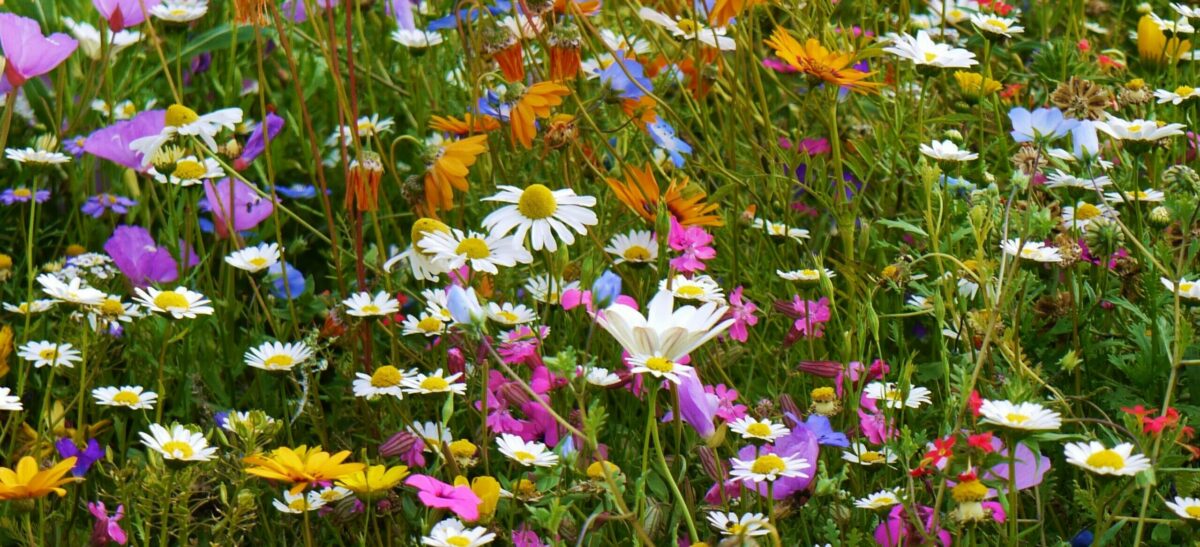
Habitat restoration site with wildflowers
Image by Robert Miller via Flickr

Ecologists at Oxford University have designed a new framework to classify how a unit of nature is defined for biodiversity credits. In the review, researchers acknowledge the lack of clarity on how one unit of nature is defined, or how measurements are standardised, and demonstrated the challenges involved with the biodiversity credit market. It presents a framework exploring how biodiversity is quantified, how positive outcomes are detected and how the number of credits can be adjusted to account for uncertainties. The authors caution against biodiversity credits to offset negative impacts, and instead direct focus on avoiding and reducing these factors.

Author interview with Richard Lewington: Pocket Guide to British Spiders

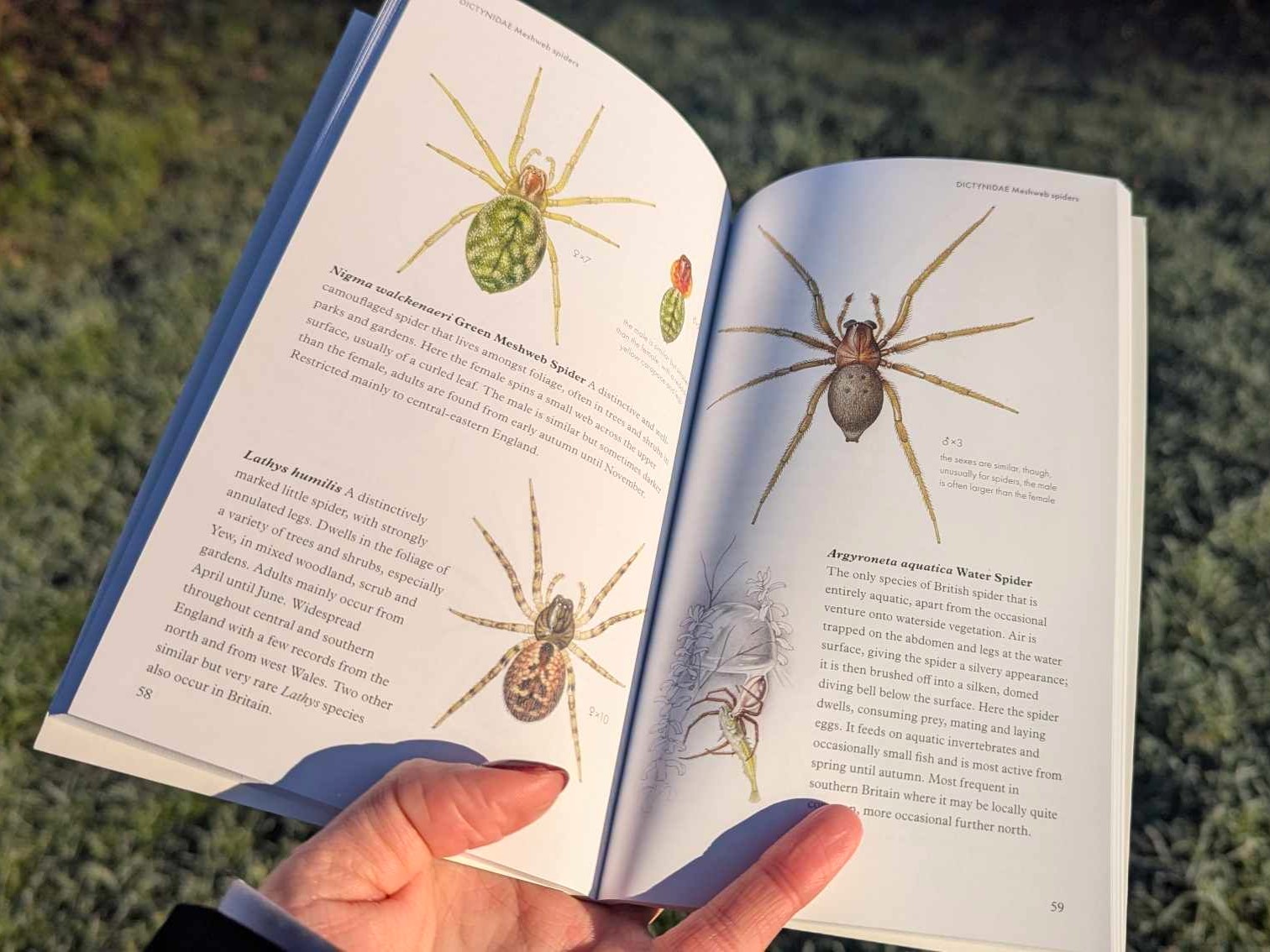
Pocket Guide to British Spiders book cover.Featuring 130 of the most common and readily available spider species, Pocket Guide to British Spiders is the ideal companion for both beginners and more experienced enthusiasts alike. Detailing identifying features, webs, egg cocoons and behaviour, these accounts are interspersed with beautifully illustrated spreads showing similarities and differences at a glance, making this introductory guide the perfect companion for use in the field.


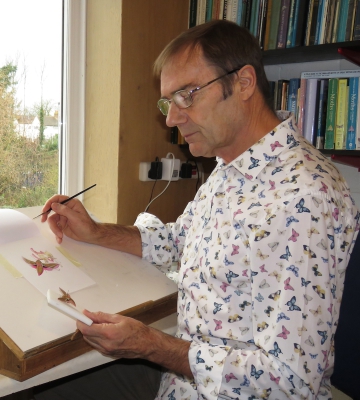
Richard Lewington is a renowned wildlife illustrator, whose beautifully detailed drawings feature in a wide array of identification guides including The Butterflies of Britain and Ireland, Field Guide to the Moths of Great Britain and Ireland, and Field Guide to the Bees of Great Britain and Ireland. In 1999, he was awarded Butterfly Conservation’s Marsh Award for the promotion of Lepidoptera conservation, as well as the Zoological Society of London’s Stamford Raffles Award for contribution to zoology in 2010.

We recently had the opportunity to speak to Richard about his latest book, including how he first became an author, why he chose to focus on arachnids and which techniques he uses to create these stunning illustrations.


Firstly, can you tell us a little bit about yourself, and how you first became an author and illustrator? 

I became a freelance wildlife illustrator soon after leaving art college in the 1970s. I’ve always had an interest in the natural world, particularly butterflies and moths, so invertebrates were the subjects I concentrated on right from the start. I’ve always worked in collaboration with various experts, until about 25 years ago, when I wrote and illustrated my first book How to Identify Butterflies. Since then, I’ve written and illustrated five books, though most of the books I work on are collaborations with authors with specialist knowledge of the subjects. 

Pocket Guide to British Spiders is your 29th identification guide published since 1979. What inspired you to focus on arachnids for this book, and how did you choose which of the 680 British species to include?  

I’ve had an interest in spiders for many years and have a collection of paintings, some of which I did about 50 years ago. I thought they would form the basis of a pocket guide, and I added more illustrations in the last few years to go with those I already had. The aim was to include common, well-known and easily identifiable species – about 130 in total. As many spiders are very small and similar to each other, it is necessary to examine them through a microscope to identify many of them, which is the next step up for those who want to study them in greater detail.

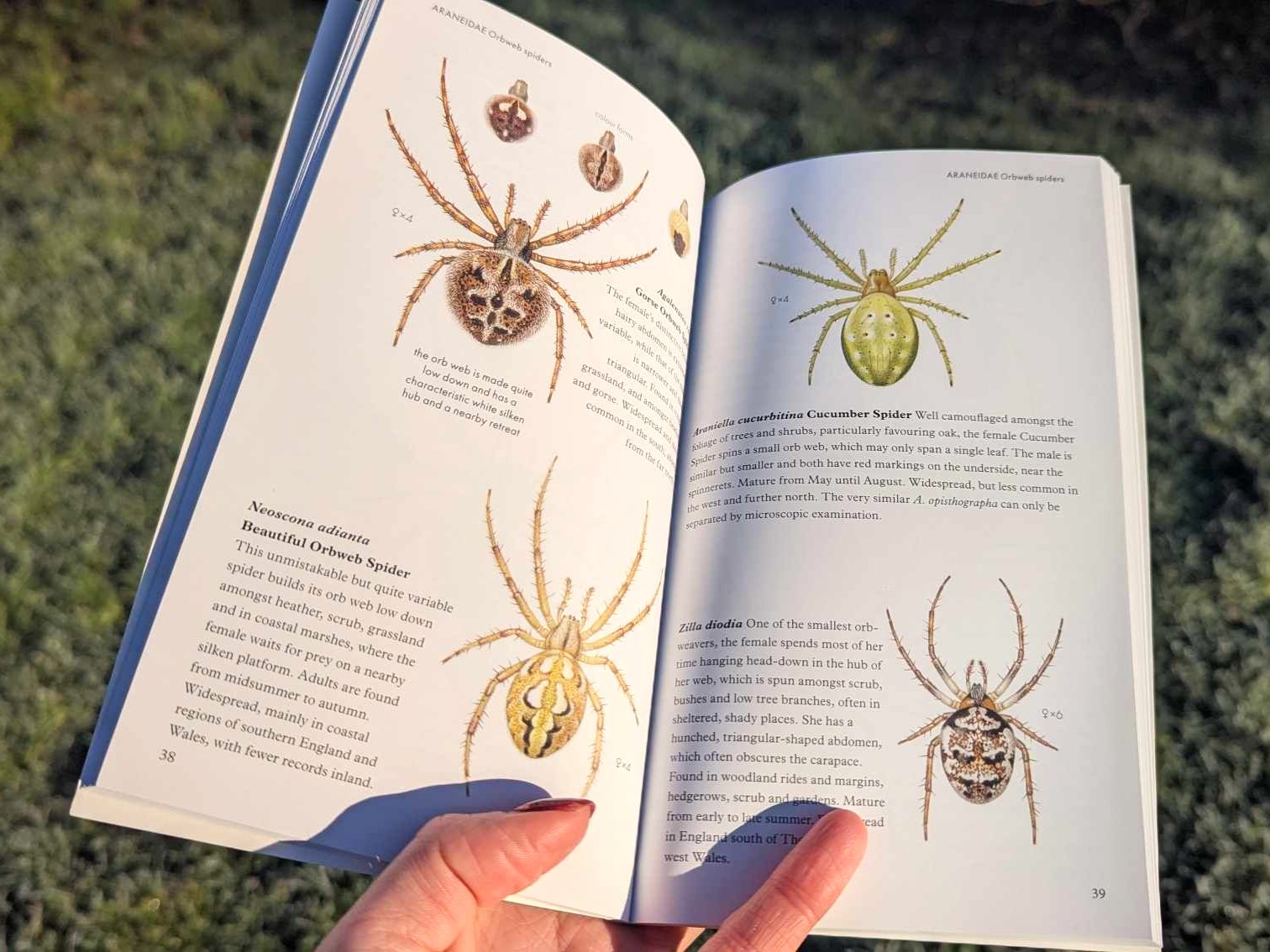
Pocket Guide to British Spiders internal pages.

I was surprised to learn about the somewhat limited conservation efforts being undertaken to protect endangered spider species across Britain. What are the largest threats to spiders, and how can we protect these vital invertebrates in the future? 

As with much of the natural world, spiders are under threat from habitat loss and pollution, but because they don’t have the same appeal as some other groups, they receive less attention. However, they are just as important, helping to keep the balance in ecological systems by eating and being eaten by a vast number of other creatures. Gardens are becoming more important, and we can all help spider well-being by not being too tidy in the garden to encourage a good variety of mini habitats in which they can live.   

Pocket Guide to British Spiders includes a vast amount of detail on nomenclature, structure, anatomy, mythology, identifying features and more. What was the most interesting thing you learned while researching this book?  

Probably their diversity. They vary hugely in size, shape and colouring, and can be found in every habitat from mountain tops to beneath the surface of water. Many also occur throughout the year when many other invertebrates are dormant.

Pocket Guide to British Spiders internal pages.

Having illustrated many guides throughout your career, can you give us an overview of the techniques you use to create such detailed works of art, and explain how your painting style has evolved over time? 

I start by doing a detailed, measured drawing on layout paper. This is transferred to watercolour paper and, using Designers’ Gouache paints, I apply washes, gradually building the colour intensity and the effect of light and shadow. Details such as textures and highlights are added to give a three-dimensional appearance. More recently, I’ve been scanning the artwork before sending it to the publishers, so that I can adjust, enhance and touch-up the images using a tablet and image enhancing software.  

What were the most difficult aspects of illustrating spiders, given their intricate and often microscopic features? 

Spiders can’t be preserved in museum collections like butterflies and beetles, as they have soft bodies which shrivel after death, so working from live specimens or from detailed photographs are the best options. This means going into the countryside to find specimens and asking other spider enthusiasts to help. I like to take my own macro photographs from the exact angle to avoid any distortion, I can then work using the photos and the live specimen, observing it under my microscope. It’s also necessary to have a good knowledge, so that the subjects can be correctly identified, as some are very similar.   

Finally, what’s taking up your time at the moment? Are you planning to write or illustrate any more books over the coming years? 

My next book will be a field guide to Orthoptera, which I completed several years ago but has been long delayed. After that I shall be working on a project about my work as a wildlife illustrator, concentrating mainly on British moths, butterflies and their caterpillars.

Pocket Guide to British Spiders book cover.

Pocket Guide to British Spiders is available from our online bookstore.

The NHBS Seed Sowing Calendar: January-March

Planting and watching seeds grow is one of the most rewarding parts of having an outdoor space. From a young age I can vividly remember chilly winter trips to the garden centre, picking out different bulbs and seeds to plants in time for spring, followed by an agonising wait for the last few frosts to pass to allow us to start planting. This patience was however rewarded with my favourite task – exuberantly poking a million holes in compost-filled trays – before carefully sowing the seed in the soil and gently covering them in a blanket of compost. 

To this day, I still get just as excited when spring is around the corner, and I can finally turn my wintery, plain garden into a hub of vibrant flowers and wildlife. But with so many different bulbs and seeds out there, all of which working to very different schedules, it can sometimes be overwhelming when thinking about where to start, what to sow when, and where.

Here, we provide a detailed Seed Sowing Calendar to make sure you’re on-track for those beautiful spring blooms in just a few months time. 

Close up of lots of Sweet Peas in mixed colours including pink, fusia, purple and white.
Sweet Peas by the Walled Garden 02 by Sam Saunders, via flickr.

January: 

January is still very much in the grasp of winter, so most seeds sown outside will perish due to the cold and frosts – therefore it is recommended that seeds are planted in trays or pots that can be kept in an enclosed greenhouse or indoors in a warm, dry, sunny place to ensure successful germination.  

Sowing this early in the year means that you’re more likely to get a good, healthy crop come springtime, but it does require a lot of patience and attentiveness. 

Sweet peas – Lathyrus odoratus 

Sweet peas are one of my favourite flowers and produce vibrant, fragrant blooms in a range of stunning colours. They are natural climbers, therefore they should be grown up a cane, netting or trellis, and can reach approximately 2m in height. Seeds should be planted 1cm deep in trays or individual pots filled with compost in late winter (January – February) and watered 2-3 times a week. As soon as the last frost is over, and the soil is loose and pliable, transfer the seedlings outside. When the plants are tall enough to reach the canes, manually wrap the stems securely, but gently, around them – the plants will naturally take to climbing the higher they grow. 

Carnations – Dianthus caryophyllus  

Carnations produce small, fringed flowers on long stems and should be grown in small to medium pots or planters with good drainage. The seeds should be planted about 0.5 cm deep, in potting soil or compost, covered in a layer of soil and pressed down firmly. Place them in a warm, sheltered space inside and water 2-3 times a week using a spray bottle. When the seedlings reach 5cm tall, transfer outside after the frost has passed.  

You can also sow carnations directly into the garden once the frosts are over, normally in late April, however it’s unlikely they will bloom the first year if they are sown this late in the spring. 

Lobelia – Lobelia erinu 

Lobelias are beautiful, colourful little bedding plants that are very hardy and will produce flowers from early summer to mid autumn. They are easy to start indoors, and need well drained, loose soil to thrive. Sow the tiny seeds liberally across the surface of the soil in a large seed tray, cover loosely with a thin layer of compost, and gently press down to ensure the seeds are fully covered. Place the tray in a warm, sunny position and water with a light mist. Ensure the soil stays moist while the seeds are growing inside and transfer into the garden once the frosts have ended. 

Close up photograph of orange and red tagetes (french marigolds).
Tagetes patula by Tacowitte, via flickr.

February: 

February is the ideal time to start sowing most summer bedding plants, as well as perennials that grow year on year. Due to the colder temperatures, it’s recommended that most flower seeds are still grown inside to begin with. 

French Marigolds – Tagetes patula 

Marigolds are very easy flowers to grow and are equally easy to maintain once they’re bedded into the garden. Fill a tray with compost and press the seeds 1cm deep into the soil, then cover lightly with another thin layer. Plant each seed 5cm apart to allow for growing room, and water every couple of days to keep the soil moist – but not soggy. You can then plant the seedlings outside in early spring (mid to late March) in pots, planters, beds or hanging baskets when they are a few inches tall and the weather is milder. Marigold seeds can also be planted directly outside, but you should wait until late spring (April – May) or early summer (May – June) to do so, otherwise they may not germinate in the cold weather. 

Snapdragons – Antirrhinum majus 

Snapdragons are bright, annual plants that come in a wide range of colours and heights, and attract an array of garden insects. They require a lot of light to germinate, so make sure you don’t cover the seeds with too much soil. Simply put the seed on top of the soil in a tray, cover with a very thin layer of compost and compress with your hand, before watering once a week. Place in a warm, very sunny location and, if sown in one large tray, thin the crop to one seedling per pot when the seedlings have developed 2-3 leaves. Snapdragons can be transferred into the garden after the final frost of spring and should be spaced 30cm apart to give them enough room to grow into full blooms. 


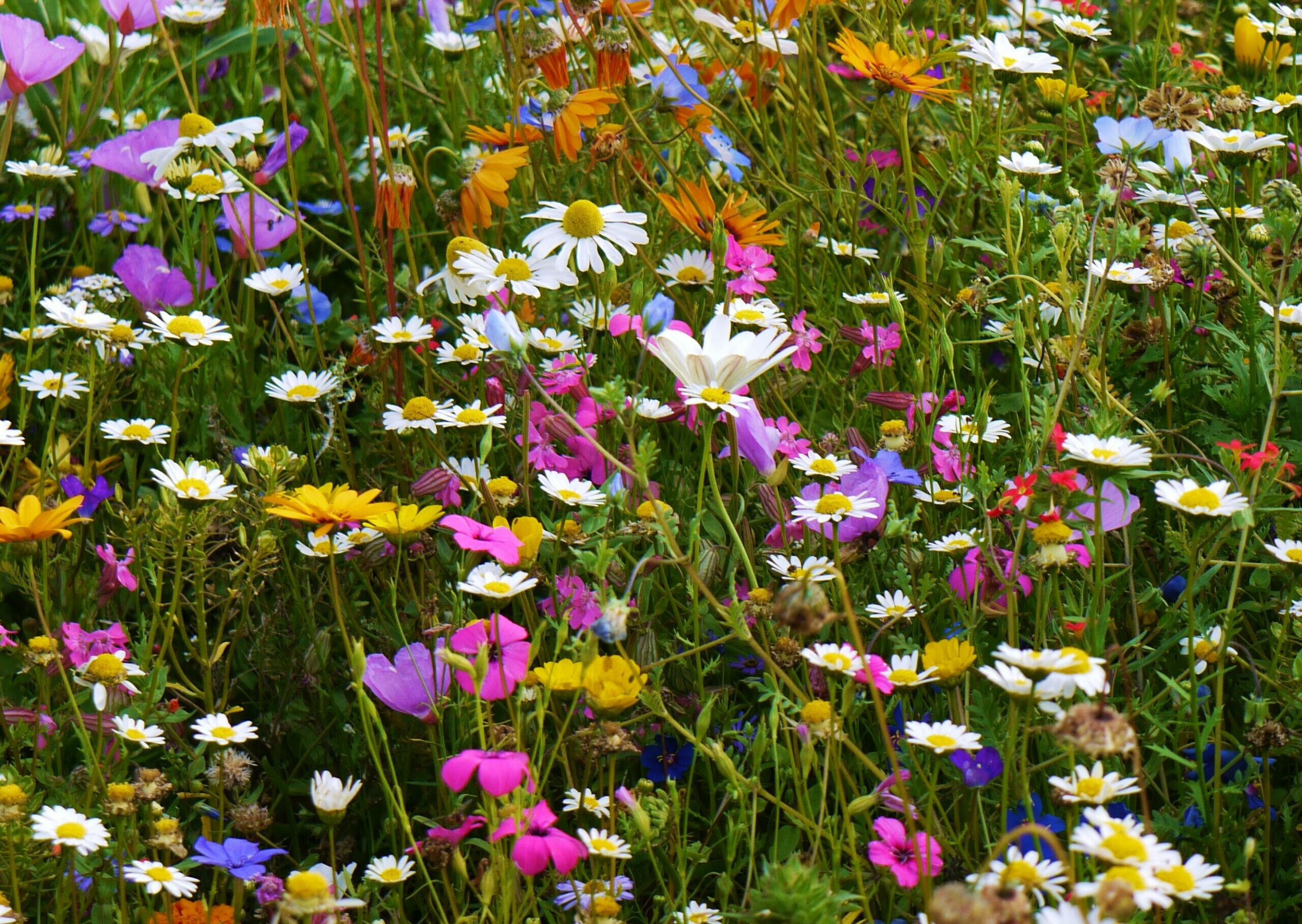
Wild Flower Bed showing a mix of pink, white, yellow and purple flowers.
Wild Flower Bed by Pete Sandbach, via flickr.

March: 

By the time March comes around, the soil is slowly starting to warm up and frosts are a lot less frequent. During this time, some of the toughest flowers can be sown directly outside, as well as summer-flowering bulbs. 

Cornflowers – Centaurea cyanus 

Cornflowers are small, vibrant blue flowers that grow best in full sunshine. They can tolerate freezing temperatures, so these seeds can be planted outside throughout the winter. If you are planning to sow Cornflowers nearer spring, plant the seeds straight into soil or planters about 5cm apart and 1cm deep, and water once every 3–4 days. Cornflower seeds are loved by many garden birds, so to make sure your hard work isn’t wasted, ensure they are covered with a good layer of compact soil. 

Cornflowers take approximately 10 weeks to flower if they are planted in spring, so these beautiful flowers will brighten up your garden in no time!  

Wildflower mixes (native) 

Late March is the perfect time to plant your mixed wildflower seeds to produce a beautiful range of native flowers, colours and scents, and most importantly provide food, shelter and habitats for key pollinators such as bees. Wildflowers are best sown straight outside in large beds or planters. Break up any large lumps of soil, then generously sprinkle the seed mix before carefully raking over the seeds, ensuring they are fully covered up. Gently water the area after planting, ensuring that you don’t dislodge the seeds with too much water, and watch them bloom!

Water your wildflower garden twice a week to ensure the soil doesn’t dry out, particularly over the hot summer months. 

If you are keen to begin your wildflower garden early, you can plant them in February if the weather remains mild and dry.

Cosmos – Cosmos Bipinnatus 

Cosmos can be grown both inside and outside, and thrive is sunny areas of the garden. They germinate very quickly and produce vibrant, tall flowers. If you prefer to start your flowers inside, yielding blooms in early summer, sow the seeds in individual pots in mid to late March in fresh, loose compost. Each seed should be 2mm deep in the soil and should be covered in a thin layer of compost. Place the individual pots or trays into a larger seed tray and water from below. Transfer into beds in the garden four to six weeks later, or after the last frost. 

If you prefer the ease of planting seeds directly outside, or are a little late to the party, wait until the weather is mild and drier in early May before scattering the seeds straight onto evenly raked soil and covering lightly. Water every few days until the plants are well established, but be careful not to overwater as this will cause fewer buds to grow on each plant. 

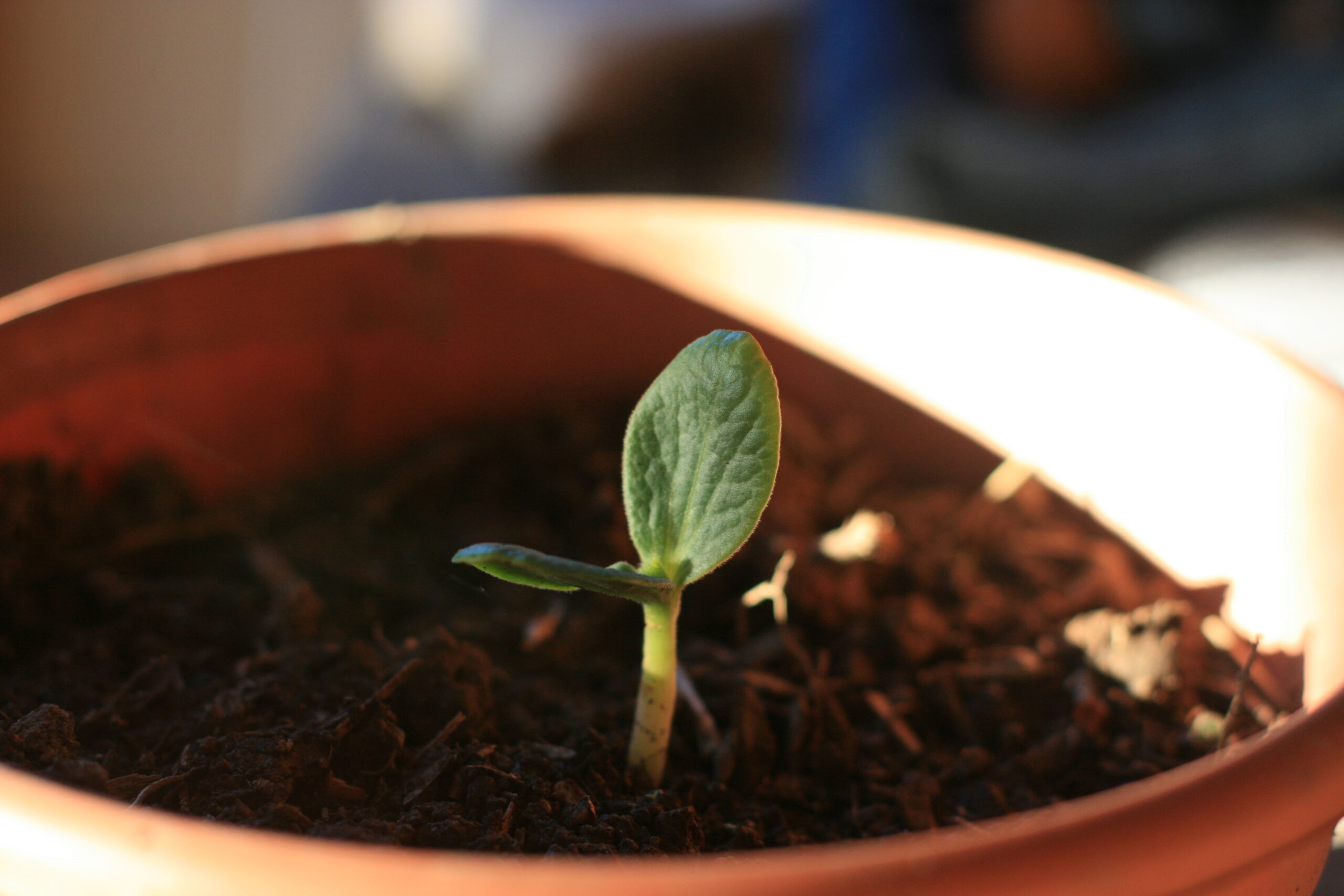
Small green seedling in a terracotta pot in compost.
Mystery seedling by Joe Lipson, via flickr.

Top Tips: 

Make sure to label your seed trays or pots if you’re growing a variety of different seeds at once, as it is very easy to get mixed up!

Ensure that any seeds grown inside are only kept in moderately warm places – too hot a temperature, such as by a radiator, can cause the seeds to perish, so it’s recommended to take advantage of sunny windowsills and French doors instead.

– It can be beneficial to ‘pinch out’ bedding plants in the early stages of growth to ensure they focus their energy on big, strong, bushy blooms, rather than becoming tall and leggy. This helps produce side shoots that should all bear flowers, but it is advisable not do so until the seedlings have grown at least two sets of leaves or you risk damaging the plants. To pinch out a plant, gently cut the growing tips just above the side shoots, repeating on as many stems as you wish until it resembles the shape you’re after

– Even if you miss the opportunity to start growing your seedlings inside, it’s rarely too late to grow your seeds if they are in season. Instead, you can plant them straight outside when the milder weather arrives, and will simply have later blooms – so you can enjoy beautiful flowers during the summer months instead.

This Week in Biodiversity News – 30th December

Conservation 

Tasmania’s farmers are helping to conserve native grasslandThese critically endangered habitats have undergone widespread deterioration due to historical agricultural practices, and remaining patches are degraded and fragmented throughout the state. An innovative partnership between landowners, the Tasmanian Conservancy and Bush Heritage Australia – the Midlands Conservation Partnership (MCP) – was formed to conserve and protect native grassland on private property through empowering farmers to manage their land sustainably. 

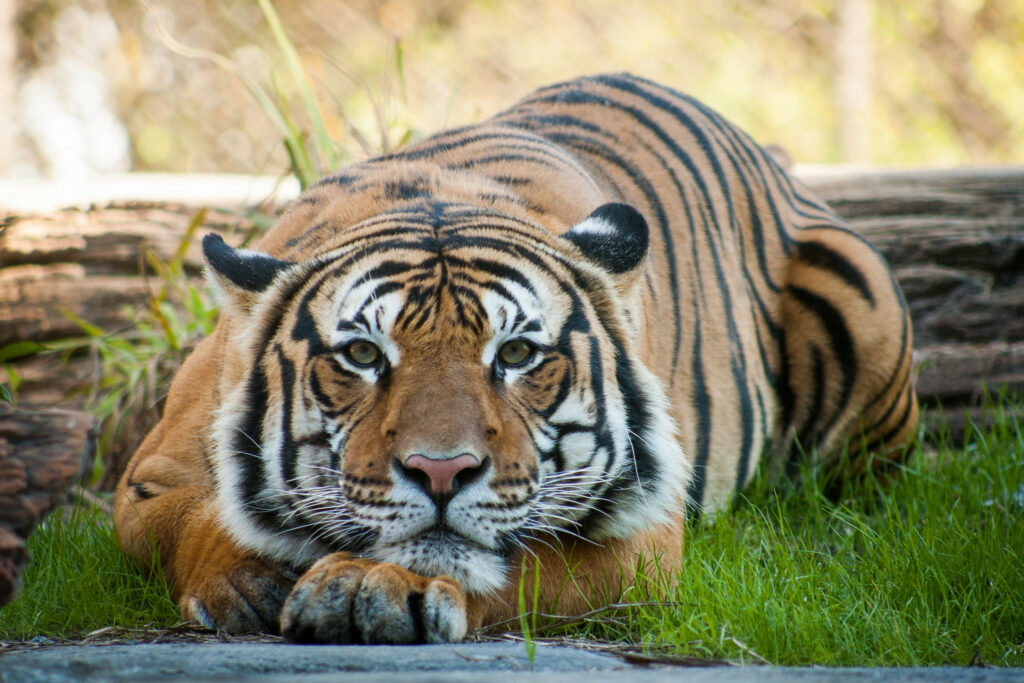
Tiger in Jacksonville Zoo
Image by Caitlin Regan via Flickr

A growing number of zoos across the globe are reporting animal death by avian influenza. The virus appears to be spreading throughout captive animal collections, which could have grave, and potentially fatal, consequences for endangered species – already, zoos have reported deaths of a number of threatened species, including lions, tigers and panthers. It is thought to have been spread through infected wild birds landing in open air enclosures, and experts emphasise the need for enhanced biosecurity, or vaccination, to ensure the safety of captive animals.  
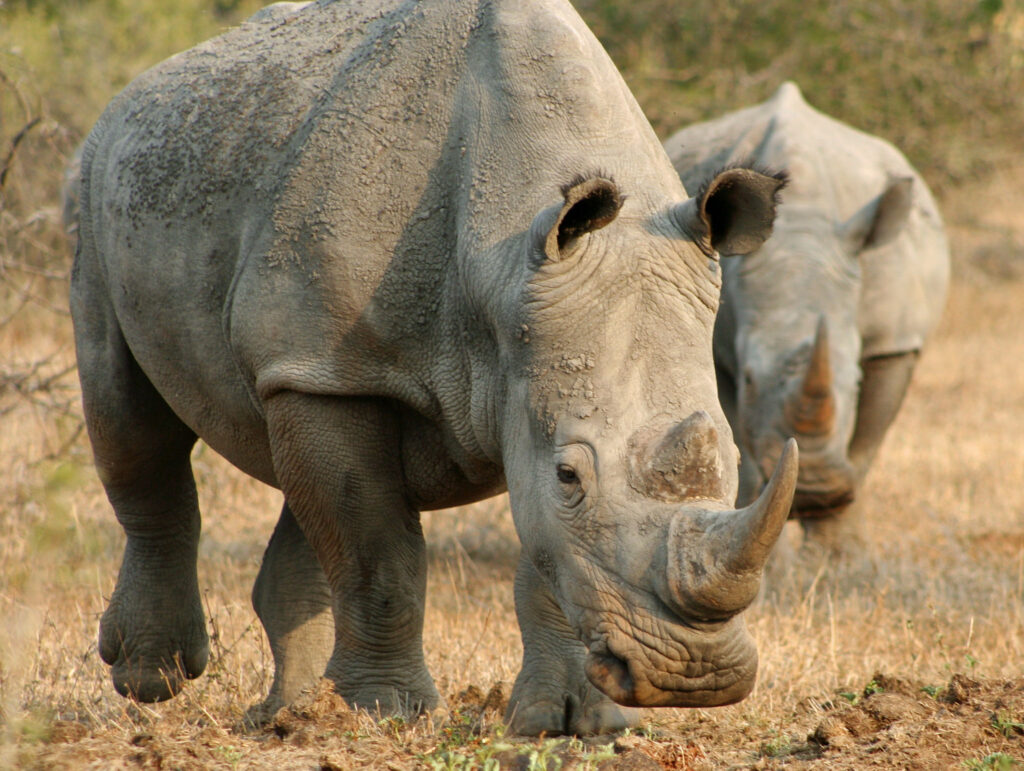
A leading wildlife expert is calling for the legalisation of rhino horn trade. Martin Wikelski wrote to the journal Science, urging authorities to take the market out of criminal hands, in order to establish carefully monitored, legal transactions and regain control of the market. Wikelski argues that monitored trade could help to raise money for increased protective measures and save the last remaining populations, since crime syndicates have overcome every countermeasure that has been implemented to protect rhinos thus far.

White rhino in South Africa
Image by Ian Turk via Flickr

Discoveries 

Twenty-seven species new to science have been discovered in a survey in Peru. A 38-day survey in Alto Mayo, a well-populated region in north-west Peru, has uncovered over 2,000 species of wildlife and plants, including new, rare and threatened species. Of these species previously unknown to science, there are four mammals, an arboreal salamander, seven species of new fish, a frog, ten butterflies and two dung beetles – and a further 48 species are awaiting verification before confirming their discovery. Alongside these exciting new discoveries, the expedition identified 49 threatened species from the IUCN Red List, including birds, amphibians and primates, and it is hoped that these discoveries will bolster conservation work in the region.
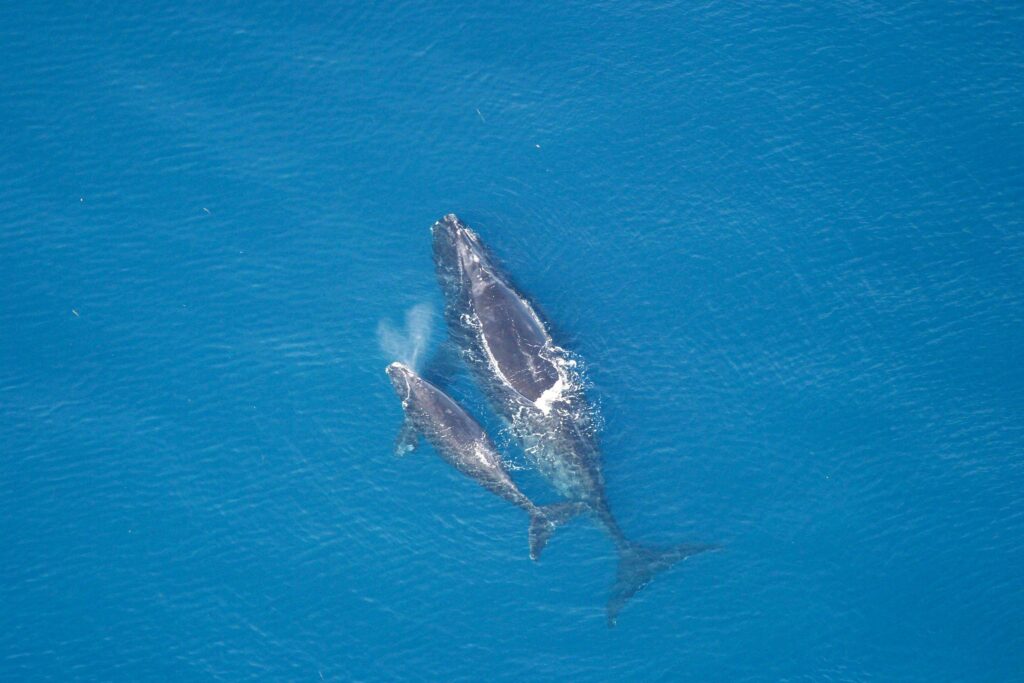
Right whales
Image by NOAA Office of National Marine Sanctuaries via Flickr

A recent study has discovered that right whales may live almost twice as long as previously thought. Four decades of photo identification data was used to analyse the life expectancy of Northern Atlantic Right Whales and Southern Right Whales. Researchers observed a life expectancy of up to 150 years for Southern Right Whales, and a contrasting 22-year average for North Atlantic Right Whales – primarily due to anthropogenic impacts, including entanglement in fishing gear, ship collisions or starvation which could be linked to environmental change. Authors plan to expand the scope of the study to examine other whale populations, in order to learn more about how whaling practices have impacted the abundance of older individuals and allow for estimates of recovery to pre-whaling population sizes. 
Wildlife   

Data shows that almost three quarters of the UK’s Sites of Special Scientific Interest (SSSI’s) have had no assessment of their condition since the start of 2019. These sites consist of ecologically valuable habitats, wildlife and natural features, and are legally protected to prevent environmental degradation. In the last assessment, nearly 40% of features were in unfavourable condition, and without further monitoring, conservationists warn that British wildlife could be disappearing unnoticed. In response, a long-term programme is being developed by Natural England to determine SSSI assessment, as well as making improvements to monitoring and data use.  

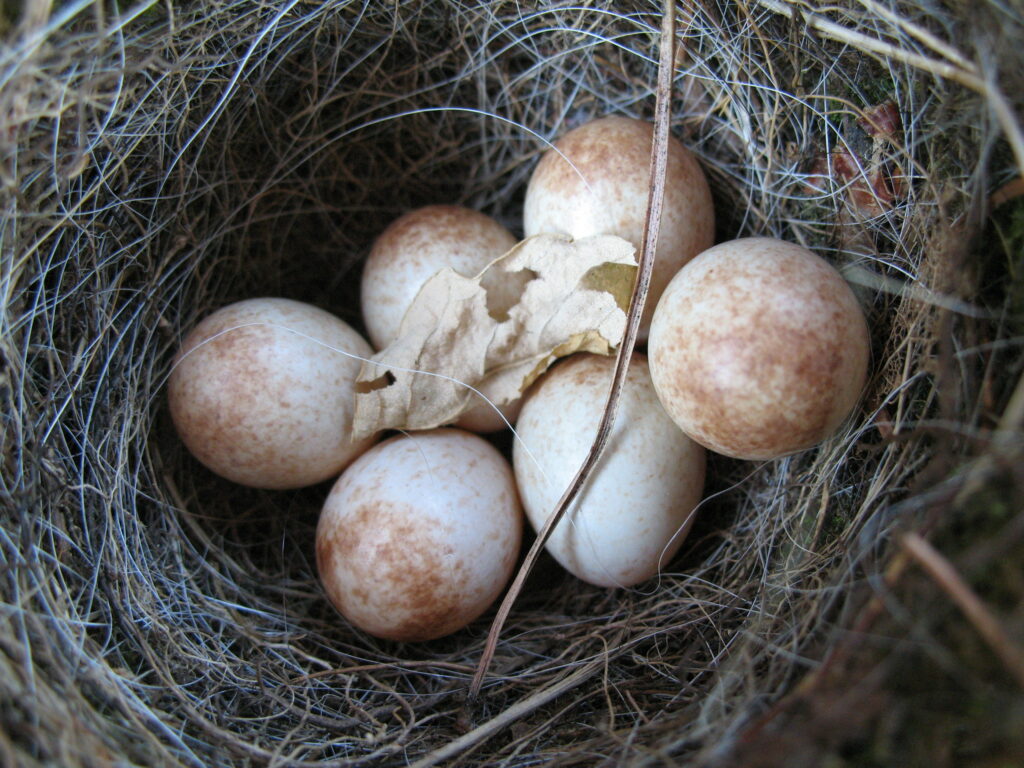
a clutch of bird eggs in a nest
Image by Lisa Risager via Flickr

Over 6,000 wild bird eggs have been seized in the UK. In the largest haul of it’s kind, raids from Scotland, South Yorkshire, Essex, Wales and Gloucester uncovered thousands of wild bird eggs in attics, offices and drawers. The raids took place under Operation Pulka – an international effort tackling wildlife crime, especially the trading of bird eggs. Harvesting by egg collectors is placing additional pressures on already threatened and rare wildlife, and for species with a limited geographic range, could be the difference between existence and extinction.