The NHBS Guide to UK Spider Identification

There are over 650 species of spider within the UK, and although many may find spiders unappealing or even frightening, they are fascinating in their own right. While many spiders are present throughout the year, autumn is the best time to see them outdoors. 

Identifying spiders can often be difficult, as they are very small, elusive, and many species resemble one another. The colouration and pattern of a spider can be a useful way to identify them, as well as other key features such as the structure of their webs. In some cases, it is necessary to take a closer look at the genitalia under a microscope, as this can be the only way to confidently identify certain species. You can also use your location as a clue, as some species are more likely to be found in certain parts of the UK.

To survey for spiders, you can search by eye or you can use equipment such as a sweep net or a sampling tray, and a hand lens can help you pick out features on smaller species. There are also lots of field guides and books available for more information on different types of spiders.

In this article, we’ll show you several fairly common species that you may find in your garden or local green space. 

Garden Spider or Cross Orbweaver (Araneus diadematus)

Distribution: Common and widespread

What to look for: These spiders are greyish-brown or reddish-brown with a white pattern across their back that resembles a cross. They can also sometimes be bright orange. They have striped legs, and females are twice the size of males. 
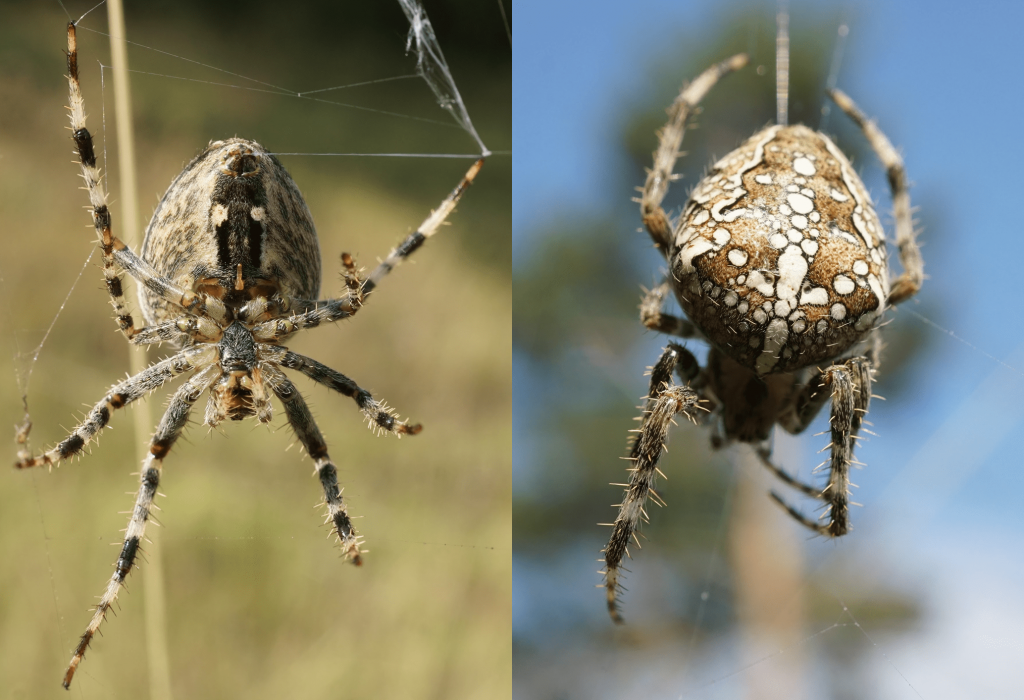
Garden spider (left and right) by xulescu_g via Flickr
Noble False Widow (Steatoda nobilis)

Distribution: Widespread across southern England, with their range increasing northwards

What to look for: This species can be confused with many other UK species. Their body is dark brown, with variable patterns on their abdomen. Usually cream and dark brown marks that can sometimes resemble a skull.

Did you know? This is a non-native species in the UK and was thought to be introduced in the late 1800s. Despite many rumours, bites from this species are rare, usually occurring when the spider is disturbed. The bites have been compared to a wasp sting, however guidance should be sort if you are concerned about a bite.
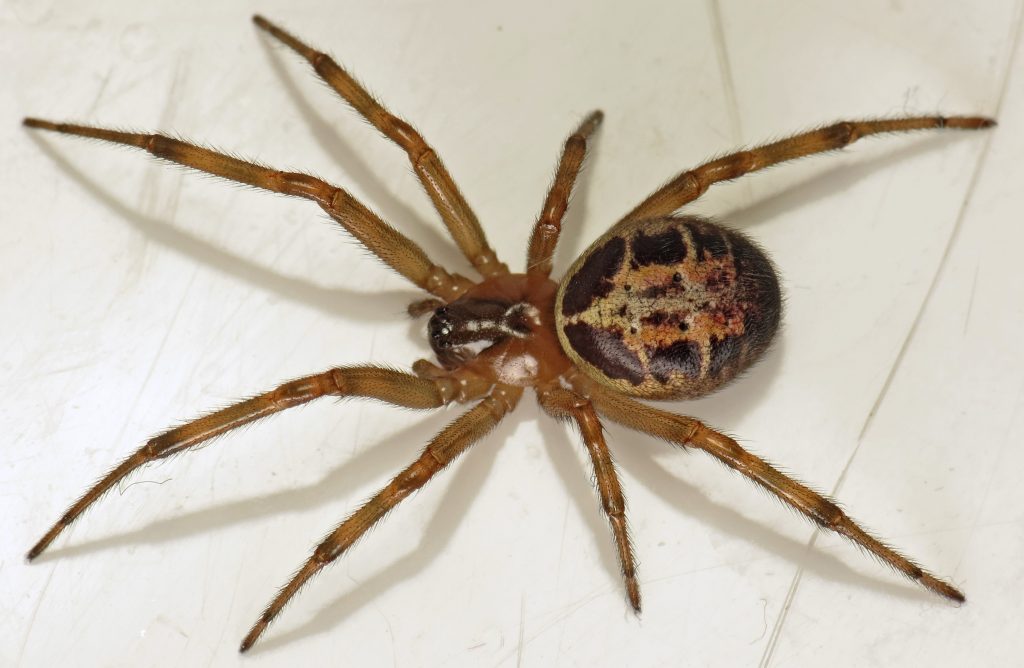
Noble false widow by Martin Cooper via Flickr
Common Candy-Striped Spider (Enoplognatha ovata)

Distribution: Occurs throughout the UK

What to look for: The common candy-striped spider has several colour variations. Their abdomen usually has a pale creamish-white background. The pattern on it can be bright pinkish-purple in a V shape pointing towards the head, a solid pinkish-purple triangle, black lines that can be either thick or thin, or a variation of black marks and spots. Their cephalothorax (fused head and thorax) is a pale yellow colour, with a dark line down the middle, and their legs are also a similar pale yellow. In the field, it is incredibly difficult to distinguish this species from a similar species, the scarce candy-striped spider (Enoplognatha latimana). Confirmation of the species usually requires examination under a microscope. 
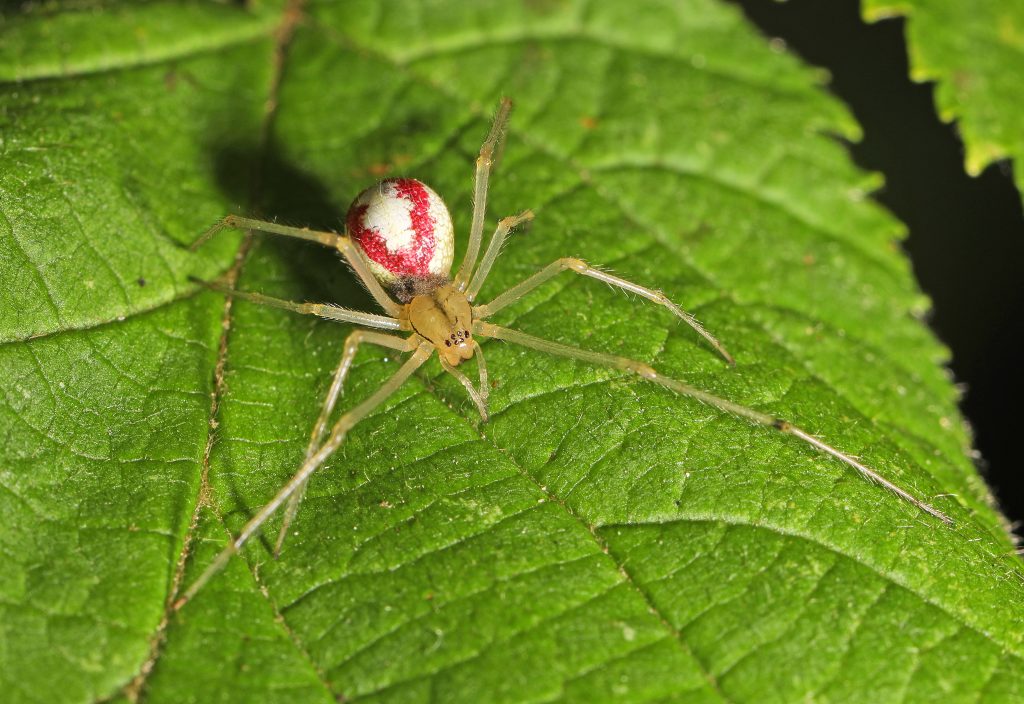
Common candy-striped spider by Judy Gallagher via Flickr
Goldenrod (Flower) Crab Spider (Misumena vatia)

Distribution: Common in southern UK

What to look for: The goldenrod crab spider has some colour variation, appearing white, yellow or green, They often have red lines on either side of their abdomen. Their abdomen is bulbous and their front legs have a crab-like appearance, hence their name. The female is much larger than the male. 

Did you know? This species can change its body colour to match its background! It takes a few days to occur, but it helps to disguise the spider as they sit and wait for their prey to land near them.  
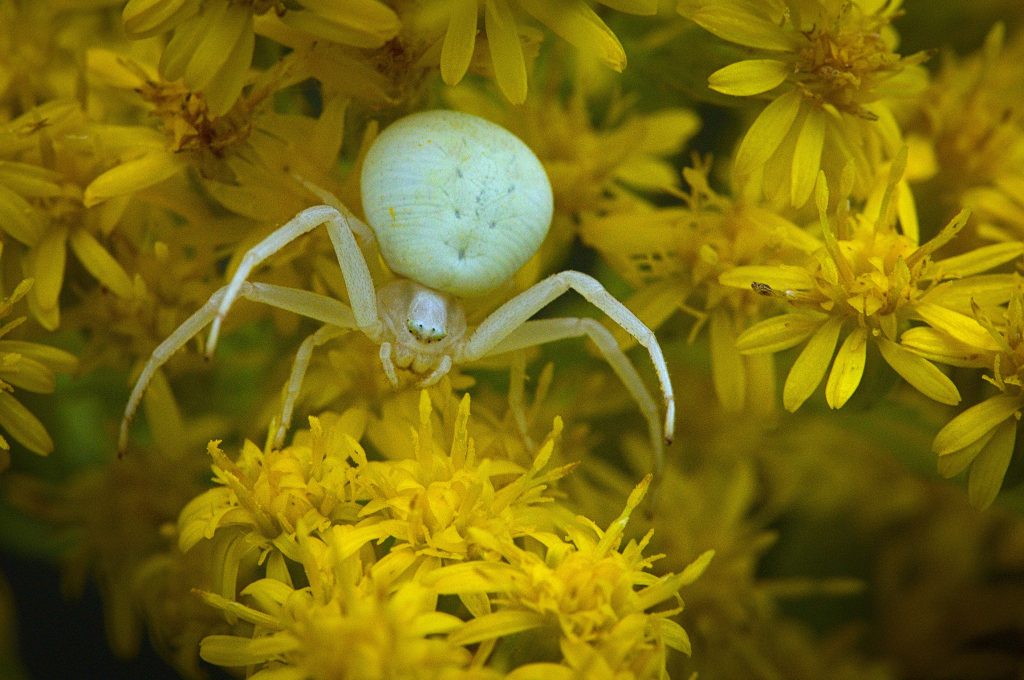
Goldenrod crab spider by hedera.baltica via Flickr
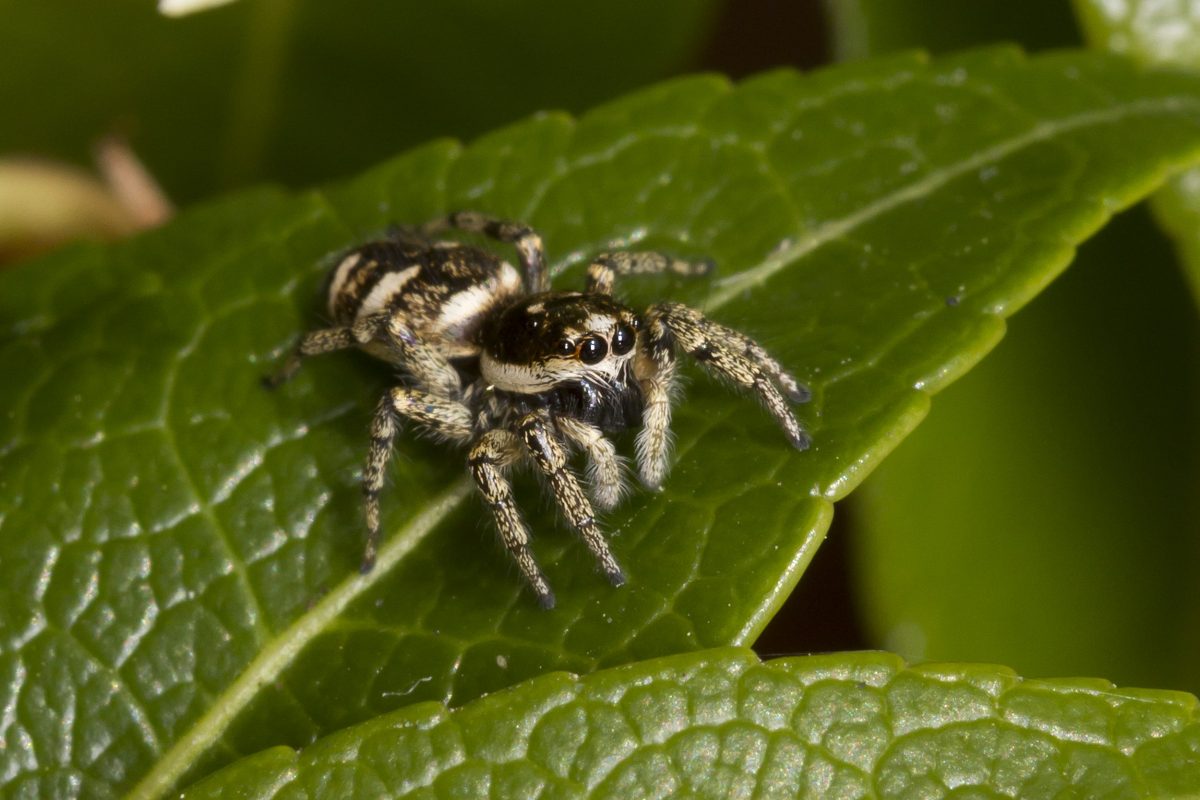
Zebra Jumping Spider (Salticus scenicus)

Distribution: Widespread

What to look for: The zebra jumping spider can grow up to 8mm, which is surprisingly large for a jumping spider, and they can jump an impressive 10cm. As their name suggests, they have a black and white striped pattern, but it can be hard to tell them apart from similar species of jumping spider. They are usually found on walls, rocks, or tree trunks.
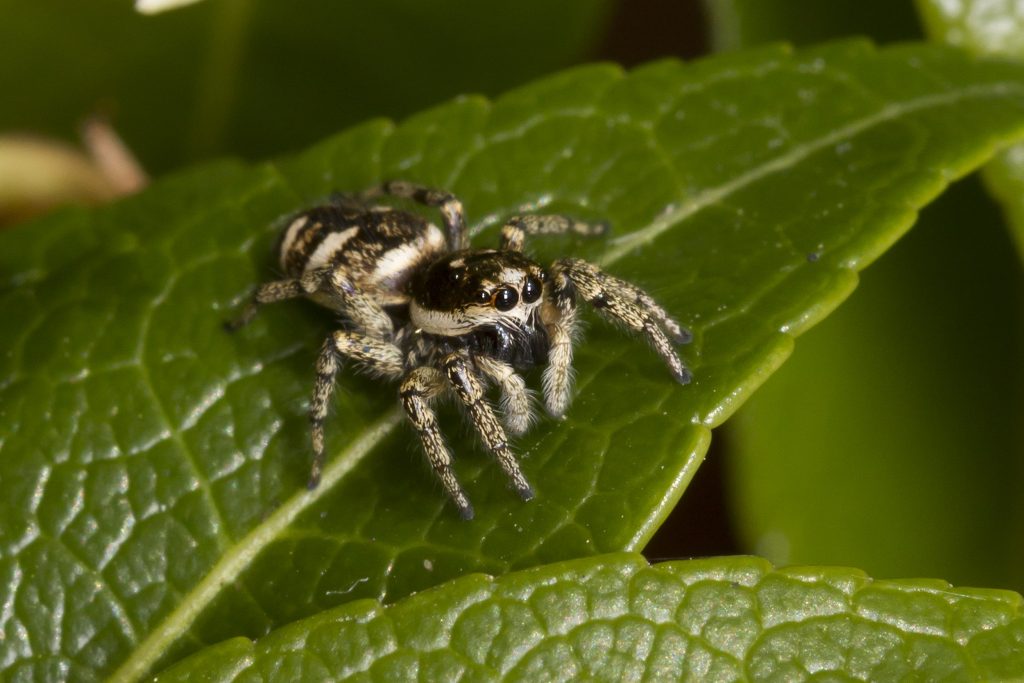
Zebra jumping spider by Chris via Flickr
Cucumber Green Spider (Araniella cucurbitina)

Distribution: Occur throughout the UK

What to look for: Around 4-6mm long, this small spider has a bright yellowish-green abdomen and a pinkish cephalothorax. They also have small black spots along their abdomen. They are very similar to another cucumber spider A. opisthographa, but it can be difficult to tell them apart in the field.
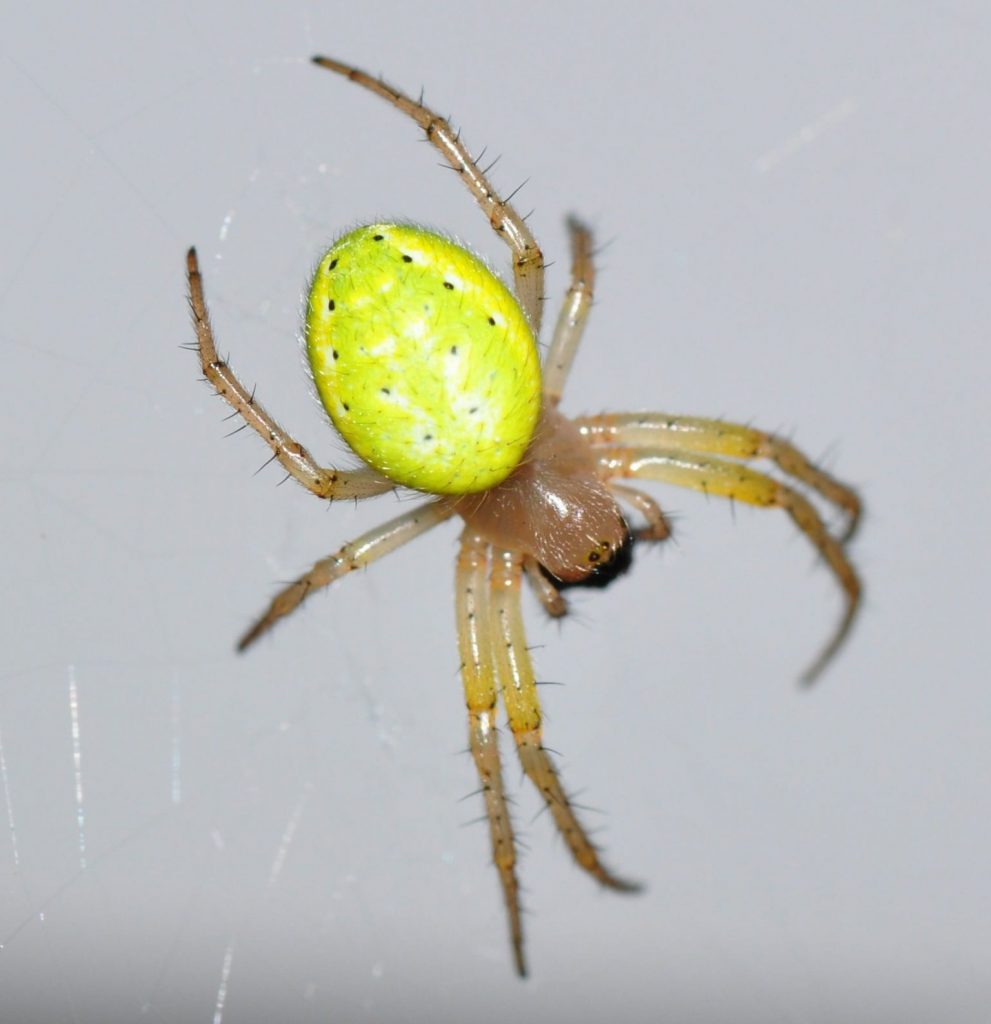
Cucumber green spider by Pavel Kirillov via Flickr
Labyrinth Spider (Agelena labyrinthica)

Distribution: Widespread in southern England, as well as in Wales

What to look for: The labyrinth spider can grow quite large, up to 18mm long. They create long, funnel-shaped webs in long grass and hedgerows. Their abdomen has a pale brown stripe with darker bands on either side, and these bands have several paler chevron markings through them. Their cephalothorax also has a pale brown stripe, with an orange-brown band on either side, and their legs are orange-brown with paler hairs.
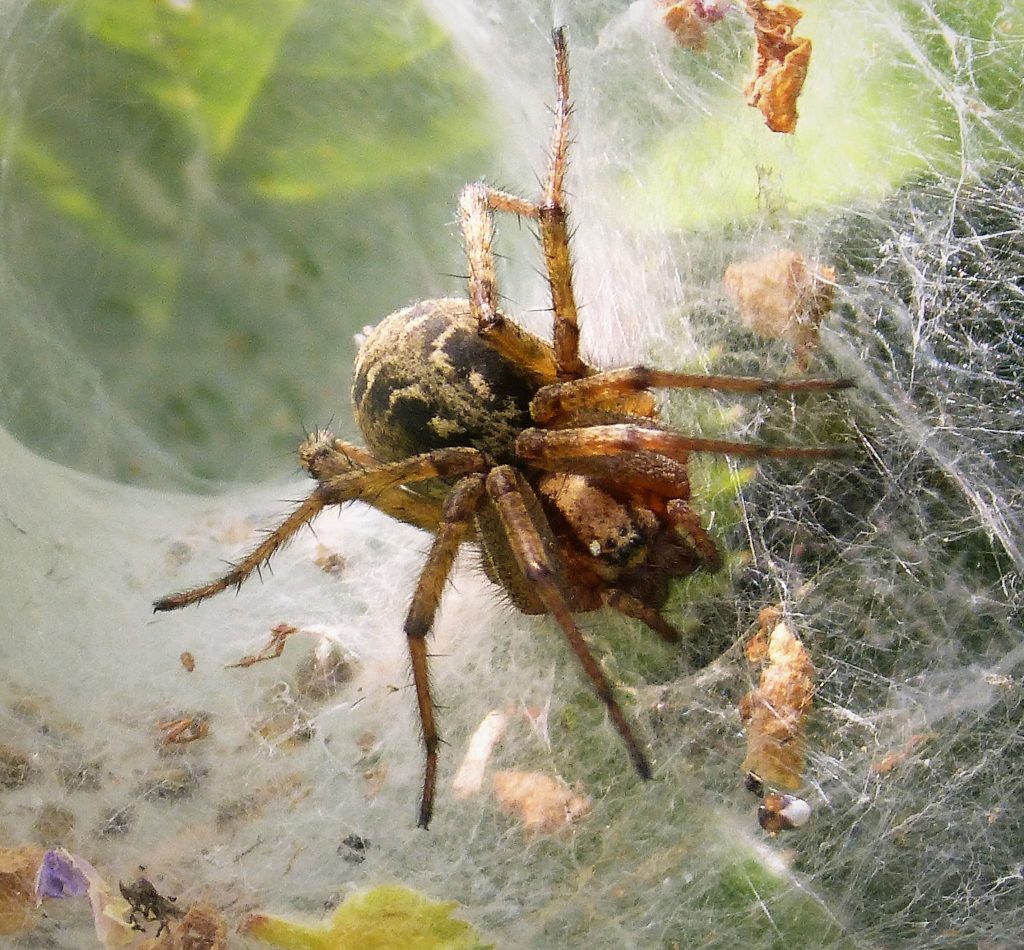
Labyrinth spider by gailhampshire via Flickr
Nursery Web Spider (Pisaura mirabilis)

Distribution: Widespread across most of the UK, although less frequent in the north

What to look for: The nursery web spider is quite variable in colour, and can have a grey, dark brown, or yellow-orange body. They have a slender, pointed abdomen, with two dark brown lines running from the spinnerets (silk-spinning organs) all the way to the front of the cephalothorax. They also have pale tear-shaped marks next to their eyes.
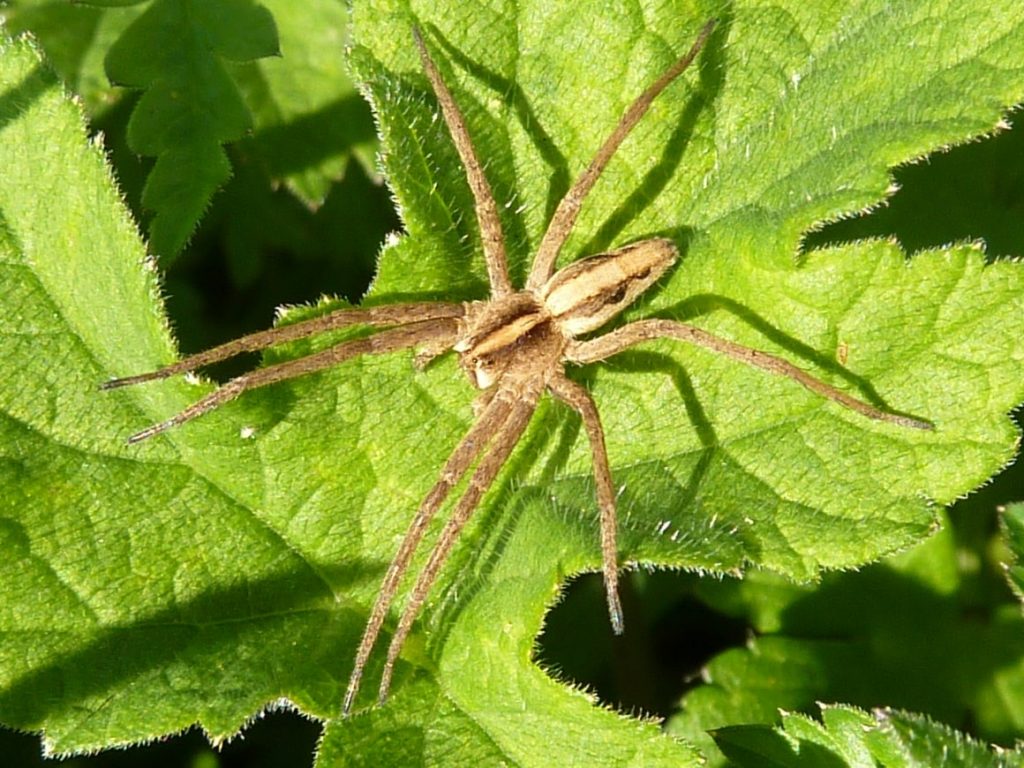
Nursery web spider by Dluogs via Flickr

Useful books and equipment

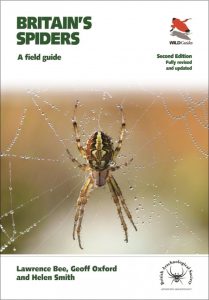
Britain’s Spiders: A Field Guide

Now in a comprehensively revised and updated new edition, Britain’s Spiders is a guide to all 38 British families, focussing on spiders that can be identified in the field. Illustrated with photographs, it is designed to be accessible to a wide audience, including those new to spider identification.
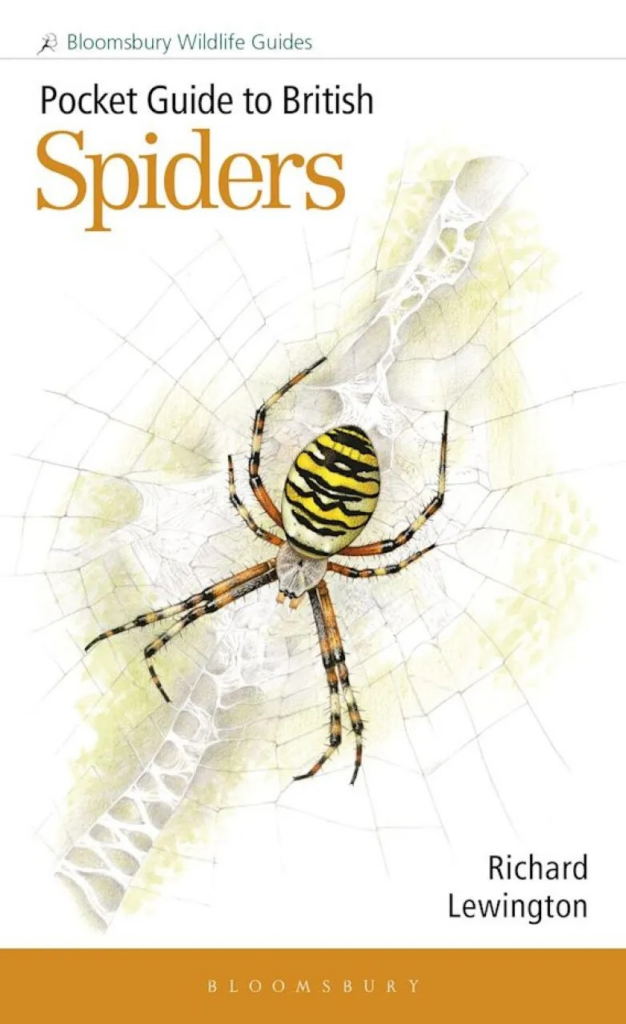


Pocket Guide to British Spiders

Featuring 130 of the most common and readily identifiable species, this illustrated pocket book is the ideal comparison for anyone interested in the naturally occurring spiders found in the British Isles.


Collins Field Guide to the Spiders of Britain and Northern Europe

This major identification guide to 450 species of spider is designed for easy use. Each species is described in detail and illustrated in colour, including common colour variants and differences between the sexes.


A Guide to House and Garden Spiders

Of the 33 spider families represented in Britain, 21 are featured in this chart. The guide includes colour illustrations and a table with identification features, habitat and methods of prey capture for the 40 spiders featured in the chart.
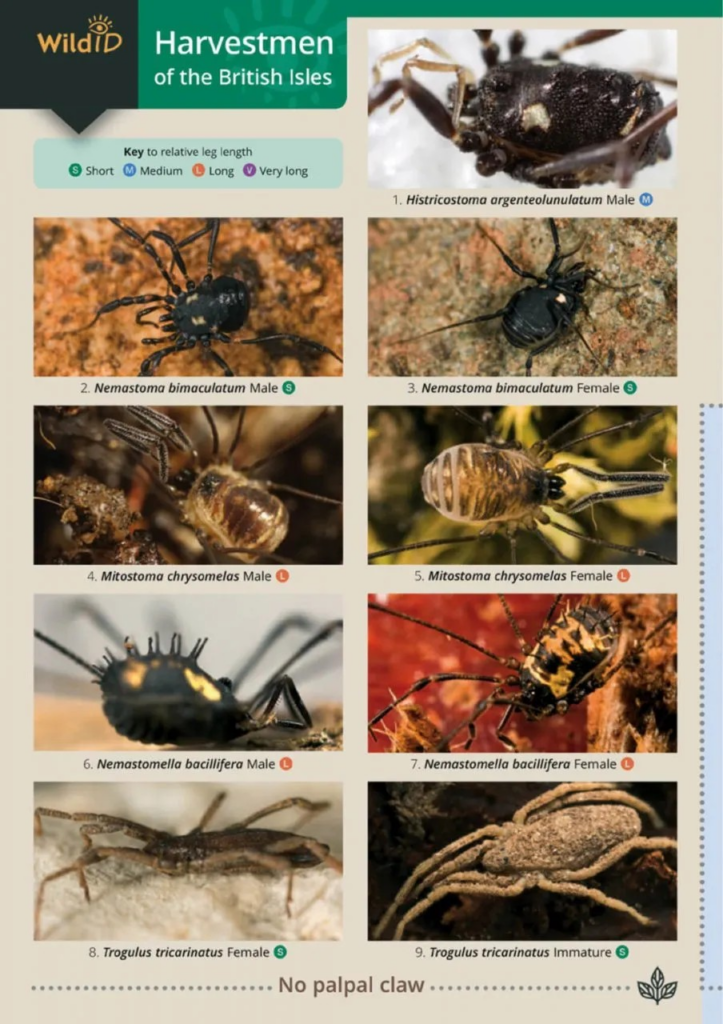


Harvestman of the British Isles

A fully up to date second edition, covering all 34 species that have been recorded in the wild in Britain and Ireland. There are photographs of each species, with separate photos for males and females, and a comprehensive identification table.



Bug Box Magnifying Pot

A clear plastic pot with a snap on magnifying lid with x3.5 magnification, ideal for viewing pond life and terrestrial invertebrates up close.



Insect PooterInsect Pooter

The pooter is a classic piece of entomological equipment, enabling the capture of small or delicate invertebrates without the risk of damaging them or losing them in the undergrowth. It consists of a transparent plastic collecting jar with a lid containing two holes, one of which has a fine mesh covering.
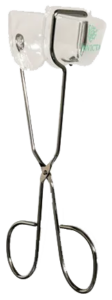


Bug Tongs

These scissor action Bug Tongs are the perfect way for children to collect larger insects and bugs which cannot easily be caught using a pooter.
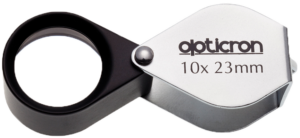


Opticron Hand Lens 23mm 10x Magnification

This Opticron Hand Lens contains a high quality 23mm doublet lens, made of glass and provides excellent distortion-free magnification. The 10x magnification is recommended for general observations and this magnifier is the one most commonly recommended for all types of fieldwork.
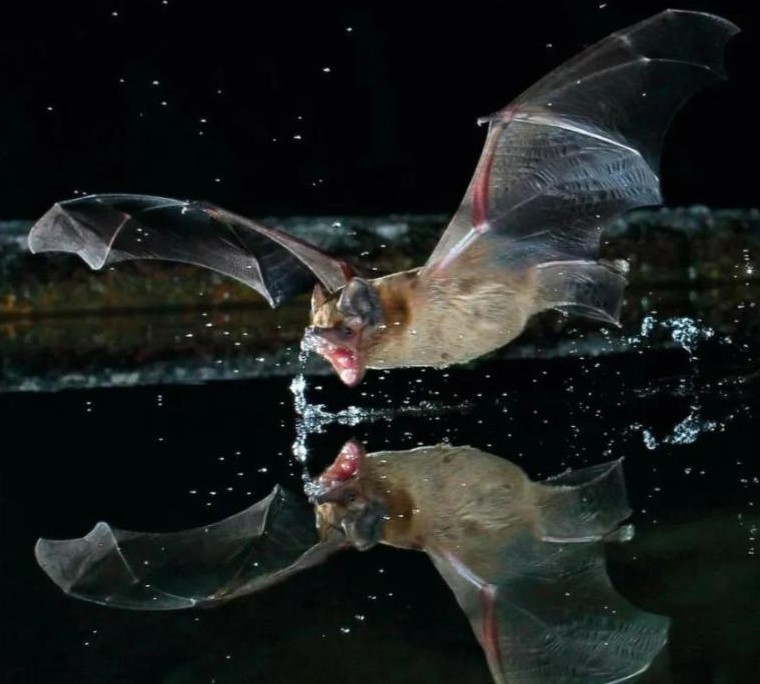
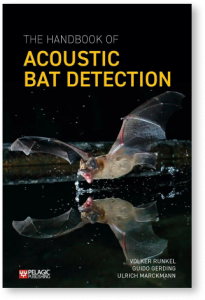
Author Interview: The Handbook of Acoustic Bat Detection

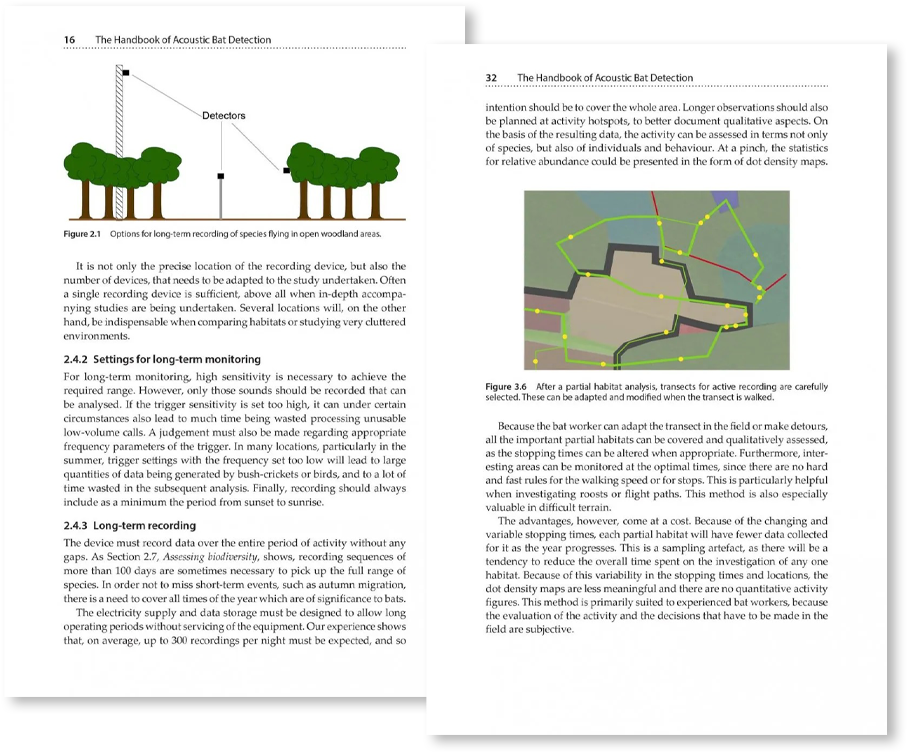
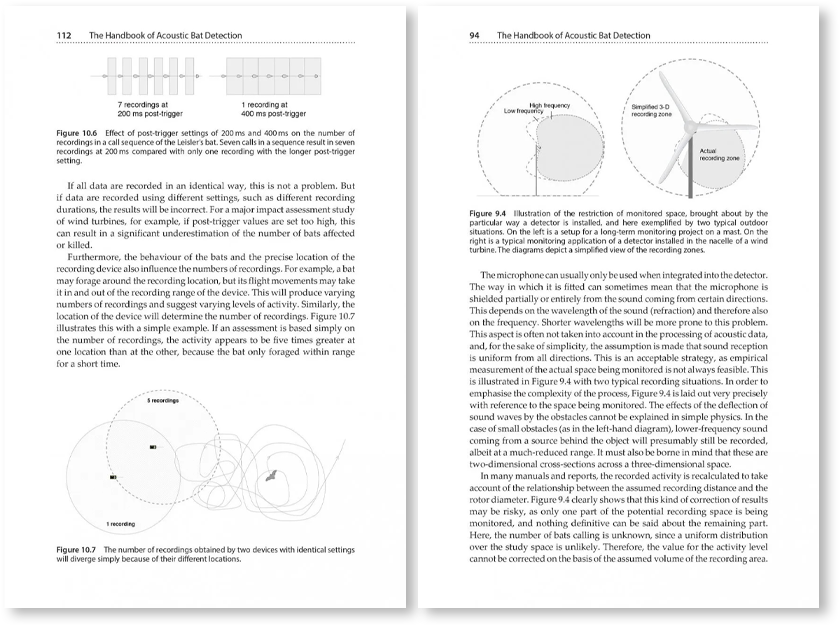
Acoustic detection is a popular and widespread method of environmental assessment, and its use is increasing, driven by the development of increasingly accessible and sophisticated detection devices. The Handbook of Acoustic Bat Detection provides an in-depth understanding of the principles of acoustic detection, study planning, data handling, properties of bat calls, analysis of results, and the manual identification of species. It also includes information on quality assurance, the benefits and drawbacks of automatic species recognition, and the background physics of sound.
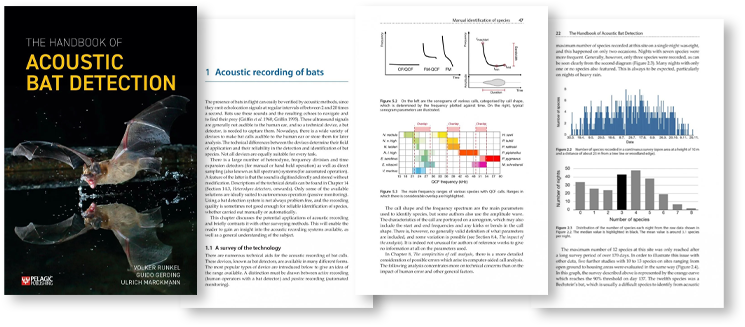
We are fortunate to have had the opportunity to ask the authors some questions.


The applications of data derived from acoustic bat detection are diverse and wide-ranging. What motivated you to write The Handbook of Acoustic Bat Detection and what impact do you hope the book has in this field?

In our daily work, we have seen a lot of improper use of acoustic data. Mainly driven by misconceptions regarding the interpretation of acoustic data and quite often due to missing basic knowledge on bioacoustics and signal analysis. With the easy availability of acoustic detectors and the relative simple usage, these problems became more common, especially in consulting activities. Many new “bat experts” appeared in the field basing their work on automatic detection and identification systems. We hope to help such users to gain a basic understanding of bioacoustics and give more experienced users new information to further improve their work. Thus overall we hope to improve the quality of projects based on acoustic data and increase the evidence level.

This book discusses some of the different methods for processing acoustic data, such as zero-crossing. What are the benefits of this method versus full-spectrum analysis?

The main benefit of zero-crossing is the much smaller amount of data produced and the possibility of listening to the recorded sounds directly. Full-spectrum detectors produce much larger amounts of data and do not allow direct listening to the bat calls. Yet, the benefits of zero-crossing are decreasing with cheaper data storage and higher processing power. Thus today one can nearly instantaneously listen to full-spectrum sound resampled to zero-crossing or heterodyne representation in real-time. In our opinion, the real-time data gives more insights into the calls on a much easier-to-understand level, yet we accept that experts can do powerful analysis with zero-crossing data as well.

You have all had many years of experience in this field; how has bat detection and acoustic analysis developed and changed since you first started?

We started working on bat acoustics in the field when only heterodyne or zero-crossing detectors were available. So in our early days, we walked through the field listening for bats. We were already interested in better and more reliable species ID back then. Then the time-expansion system was available as well as the Anabat system. We used time-expansion a lot, but both didn’t work well for our scientific research interests. So we developed with the batcorder a real-time detector that completely changed bat work in Germany within a few years. Back in the beginning, sound analysis of bat calls was something only a few were able to do. Now with fully automated systems, the whole process changed. Surveys can run for multiple months nearly everywhere – not only ground-based but also on wind turbines or off-shore. We collect billions of bat calls a year with these systems and thus are able to learn more about their calls and ecology. Yet this is not always the best, since a lack of bat knowledge often prevents optimal solutions for bat-related landscape changes.

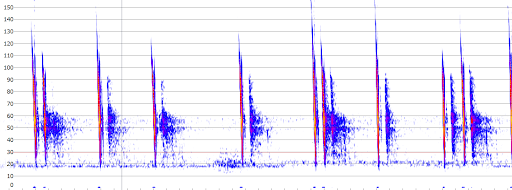
Bat acoustic recording visualised through the Anabat Insight Software 

In chapter 11, ‘Quality assurance of reports’, you provide criteria to improve the quality of specialist reports used in impact assessments, such as which information should be included and the procedures that should be followed. How do you think the previous lack of clear guidelines has impacted bat surveying and, consequently, conservation?

In Germany, quite often surveys were conducted and it was later not possible to understand the low or high results since important information was missing. Also for legal complaints in planning processes, it was quite often impossible to understand how the data was actually sampled. If surveys and methods are well documented, it is much easier to evaluate the planning process and even more to work out optimal sampling schemes for following surveys in the new planning processes.

Now that this book is complete, do you have any future projects you would like to tell us about?

There are many projects – especially since we now face a major green-green dilemma with climate conservation often acting against biodiversity conservation. This especially is visible in the renewable energy sector. So currently some of us are investigating chances to further identify the possibilities of improving bat conservation for planning wind parks and other sources of renewables.

Another project is the ongoing improvement of species identification based on bat calls. We are working on new solutions to give better results.


The Handbook of Acoustic Bat Detection

Available for pre-order: Due September 2021

Paperback | £39.99


All prices correct at the time of this article’s publication.

July Top 10

NHBS’s Top 10 bestsellers July 2021

We love looking back at our bestsellers from the month before and are very excited to share our second Top 10 list, featuring the best of July.

This month, highlights include recent works such as Sphagnum Mosses and Seabirds, as well as some you may recognise from last month’s Top 10, Secrets of a Devon Wood and Insectinside, as recently featured on BBC’s SpringWatch.


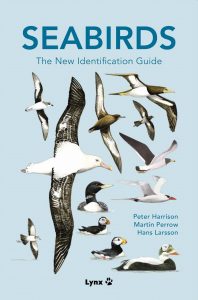
seabirds: The New Identification Guide | Peter Harrison, et al.
Hardback | June 2021

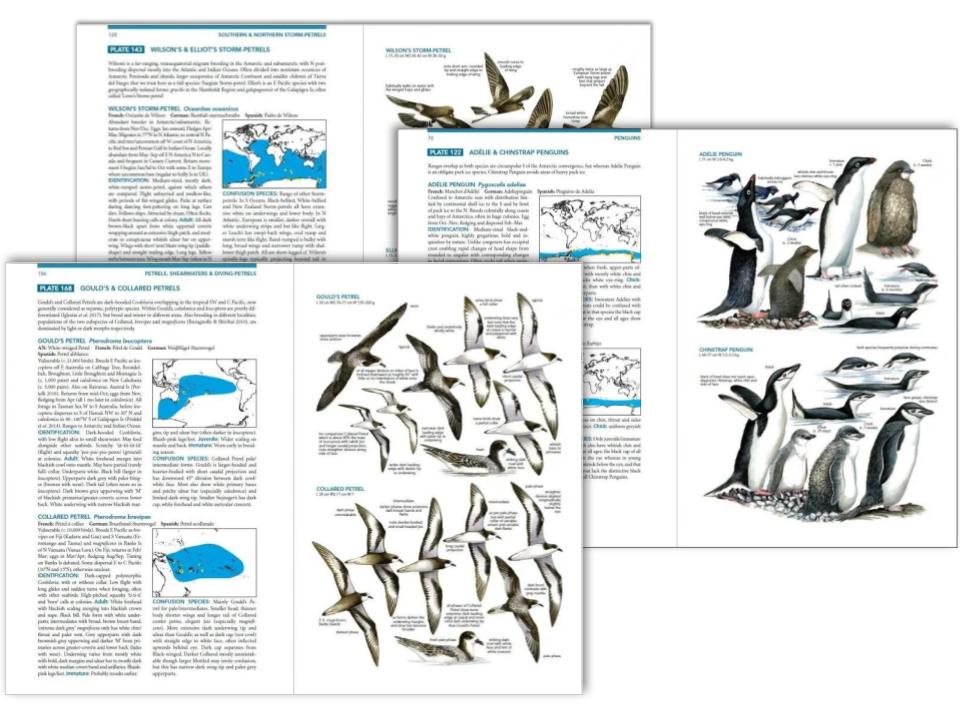
In top place this month is Seabirds: The New Identification Guide, a 600-page treatment to all know seabird species. It’s the first comprehensive guide to the world’s seabirds to be published since Harrison’s Seabirds in 1983. This guide contains 239 brilliant, full-colour plates, along with detailed text covering status, conservation, geographic range and more.

Seabirds Publisher, Lynx Edicions, is also our publisher of the month for August!


a field guide to grasses, sedges, and rushes | Dominic price
Spiralbound | April 2016

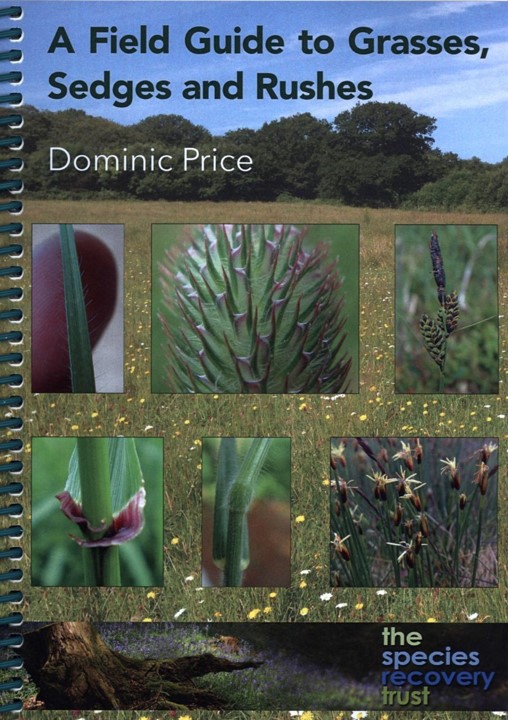
Field Guide to the Grasses, Sedges and Rushes has moved up the list this month from the 7th spot and is a consistent bestseller for NHBS. This guide aims to simplify the identification of this fascinating group of plants, using characters that are both easy to spot in the field and simple to remember. Over 100 species are described, focusing on key features of both their genus and species.

Read our interview with Dominic Price here.


Sphagnum Mosses: FIeld Key to the Mosses of Britain and Ireland | Martin Godfrey and Karen Rogers
Paperback | July 2021

Brand new last month, Sphagnum Mosses: Field Key to the Mosses of Britain and Ireland is proving to be popular. This short handbook is intended to provide an accessible key for identifying Sphagnum species in the field.

It contains brief descriptions of the more important identification features, plus a guide to the vegetation types that the individual species occupy. As some individual specimens can be problematic, short keys based on microscopic characters are also provided.


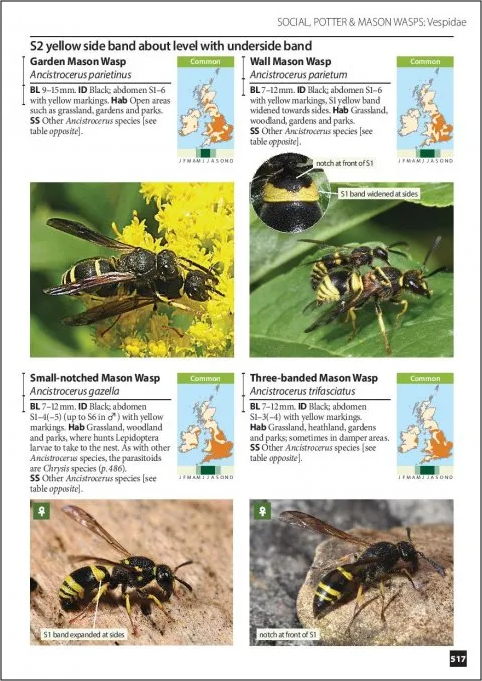
Britain’s insects: A Field guide to the insects of Great Britain and Ireland | Paul brock
Flexibound | May 2021

Britain’s Insects remains just as popular this month! This field guide is an innovative, up-to-date, carefully designed and beautifully illustrated field guide to Britain and Ireland’s 25 insect orders, concentrating on popular groups and species that can be identified in the field.


Featuring superb photographs of live insects, Britain’s Insects covers the key aspects of identification and provides information on status, distribution, seasonality, habitat, food plants and behaviour.


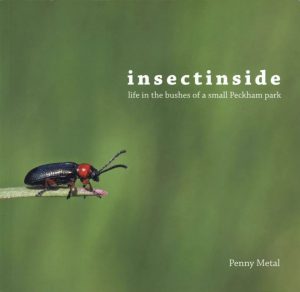
Insectinside: Life in the Bushes of a Small Peckham Park | Penny Metal
Paperback | October 2017  

As recently featured on BBC’s Springwatch, Insectinside is a fantastic book featuring hundreds of species of insect that have all been found in Warwick Gardens in Peckham by author, Penny Metal.

We caught up with Penny to ask her some questions about her book – read the full interview here.


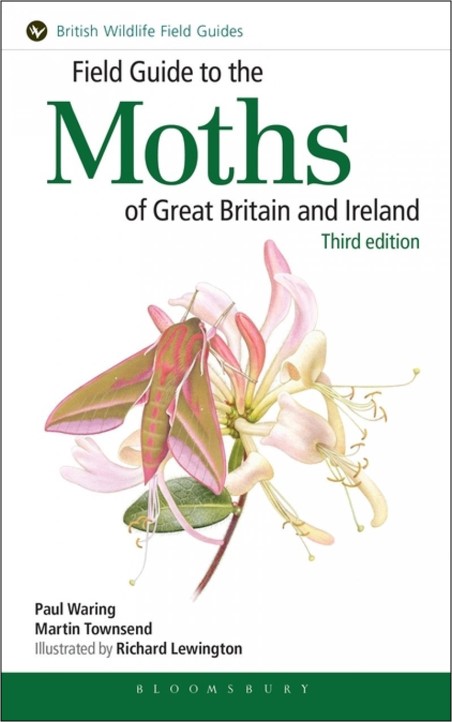
Field Guide to the Moths of Great Britain and Ireland | Paul Waring, Et al.
Paperback |  November 2018

The third edition of the Field Guide to the Moths of Great Britain and Ireland is a fully revised and updated version.

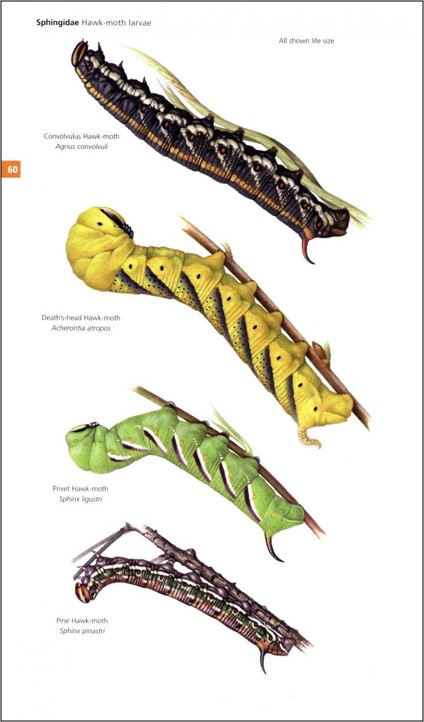
This field guide includes beautiful illustrations displaying key features to help with identification. It covers flight season, life cycle, larval foodplants, habitat and more, along with maps presenting distribution information.


The revised edition also contains an introduction explaining how the methods of identifying and recording moths have evolved over recent years.


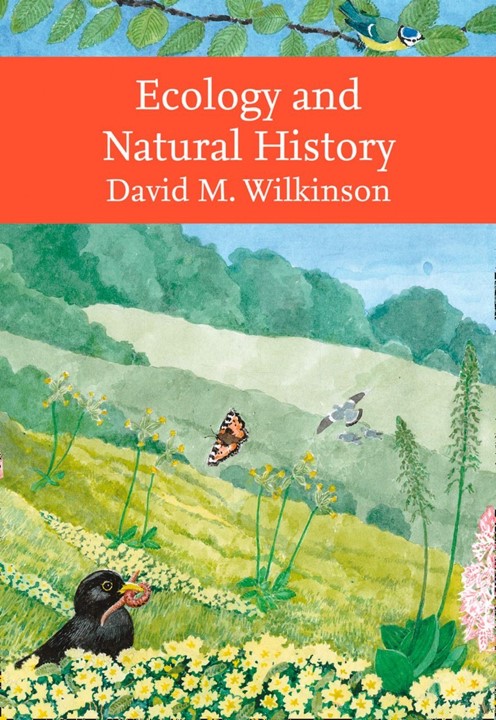
Ecology and Natural history | David Wilkinson
Paperback | June 2021

The latest addition to the New Naturalist Series, Ecology and Natural History, makes it into the top ten again this month.

Ecology is the science of ecosystems, of habitats, of our world and its future. In the latest New Naturalist, ecologist David M. Wilkinson explains key ideas of this crucial branch of science, using Britain’s ecosystems to illustrate each point.

Read our Q&A with David M. Wilkinson here.

We have a limited number of signed bookplates for the hardback edition, available while stocks last. 


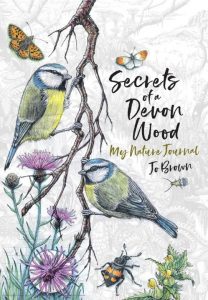
secrets of a devon wood: my nature journal | jo brown
Hardback | October 2020

Another repeat occurrence in this months Top 10, Secrets of a Devon Wood is still high up on NHBS’s list. Artist and illustrator Jo Brown started keeping her nature diary in a bid to document the small wonders of the wood behind her home in Devon. This book is an exact replica of her original black Moleskin journal, a rich illustrated memory of Jo’s discoveries in the order in which she found them.

Jo very kindly agreed to answer some of our questions for a Q&A. Read the full interview here.


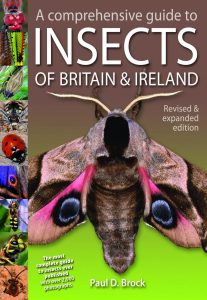
A Comprehensive Guide to Insects of Britain & Ireland | Paul  D. Brock
Flexibound | October 2019

A Comprehensive Guide to Insects of Britain & Ireland is a complete, photographic field guide to over 2,300 species of insects in Britain and Ireland – including beetles, flies, ants, bees, and wasps. The clear photograph will assist in the identification of the majority of insects likely to be encountered.

This guide also contains concise text on behaviour, present-day conservation status, and pointers on species of similar appearance. Serious naturalists will welcome notes on areas to look for rarities and information on where to look for additional information on particular insect groups


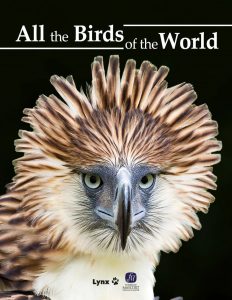
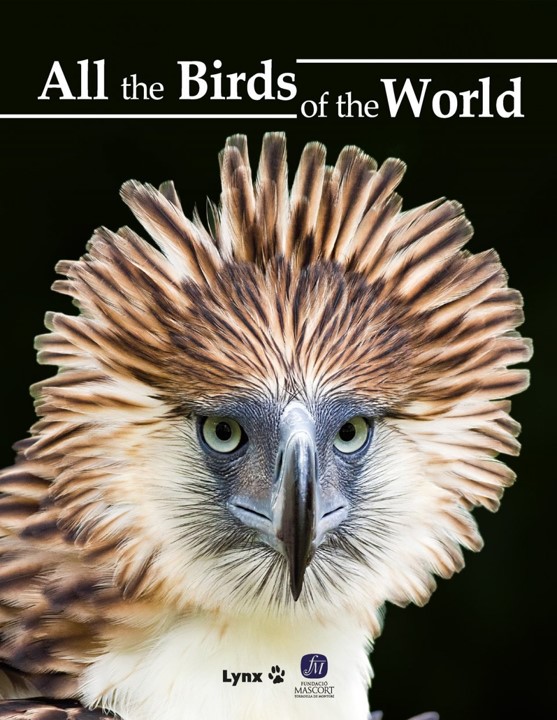
All the Birds of the World | Josep Del Hoyo          Hardback | August 2020

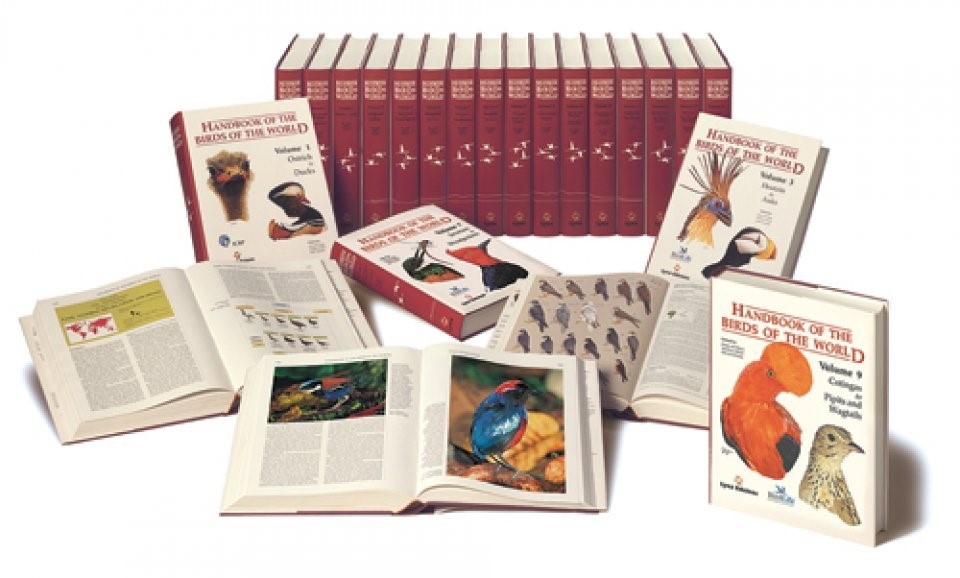
Another title from our publisher of the month, Lynx Edicions, is All the Birds of the World. With the completion of the famed Handbook of the Birds of the World, this book lists all the birds of the world, allowing readers to browse and compare Earth’s amazing avian diversity between the covers of one volume.


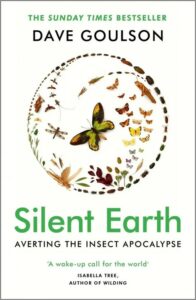
Book Review: Silent Earth by Dave Goulson

On the 27th of September, 1962, marine biologist and conservationist Rachel Carson saw her book, Silent Spring, published. A powerful examination of the effect that humans have on the natural world, with a particular emphasis on the use of pesticides, Silent Spring met with rapid success and soon became a landmark text on the subject. Despite fearsome opposition it became a rallying point for the environmental movement, fuelling discussions that would result in the widespread re-evaluation of the damage that pesticides can cause and the banning of some of the most damaging chemicals, such as DDT. 

Dave Goulson’s new book, Silent Earth: Averting the Insect Apocalypse, is at once a tribute to Carson’s masterpiece and an innovative new work in its own right. Building upon Carson’s inspirational text, Silent Earth provides an up-to-date analysis of our impact upon the natural world over the last sixty years and beyond. The message is simple: despite the advances we’ve made, the warnings of Silent Spring have gone terrifyingly unheeded and without action we might soon find ourselves in a situation that we cannot reverse.

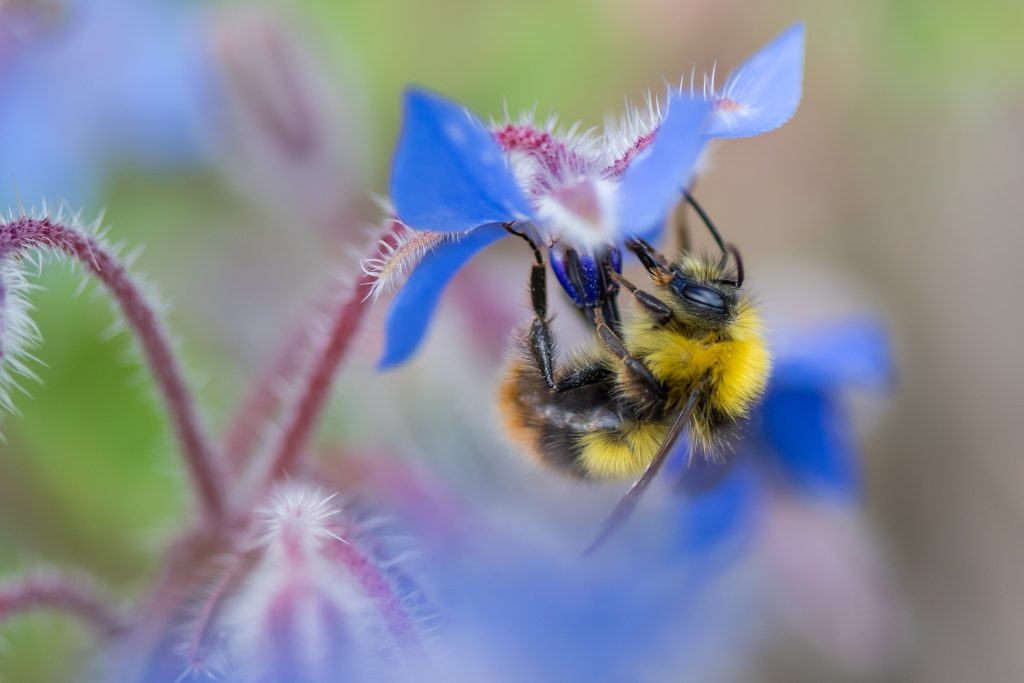
Goulson is a biology lecturer and leading expert in insect ecology, particularly bumblebees, as well as a highly respected scientific writer with several books and hundreds of published papers in his portfolio – it comes as no surprise that Silent Earth is both supremely well researched and beautifully written. It is written in five parts. The first, “Why Insects Matter”, is a fascinating delve into the significance of insects both to the natural world and to human society. With an expert eye, Goulson skillfully guides the reader through different aspects of their importance, from the multi-million pound service that dung beetles provide the farming industry each year in the UK alone to the vital role that pollinators play in underpinning ecosystems across the planet, and the value that insects have in their own right as beautiful, vibrant denizens of our planet. The author’s passion is infectious; it is difficult to read this section without becoming invested in the wondrous ranks of the planet’s invertebrates, making the threat of their decline feel all the more personal. 
In the next two parts, “Insect Declines” and “Causes of Insect Declines”, Goulson introduces the sources of evidence that can be drawn on to track insect declines and explores some of the reasons why society seems oblivious to our dwindling invertebrate fauna. He then moves on to explore in detail the various pressures upon their populations, examining and evidencing each before moving on to the next. Goulson writes with respect for the reader, never over-simplifying his prose while providing ample detail to engage any reader, be they a newcomer to the field, amateur enthusiast, ecology professional or academic. Particularly notable is the way in which Goulson details his own work, which has at times proved controversial among some parties. He consistently highlights the arguments of his critics, treating them with respect and validation. At some points he provides his rebuttal while at others he admits to the shortcomings of the relevant research, explaining why a different approach was impossible at the time. This is indicative of an attitude that permeates the book – the issues that he writes about are bigger than minor gripes with experimental methodologies, bigger than business margins or political leanings. He presents with a neutral eye the irrefutable reality that insects are vanishing at a terrifying rate, and unless action is taken the world is heading towards a very real disaster within generations. Though frequently distressing and at times heartbreaking, Goulson writes with a voice compelling and just witty enough to prevent the reader from becoming despondent. This book is not intended to drive us to despair, but to action. 
Part Four –  “Where Are We Headed?” – is a brief but poignant exploration of the author’s vision of the future. From another writer, this might seem like a flight of fancy, but from Goulson it comes across as a warning every bit as earnest and necessary as the hard science of the preceding chapters. It acts as a kind of crescendo, a snapshot of the future that the author is trying to warn us about, as well as a perfect segway into the final part. Perhaps most importantly after the relentlessly grim picture painted in “Causes of Insect Declines”, it ends with a ray of hope. 

The fifth and final part of the book is simply titled “What Can We Do?”. It lists from the point of view of the author – a researcher, educator, and father – the actions that should be undertaken by everyone in society, from members of the public to researchers, farmers and politicians, among others, to begin to turn the tide. Various key actions are explored in detail – the importance of instilling an environmental ethos in young people, of encouraging native plants in our towns and cities and overhauling the way in which we view farming. Finally, there is an extensive list of actions, large and small, that people can take, listed by occupation. This section is what the book has been building to, and it is worth reading for this alone. As usual, respect is paid to all viewpoints and all members of society. It doesn’t matter whether the reader is in a position where a free-range organic, locally sourced diet is financially viable or not – there will be other actions that they can take regardless of financial matters. Nor does it matter if they have beliefs, political or economic, that might conflict with the author’s. It is a call for society to overlook such matters which are, in the face of such a crisis, trivial. 
Silent Earth: Averting the Insect Apocalypse is, in my opinion, a masterpiece of popular science writing. It is a feat to present such dire information in a way that is not only readable, but also engaging and compelling – Goulson’s prose manages never to lose the reader for a moment. It is a stark, hard-hitting warning, but one that must be heard by as many people as will listen. Moreover, it goes far beyond the reactionary doomsayings sometimes written on the subject to provide an inspiring manifesto for change. It equips the reader with the knowledge that they need to understand the problem, and the actions they can take to enact this change. It leaves you with the impression that, if the message can get through to enough readers across the world, we might just be able to turn the tide and preserve the buzzing of bees, the chirping of crickets and the droning of cicadas to prevent the silence falling for good.  


Silent Earth: Averting the Insect Apocalypse
By: Dave Goulson


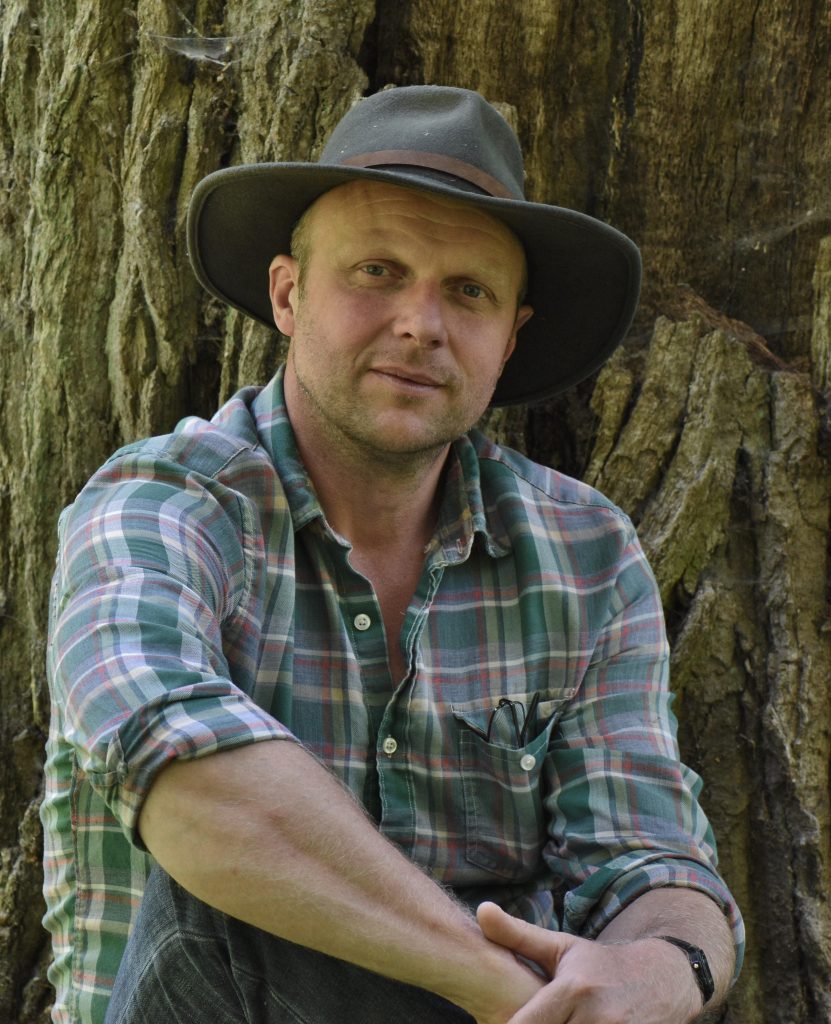
Author Interview with James Aldred: Goshawk Summer

James Aldred is an award-winning documentary wildlife cameraman and filmmaker. James has collaborated on numerous high-profile projects with Sir David Attenborough, including Life of Mammals, Planet Earth and Our Planet, resulting in several BAFTA/RTS nominations. He is also the author of The Man Who Climbs Trees.

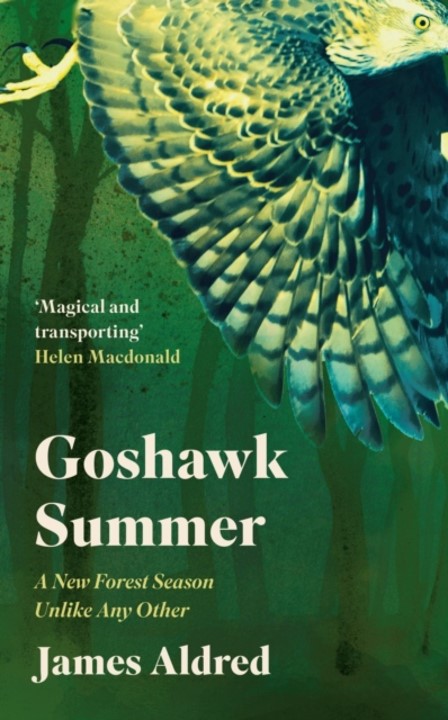
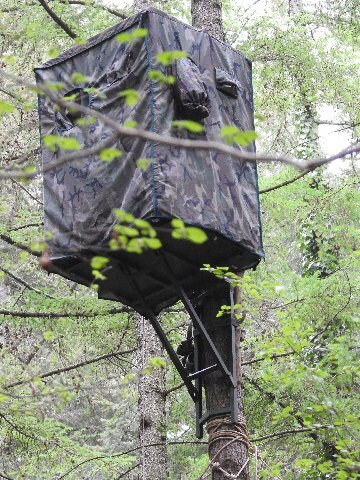
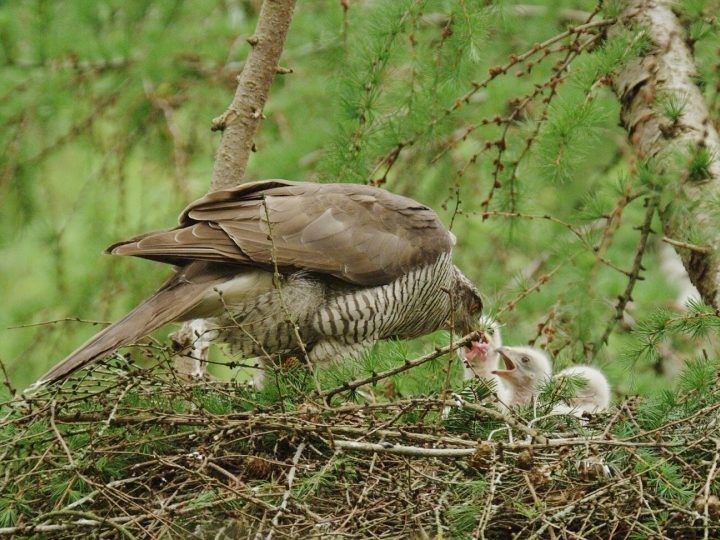
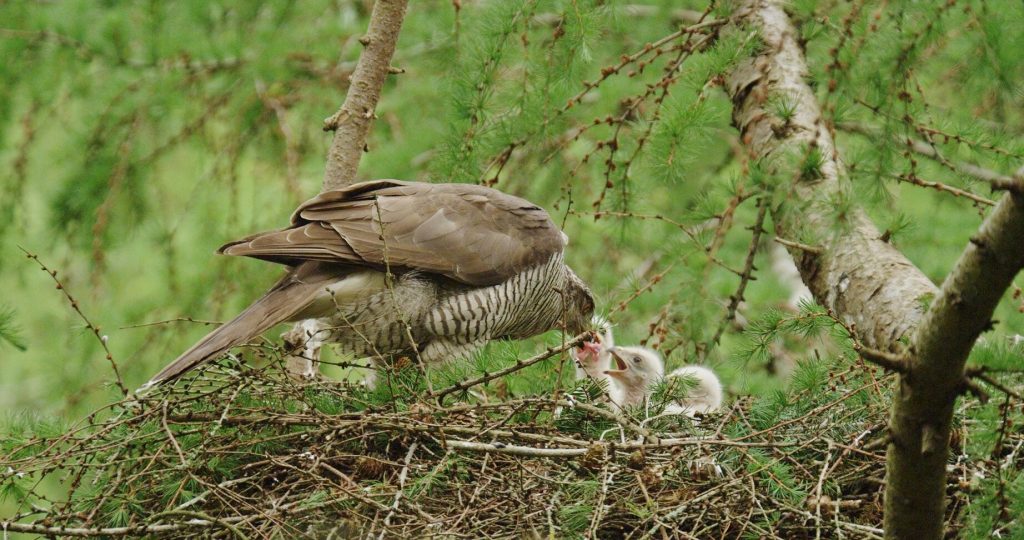
In his latest book, Goshawk Summer, James details his extraordinary and unique experience documenting a family of goshawks in the New Forest during the national lockdown of 2020. We have had the very fortunate opportunity to ask James some questions

Could you tell us about how you first came to be interested in the natural world?
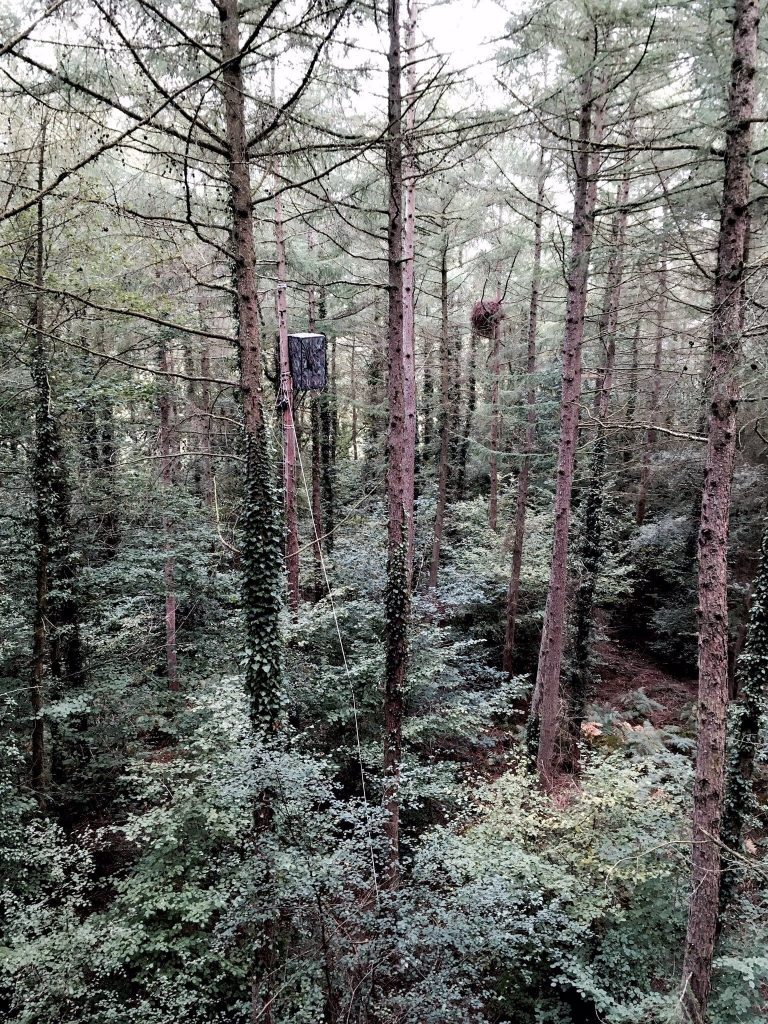
Through time spent outdoors in the New Forest, where I spent much of my childhood. My teenage obsession was tracking deer, particularly Red, which were quite scarce in the Forest during the 1980s. I also got into tree climbing at an early age. Many of my friends were training to be foresters and tree surgeons and they showed me how to use ropes to access the forest canopy. I immediately fell in love with this hard-to-reach, but wildlife-rich environment and regularly took my stills camera up with me to try and capture images of the New Forest from this unique perspective.

Travel restrictions due to the Covid-19 pandemic presented a unique opportunity to document nature with very little human interference. Do you think this period of time will have had any lasting impacts on the country’s wildlife?

Yes, but in a rather unforeseen way. The space provided by the initial lockdown period definitely helped those birds and animals with a shorter breeding cycle, but ultimately the lockdown period was too short to be of much lasting benefit to a lot of the larger wildlife, including large ground-nesting birds such as curlew. The levels of disturbance in the post-lockdown period were very high in some places and this had the unfortunate effect of causing problems for those species that had not yet completed their breeding season. Ironically though, these high levels of disturbance in the countryside in the immediate aftermath of lockdown may yet provide useful data in terms of how best to manage large visitor numbers in the future as our population increases to grow and national parks are placed under increased pressure.

To capture footage of the goshawks required time, patience and understanding, but your efforts were clearly rewarded. Do you have any particular highlights from your goshawk summer?

There were so many, but I think the nesting dynamics between an adult male and female were particularly fascinating. Their relationship was surprisingly complex, subtle and even-keeled for such a fiery bird. The male often covered the clutch to keep the eggs warm whilst the female fed off site, and was even allowed to feed the chicks himself on several occasions whilst the female stood by and looked on. Very unusual for Goshawk females to tolerate their mate being so close to the chicks like this.

For a young aspiring naturalist, a career as a wildlife photographer would seem to be an ideal choice, especially since our collective experience and knowledge is usually limited to what we see on film/television or on paper. Could you tell us a bit about the reality of what it’s like to be a wildlife cameraman?

The reality is very anti-social working hours, high levels of frustration and a huge impact on home life! But I wouldn’t change it for the world as it is undoubtedly one of the most soul-nourishing jobs you could ever hope to do, in my opinion. It’s a tough, highly competitive industry, but this doesn’t mean you can’t get in through gentle persistence and dedication. Knowledge is everything: read, watch and learn everything you possibly can about your chosen wildlife subject before even attempting to film it.


 

What’s next for you? Do you have any current or future projects planned?

I’m currently working on a large project commissioned by a popular US-based video-on-demand provider. I’ve just been filming in the Congo for them and due to head out to Borneo soon. I’m also working on an exciting UK-based project about rewilding, which is a subject I find particularly compelling and relevant. All the more so since it is UK based and has the potential to inspire the next generation of naturalists.


Goshawk Summer
By: James Aldred
Hardback | July 2021 


Lynx: Publisher of the Month

Lynx Edicions is a Barcelona-based publishing house known for their fantastic ornithology titles, alongside a varied collection of general natural history. Originally founded in 1989 to create the Handbook of the Birds of the World series, they have since expanded to over 150 titles, including field guides, monographs, and bird checklists. They continually produce exciting works, such as their most recent publication Seabirds: The New Identification Guide, a full, 600-page treatment of all known seabird species. NHBS is delighted to announce Lynx Edicions as our Publisher of the Month for August.

Throughout August we will have special offers on a selection of titles, giving you the perfect opportunity to explore their books. Browse a selection of highlights below, or Lynx’s entire range here.


Handbook of the Birds of the World (16-Volume Set + Special Volume)
Josep Del Hoyo (editor) et al.
SERIES: Handbook of the Birds of the World (HBW)
Hardback | £1,999.00 £3,375.00

Handbook of the Birds of the World (16-Volume Set + Special Volume) comprises all volumes of HBW, illustrating and describing in detail every species of bird in the world. This is the first work ever to illustrate and describe in detail every species of bird in the world, and also the first to verbally and visually portray each member of an entire Class of the Animal Kingdom.


All the Birds of the World
Josep Del Hoyo (editor)
Hardback | £64.99 £84.99

An easy-to-use, fully-illustrated volume of all the birds of the world. Created for a broad audience, from novice birders to expert ornithologists and anyone interested in the spectacular diversity of birds, this fascinating book has something for everyone to discover.


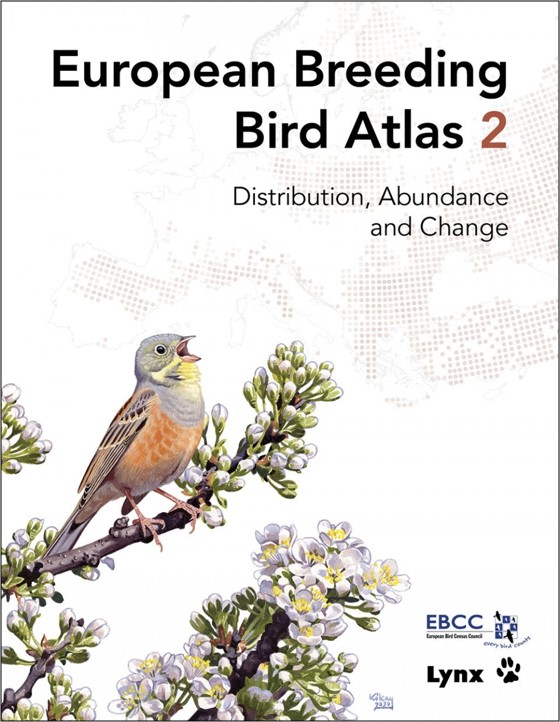
European Breeding Bird Atlas 2
Verena Keller et al.
Hardback | £69.99 £84.99

This book represents the most up-to-date source of information on bird distribution and change in Europe, and is a great contribution to the global aim of understanding biodiversity to ensure its conservation.


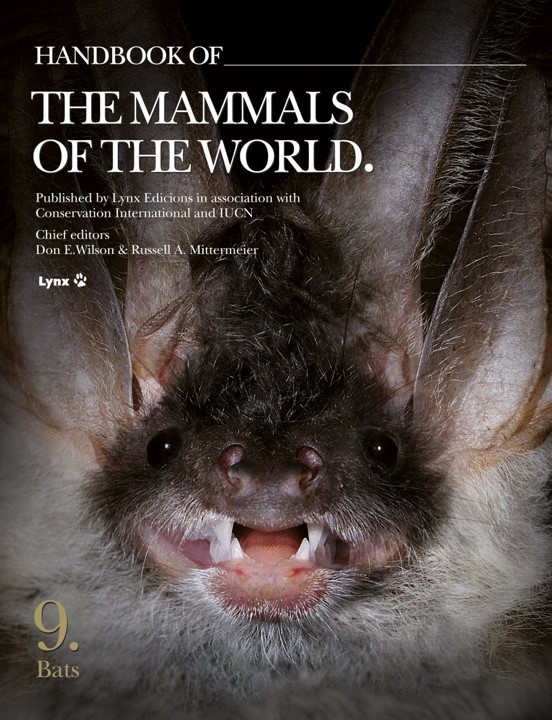
Handbook of the Mammals of the World
Don E Wilson et al.
SERIES: Handbook of the Mammals of the World (HMW)
Hardback | £140.00 £155.00

Volume 9 completes the Handbook of Mammals of the World series, and it deals with the bats, order Chiroptera.

Read our interview with the series creators


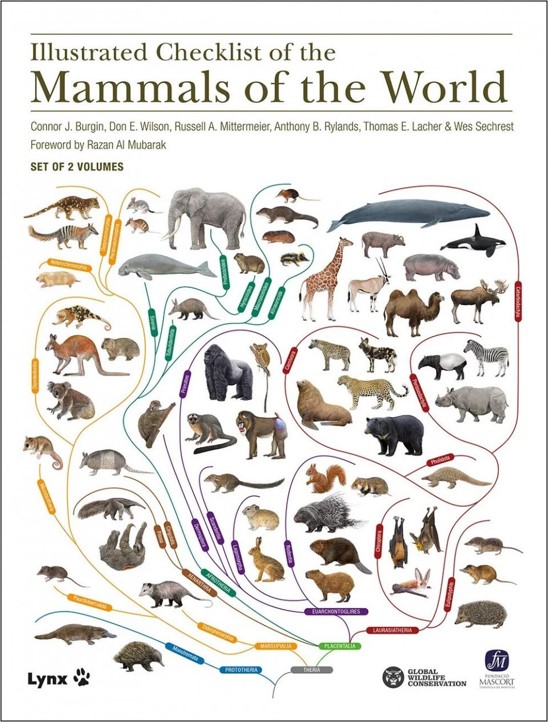
Illustrated Checklist of the Mammals of the World
Connor J Burgin (editor) et al.
SERIES: Handbook of the Mammals of the World (HMW)
Hardback | £180.00 £200.00

This series of 9 large-format volumes describes and illustrates every currently recognised mammal species, and gives a detailed overview of each mammalian family. It provides up-to-date information on the evolutionary relationships, natural history, ecology, and current conservation status for all mammals.


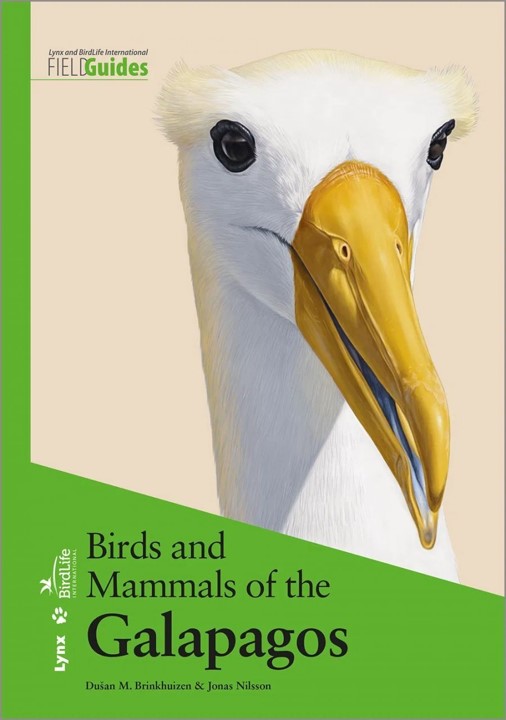
Birds and Mammals of the Galapagos
Dušan M Brinkhuizen (Author), Jonas Nilsson (Author)
SERIES: Lynx and BirdLife International Field Guides
Flexibound | £22.99 £29.99

This comprehensive field guide covers all of the birds and mammals known to occur in the Galapagos archipelago, providing the latest insights on field identification and taxonomy for challenging groups such as pelagic birds, Darwin’s finches, and cetaceans.


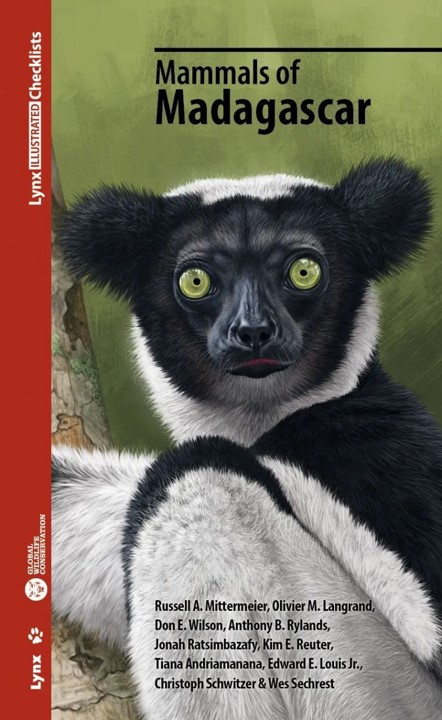
Mammals of Madagascar 
Russell A Mittermeier et al.
SERIES: Lynx Illustrated Checklists Collection
Paperback | £18.99 £22.99

The first book to describe and illustrate every mammal species found in Madagascar. Also includes those of the nearby islands of Comoros, the Seychelles, Réunion and Mauritius.


All prices correct at the time of this article’s publication.

Book Review: A Trillion Trees by Fred Pearce

A Trillion Trees is an optimistic take on the future of the world’s forests, with Fred Pearce believing that the damage humanity has inflicted can be undone, so long as nature is allowed space to recover. The book opens with an introduction to the myth and magic of forests. Through describing a botanical explorer’s conservation of orchids in the rainforests of Ecuador, recounting one of the author’s most memorable forest experiences (getting lost in a wood on the North Downs as a child), and presenting the varied reactions of early European explorers to the rainforests of the tropics, Pearce laments the loss of ‘primaeval wildness’ and the untouched forests of those times. 

Since 1992, Pearce has been writing for New Scientist magazine on the importance of trees, as well as their ownership, uses, protection, and destruction. He has spent his career contributing to multiple well-known publications, writing a range of books, and speaking on environmental issues such as carbon emissions, invasive species, and climate change. Despite forty years of continued reporting on global environmental issues, he maintains optimism for the future and for forest regrowth.

Pearce’s enthusiasm and respect for trees is clear throughout. This book celebrates trees, exploring their importance and the impact they have on the climate, the history of how our relationship with forests has changed, the recovery that is already taking place, and the future role of trees in an emerging community-centred approach to the land. Pearce intersperses topics on the politicisation of forest and climate research, the impacts of deforestation, and the damage of acid rain. He also includes some of his personal adventures, such as his visit to the ATTO, a 325m tall tower in the middle of the Amazon Rainforest, and the exploits of others, such as a bush pilot’s flight along the ‘flying river’ above the Amazon. 

A Trillion Trees champions the role of trees in more than just the fight against climate change, but also in the daily lives of everyday people. The tales of forest regeneration tell of the economic value of trees, through tourism, increased resources, and even ‘inspiration for artists’. Pearce presents the debate of rewilding versus replanting forests, asking who should be responsible for the regeneration of our forests and whether we should be taking an active role at all.  The ‘great forest restoration’, as Pearce puts it, is occurring less due to the many government plans and promises of replanting, and more through the process of rewilding. Where farmers and landowners have stepped back, Pearce notes that nature seems to move in, allowing much of the fields and pastures to revert to shrubland and then to woodland. The return of wildlife soon follows. 

In a world scrambling for solutions to combat climate change, the notion of stepping back and taking a passive role in regeneration may be a daunting one. However, it is not the only solution Pearce suggests. In the final section, Forest Commons, the author advocates for the rights of indigenous people to own and manage the land and forests within their traditional/ancestral territories. The rate of deforestation is far less in areas owned and managed by indigenous people than in other areas, even nature reserves, with communities seeming more resilient against threats such as illegal logging than government-owned parks. 

This book closes by paying homage to the wild spaces near the author’s home in London, their ability to filter out noise and pollution, and the calming, cooling effects trees can have in otherwise overheated cities. After a book full of adventure and debate, the postscript acts almost like the ‘forest bathing’ it discusses, ending the book in a calmer tone that calls for more woods full of darkness and gnarled, twisted yew trees and forests that harken back to the lost primaeval wilderness. 


The NHBS Guide to UK Marine Mammal Identification

Marine mammals, including seals and dolphins, are generally well-loved and charismatic species. Some people may be surprised by the variety of marine mammals we are lucky enough to have living around and visiting our coasts.

In this guide we will summarise a number of the marine mammal species you are most likely to spot in UK waters, and how to identify them. Identifying marine mammals can be a rather challenging task as often only a bobbing head or fin is visible, but knowing what features to look out for can sometimes be enough to make a fairly confident identification.

It is very important to note that seals and cetaceans are legally protected in the UK and all efforts should be made not to cause disturbance. It is strongly recommended that you do not approach marine mammals in person or by boat – any interactions should be fully on their terms.

Seals (Pinnipeds)

Two species of seal make our coasts their home: the common and grey seals. Both species are members of the family Phocidae, the true seals. Unlike other pinnipeds, such as sea lions, the true seals lack external ear flaps hence their other name, the earless seals.

Common Seal – Phoca vitulina
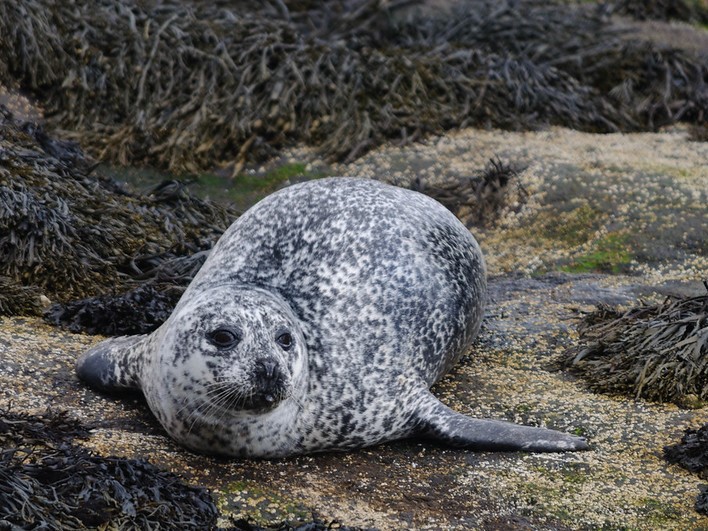
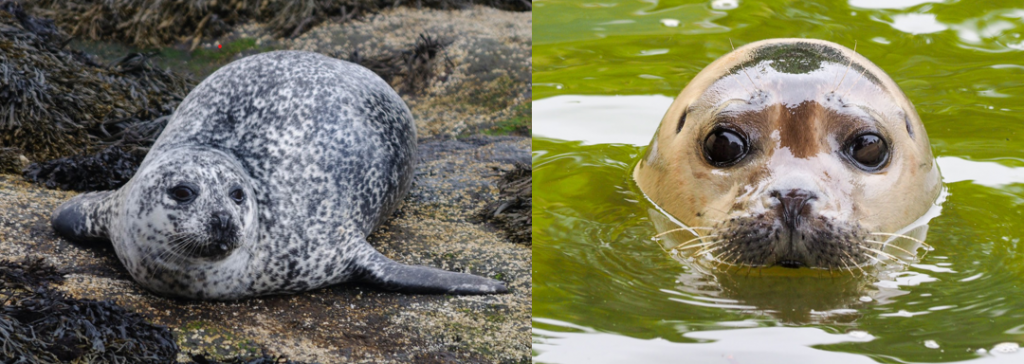
Common seal by Caroline Granycome (left – image cropped) and by Mike Prince (right – image cropped) via Flickr

Also known as harbour seals due to their common presence in these locations.

Appearance: Rather cat-like in appearance, with a relatively shorter snout than the grey seal and a more concave forehead. Their nostrils are closer together than the grey, creating a ‘V-shape’. Often the pelage (coat) is grey and speckled. Both males and females of this species look similar.

Behaviour: When on land, the common seal can be seen to lay on its side and hold its tail and head in the air forming a banana-like shape. They tend to be found in smaller aggregations on land than grey seals, leaving more space between individuals.

Where are they seen? Despite their name, common seals are seen less frequently than grey seals, with their population numbers less than half that of the grey. Abundant in northern England and Scotland, but rarely seen in the south. Generally seen coastally, or hauled out on rocks and beaches.

Grey Seal – Halichoerus grypus
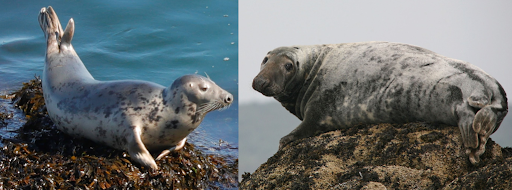
Grey seal female (left) and male (right) by Ian Watson-Loyd

The grey seal is the most common seal species in the UK, and the UK population makes up roughly 40% of the global population.

Appearance: Grey seals have a ‘blotchy’ pelage and tend to be darker than common seals. They are also larger in size, have a more prominent snout and their nostrils are separate and roughly parallel. Female grey seals can be more difficult to separate from the common seal as they do not have such a striking snout.

Behaviour: Rather gregarious seals, they often haul out in large colonies during the breeding and moulting season. Grey seals are generally curious and on occasion will approach a boat or humans in the water to investigate (see note about disturbance, any interactions should be on the animal’s terms).

Where are they seen? Common around the UK, particularly along the western coast, Scotland and Norfolk. Generally seen coastally, or hauled out on rocks and beaches.

Dolphins and Whales (Cetaceans)

At least 25 species of cetacean have been spotted in UK waters, although significantly fewer are regularly seen. Some species are resident year-round while others simply pass through seasonally. All cetaceans, including porpoises and dolphins, are technically whales, although commonly only the larger species are referred to by this name. They are split into two groups: the toothed whales that actively hunt prey and the larger baleen whales, that use sheets of keratin (baleen) to filter feed.

Toothed whales (Odontocetes)
Harbour porpoise – Phocoena phocoena
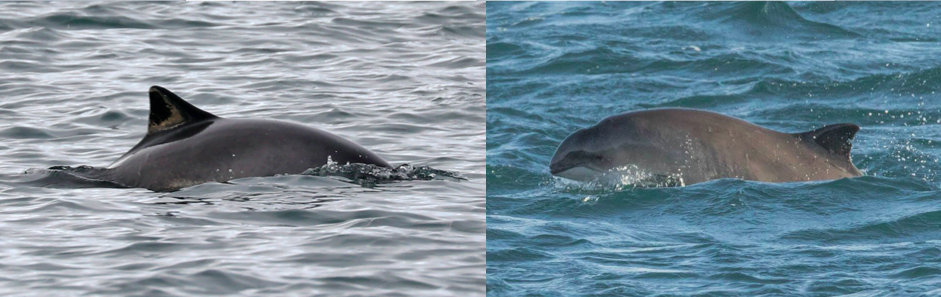
Harbour porpoise by Ian Watson-Loyd (left) and Ben Porter (right – image cropped)

Also known as the common porpoise. The name porpoise is derived from ‘porcus’, the Latin word for ‘pig’. Colloquially they are sometimes referred to as the ‘puffing pig’ due to the characteristic ‘chuff’ made when surfacing.

Appearance: The smallest cetacean in the UK, not exceeding a length of 1.5 metres. Their dorsal fin is small and triangular and their head is rounded at the front, lacking a clear beak.

Behaviour: Generally seen as individuals or in small groups with 2-5 members. They often surface three or four times before disappearing for a longer dive. Elusive and unlikely to approach boats.

Where are they seen? Seen nationwide in shallow, coastal waters.

Common dolphin – Delphinus delphis
Common dolphin and calf (left) by Gemma Haggar and Common dolphin by Gregory Smith (right – image cropped) via Flickr

Appearance: A sleek and agile dolphin with an elongated beak and sickle-shaped dorsal fin. Easily identified by their cream and white ‘hourglass’ colouration.

Behaviour: Acrobatic and generally inquisitive dolphins. Common dolphins are frequently seen bow-riding alongside boats and leaping from the water. On occasion, groups join together to form a super-pod of hundreds of individuals. If a group of cetaceans this large is spotted in UK waters, it is almost certainly common dolphins!

Where are they seen? They tend to spend most of their time offshore in deeper waters, so are more likely to be seen by boat rather than from the shore.

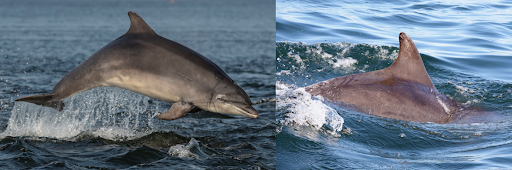
Bottlenose dolphin – Tursiops truncatus
Bottlenose dolphin by Caroline Legg via Flickr (left – image cropped) and dorsal (right) by Ian Watson-Loyd

Appearance: A large, muscular dolphin with fairly uniform grey colouration. British bottlenose dolphins are the largest in the world, presumably to allow them to cope with our colder waters.

Behaviour: Travel and feed in small-medium pods, although lone animals have been seen around the UK.

Where are they seen? Bottlenose dolphins can be spotted all around our coasts if you are lucky, but are most likely to be seen in the Moray Firth, Cardigan Bay and Cornwall, where resident pods reside.

Risso’s dolphin – Grampus griseus
Group of Risso’s dolphins by ‘National Marine Sanctuaries’ (left – image cropped) and Risso mother and calf by Adam Searcy (right – image cropped) from Flickr

Appearance: Unmistakable dolphins with distinct colouration except as calves. Risso’s begin their lives dark grey but become paler and scarred with age. These marks occur from social interactions with other Risso’s and during predation events, such as with squid.

Behaviour: Studies show Risso’s dolphins to be social animals that remain in long-established pods. They are fairly active at the surface of the water and can be seen ‘spy-hopping’ – holding themselves vertically in the water with only their heads bobbing above the surface.

Where are they seen? In deeper, offshore waters. Generally spotted along the west coast of Scotland and around the Isle of Man.

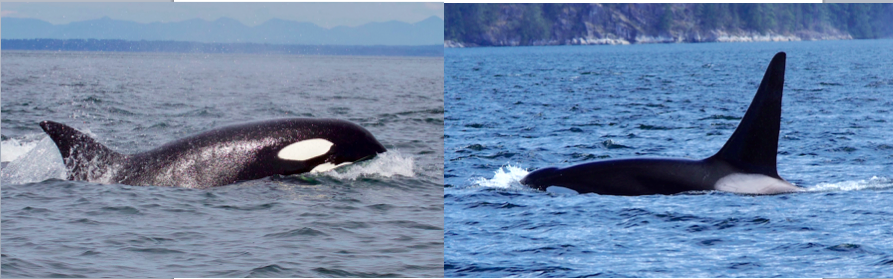
Orca – Orcinus orca
Orca (left – image cropped) by Glenn Brunette via Flickr and right by Gemma Haggar

Appearance: Striking and characteristic large black cetaceans with white eye and saddle (behind dorsal fin) patches. Male orcas have the largest dorsal fin of any species at up to 6ft, significantly taller than the female orcas.

Behaviour: Orcas are very social animals that remain with their maternal pod. Different groups display different feeding strategies, tending to focus on either smaller marine mammals or fish. Orcas are fairly active at the surface and can be seen spy-hopping or tail-slapping the water.

Where are they seen? The UK’s only resident pod (8 individuals) tends to be seen on the West coast of Scotland but were spotted roaming as far south as Cornwall in early 2021. Further transient groups appear in the summer but are generally limited to northern Scotland, Orkney and Shetland.

Baleen whales (Mysticetes)
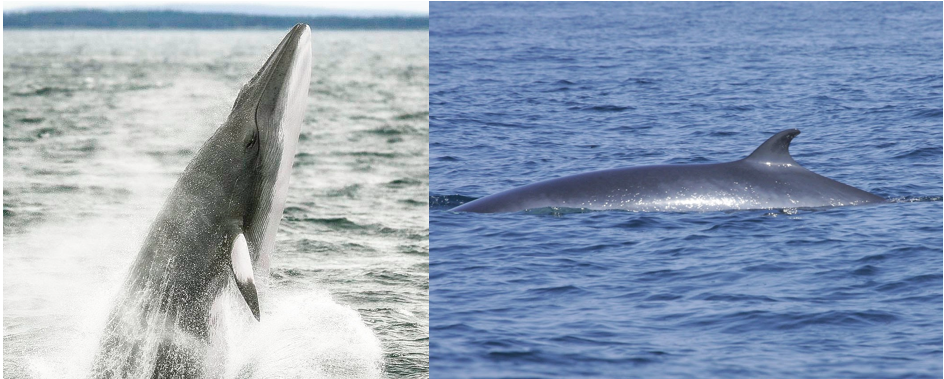
Minke Whale – Balaenoptera acutorostrata
Minke whale by Vaughn Mullen (left – image cropped) and Oregon State University (right – image cropped) via Flickr

Appearance: The smallest baleen whale seen in the UK at around 9 metres in length when fully grown. A dark grey whale with a white underside with a sickle-shaped dorsal fin located roughly two-thirds along the back. If you’re lucky enough to spot the pectoral (side) fins, the white ‘armbands’ will confidently identify this species.

Behaviour: Generally seen alone or in small groups. Minke can be seen to lunge feed at the surface, side-lunging with open mouths to take in large quantities of water and therefore prey. From afar, aggregations of seabirds can be the first hint of such a feeding event.

Where are they seen? Minke are the most commonly spotted baleen whale and can be seen nationwide. Sightings are significantly higher around Scotland and the south-west.

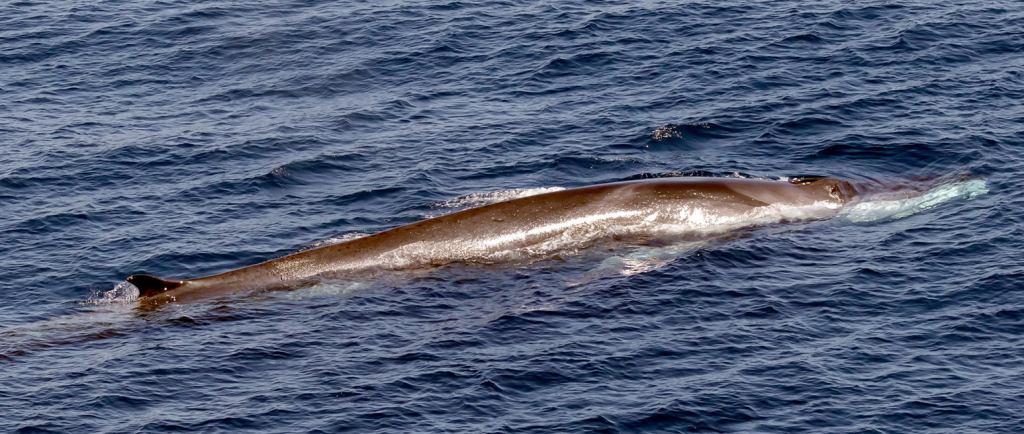
Fin Whale – Balaenoptera physalus
Fin whale by Charlie Jackson (image cropped) via Flickr

Appearance: The second largest whale in the world, reaching up to 24 metres in the northern hemisphere. Very dark colouration on the upper body, with the dorsal fin placed far back on the back. The fin whale has an asymmetrically coloured lower jaw, with bright white only present on the right-hand side (as shown in the above image).

Behaviour: Seen on their own, or in small groups of up to 7 individuals. When diving their tail does not rise above the surface, unlike some other large whales.

Where are they seen? Rare in UK waters, but most likely to be seen around northern Scotland and the Hebrides, although sightings have occurred off Cornwall and Ireland in recent years.


NHBS In the Field – The Anabat Scout product review

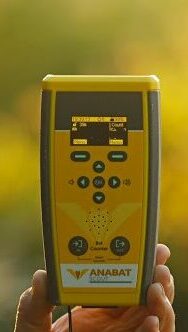
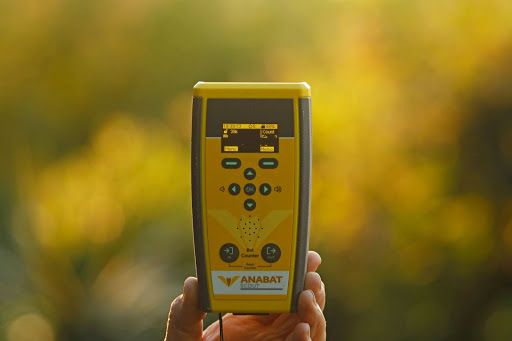
Here we review the Anabat Scout from Titley Scientific. The Scout is an easy to use active bat detector that offers excellent quality live audio and recording, plus many handy surveying features and durability that sets it apart from other detectors. It uses heterodyne, auto-heterodyne and frequency division audio that can be recorded in either full spectrum or zero crossing files.
Designed with professional surveyors as well as the more serious bat enthusiast in mind, the Scout is an ideal detector to take on bat emergence and transect surveys. This is thanks to great features such as a bat counter and GPS tracking transect mode.

How we tested

In early July 2021, we tested the Scout outside an old barn in South Devon to monitor the dusk emergence of several bat species. The building was known to host many common pipistrelles, brown long-eared, lesser horseshoes and some myotis species. We wanted to see how easy the detector was to use in the setting of a busy emergence and get a feel for its recording quality and its special features. The audio was set to auto-heterodyne to see how good this feature would be with multiple bats close by. Under the trigger settings is the option to adjust the sensitivity, which we set to high as there was unlikely to be too much undesired noise in this setting.

What we found

Firstly, it is worth noting just how lightweight (at 160 grams without batteries) and easy to hold the Scout is with its handy wrist lanyard and comfortable fit within your hand. These features are particularly important when undertaking long surveys and holding other equipment such as a clipboard for instance.

The OLED display screen is small, but bright, so key information such as peak frequency and time is easy to note in the dark. With just key information visible, the screen does not become too “busy” unlike some detectors, which in some circumstances is a real advantage as it avoids too much distraction. The buttons all glow in the dark, which we found very useful once it had become completely dark, as it kept navigation simple, without having to use a torch.

One of the Scout’s most handy features are the in/out bat counter buttons which enable you to easily tally the number of bats recorded coming out and back into a roost, without the need to look away to make notes and perhaps miss bats. The counter also time and date stamps and geotags each count (CSV file output), so saves you having to manually note this data.

The Scout has a transect mode which notes a GPS coordinate every second so maps out your route as you walk it. It also logs another GPS coordinate for every bat recording made which produces detailed transect maps.

We found that the adjustable volume control was very good and loud enough when needing to compensate for background noises such as a passing lorry.

Also noteworthy was the Scout’s ability to record voice notes. Once it has become fully dark or if you are surveying and need to keep your eyes fixed on bat watching, then the ease of just speaking into the device to add survey notes or further information is very helpful.

The Scout was very productive at picking up all the bats we encountered during the evening (although sometimes a brown long-eared emerged without calling and was missed). The auto-heterodyne tuning to the peak frequency was superb and saved much time. On a few occasions, we switched to manual heterodyne which enables you to adjust the frequency by moving the up and down arrows. This setting would be useful when first teaching beginners. The Scout’s range is also excellent, which was demonstrated when a high flying noctule was picked up probably over 30 – 40 meters away.

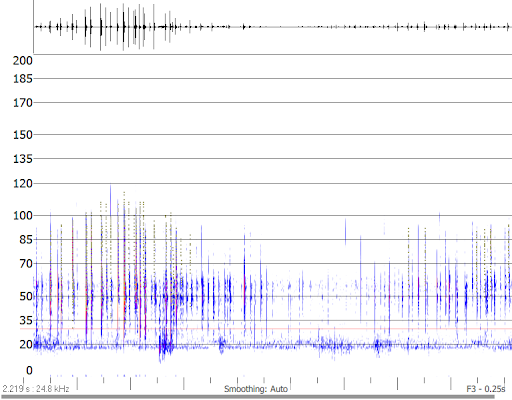
Two recordings taken on the Anabat Scout and visualised through the Anabat Insight Software.

The recordings were always clear through the built-in speaker, although there is also the option to attach a 3.5mm headphone jack. All recordings come with GPX track files attached. This gives accurate GPS data, that when viewed on the free software: Anabat Insight, a .KML (Keyhole Markup Language) file can be generated using Google Earth which will show your route with location tags for each bat recording.

All recordings were stored on an SD Card (recommended min: 32GB and max 512GB) and then output via WAV (Full spectrum) and Anabat sequence files (Zero Crossing).

Battery life lasted roughly 10 hours on 2 x AA (NiMh, Alkaline or Lithium) batteries with the remaining memory space and battery life displayed on screen, so we could keep a check during the evening.

Our Opinion

The Anabat Scout is certainly one of the easier to use, professional bat detectors available. It is highly accurate with its triggers and by being so lightweight and practical it makes for an ideal choice for both ecological surveyors and keen naturalists alike. The Scout has been designed with the needs of surveyors in mind and even those new to bat detecting, will find it simple to use and highly rewarding.

The main limitation found was that the Scout does not display full spectrograms like the Anabat Walkabout, therefore beginners particularly, may not find this detector so helpful for learning the differences in calls and identification in the field.

Overall, we feel the Scout offers very good value as an active detector that will fulfill the needs of most ecological surveyors. Its advantage of being incredibly easy to use and get to know, makes it fantastic for beginners, subcontractors and educational purposes also.


The Anabat Scout can be found here. Our full range of active bat detectors can be found here.

If you have any questions about our range or would like some advice on the right product for you then please contact us via email at customer.services@nhbs.com or phone on 01803 865913.


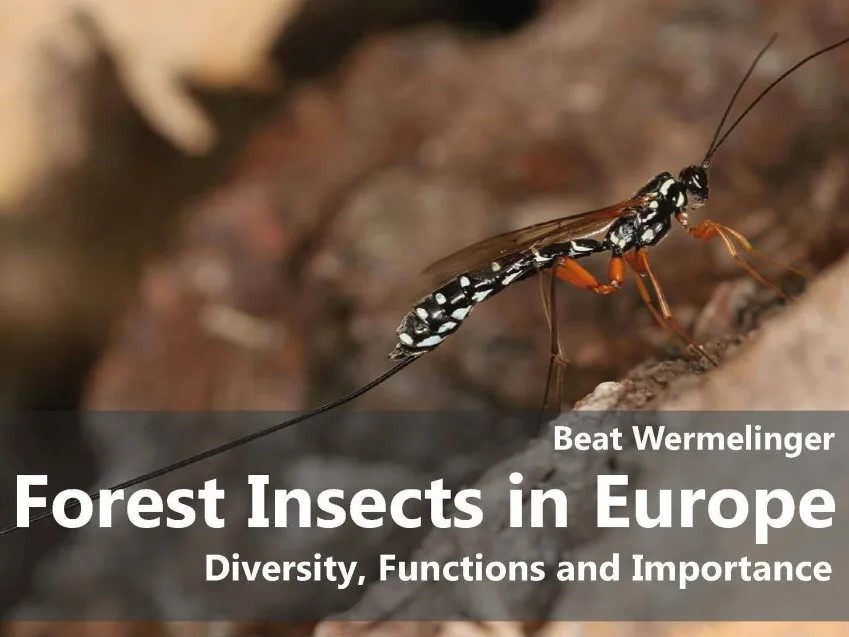
Author interview with Beat Wermelinger: Forest Insects in Europe

Forest Insects in Europe has been written not only with professional entomologists in mind, but also for nature lovers generally. The descriptions of the various roles insects play in forest ecosystems are intended to be easily comprehensible, but still scientific.

We recently caught up with the book’s author, Beat Wermelinger, who works as a Senior Scientist at the Swiss Federal Research Institute WSL. His research interests include bark beetles and natural enemies, Biodiversity, windthrow succession, climate change and neozoa. Beat answered our questions in German and our bi-lingual team members were excited to translate these to English for us. Discover more below in both languages.

1) Could you tell us a little bit about your background and how you came to write Forest Insects in Europe: Diversity, Functions and Importance?

I have been working at the Swiss Federal Research Institute WSL (Swiss Federal Institute WSL) (a forest research institute) for 30 years and until recently was the head of the entomology group. Simultaneously, I have also been teaching forest insects at the ETH Zurich. During this time, a large pool of knowledge and information has accumulated. I have also been a passionate insect photographer for just as long, which is reflected in an image database of around 16.000 insect photos. These two strands provided an ideal basis for conveying the importance and fascination of insects in one scientifically based book, which was also richly illustrated with photos, for both specialists and all those interested in nature.

Können Sie uns etwas über Ihren Hintergrund erzählen und wie Sie dazu kamen, Forest Insects in Europe: Diversity, Functions and Importance zu schreiben?

Seit 30 Jahren arbeite ich an der Eidgenössischen Forschungsanstalt WSL (Swiss Federal Institute WSL) (einem Waldforschungsinstitut) und leitete dort bis vor kurzem die Gruppe Entomologie. Zugleich unterrichte ich fast gleich lang zu Waldinsekten an der Hochschule ETH in Zürich. In dieser Zeit hat sich ein grosser Fundus an Kenntnissen und Informationen angesammelt. Ausserdem bin ich seit mindestens ebenso langer Zeit ein passionierter Insektenfotograf, was sich in einer Bilddatenbank von rund 16.000 Insektenbildern niedergeschlagen hat. Diese beiden Grundlagen boten eine ideale Basis, die Bedeutung und Faszination von Insekten in einem zwar wissenschaftlich fundierten, aber auch reich mit Fotos illustrierten Buch sowohl Fachpersonen als auch allen Naturinteressierten zu vermitteln.

2) The book tackles a vast array of insect groups and ecological functions – were there any particular challenges in collating so much information in one place?

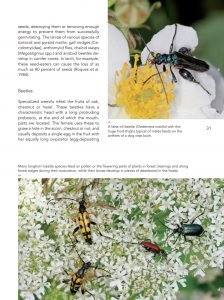
Much of the information comes from my readings or lectures. However, since I wanted to portray the ecological and economic importance of forest insects as broadly as possible, I still had to review a lot of published material. Above all, I wanted to support quantitative data with accurate citations. Owing to the Internet, such research is easier today than it was 20 years ago… Fortunately, I also had my own photographs on almost all topics.
Das Buch befasst sich mit einer Vielzahl von Insektengruppen und Funktionen – gab es besondere Herausforderungen, so viele Informationen in einem Buch zusammenzufassen?

Ein wesentlicher Teil der Informationen stammt aus meinen Vorlesungen oder Vorträgen. Da ich aber die ökologische und ökonomische Bedeutung von Waldinsekten möglichst breit darstellen wollte, musste ich doch noch Einiges an Literaturarbeit leisten. Vor allem wollte ich quantitative Angaben mit korrekten Literaturzitaten abstützen. Dank dem Internet sind solche Recherchen heute einfacher als noch vor 20 Jahren… Erfreulicherweise hatte ich auch zu fast allen Themen eigene Bilder.

3) Are there any insect groups that hold a particular interest for you?

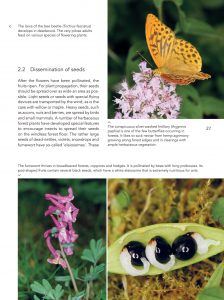
Professionally, I am mainly concerned with wood-dwelling insects. I am especially interested in the bark beetles, and their natural enemies as well as the intensive interactions with their host trees. Bark beetles are known to be pests, but they are also pioneers in the decay of wood. I also deal with the wood-dwelling longhorn beetles and jewel beetles, which often lend themselves to photography because of their size and beauty. For decades I have dealt with the development of their biodiversity after disruptive events such as storms or fire. The social red wood ants or the galling insects also fascinate me with their ingenious way of life.
Haben Sie eine Insektengruppe, an der Sie besonders interessiert sind?

Beruflich beschäftige ich mich vor allem mit holzbewohnenden Insekten. Mich interessieren die Borkenkäfer, ihre natürlichen Feinde und die intensiven Wechselwirkungen mit ihren Wirtsbäumen. Borkenkäfer sind zwar als Schädlinge bekannt, sie sind aber auch Pioniere beim Holzabbau. Weiter befasse ich mich mit den holzbewohnenden Bock- und Prachtkäfern (longhorn beetles, jewel beetles), die sich oft ihrer Grösse und Schönheit wegen auch zum Fotografieren anbieten. Über Jahrzehnte habe ich mich mit der Entwicklung ihrer Artenvielfalt nach Störungsereignissen wie Sturm oder Feuer beschäftigt. Auch die staatenbildenden Waldameisen (red wood ants) oder die gallbildenden Insekten (galling insects) faszinieren mich durch ihre ausgeklügelte Lebensweise.

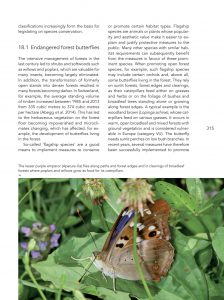
4) In Chapter 18, you discuss the severe and widespread decline of several insect groups. What has caused so many species to dwindle in European forests? And what is being done to address these threats?

There are two main causes for the decline in much of the forest insect fauna. The intensive use of wood in the past centuries has led to the fact that the forest area in Europe has decreased significantly over a long period of time, the trees no longer reach their natural age phase, and there were almost no dead trees that could slowly rot. In the case of many wood-dwelling insects that are dependent on so-called habitat trees or develop in decayed, thick tree trunks, this has led to a severe threat to their biodiversity. In recent decades, the forest area has increased again and in many countries the preservation of old trees and dead wood is being promoted. However, the impact is still modest.
A second reason is the fact that many shrubs and pioneer tree species such as willow and poplar have disappeared and the forests have often become more monotonous and closed. This mainly affects the forest butterflies. Today, clearings are created on purpose from which not only these insects, but also other light-loving forest species such as certain orchids or birds can benefit.

In Kapitel 18, erwähnen Sie den verbreiteten Rückgang mehrerer Insektengruppen. Was hat den Rückgang so vieler Arten in den europäischen Wäldern verursacht? Und was wird getan, um diese Bedrohungen zu begegnen?

Es gibt hauptsächlich zwei Gründe für den Rückgang eines grossen Teils der Waldinsektenfauna. Die intensive Holznutzung der vergangenen Jahrhunderte hat dazu geführt, dass die Waldfläche in Europa über lange Zeit sehr stark abgenommen hat, die Bäume nicht mehr ihre natürliche Altersphase erreichten, und fast keine abgestorbenen Bäume vorhanden waren, die langsam verrotten konnten. Dies hat bei vielen holzbewohnenden Insekten, die auf sogenannte Habitatbäume angewiesen sind oder sich in toten, dicken Baumstämmen entwickeln, zu einer starken Bedrohung ihrer Artenvielfalt geführt. In den letzten Jahrzehnten hat die Waldfläche zwar wieder zugenommen und in vielen Ländern wird der Erhalt von alten Bäumen und Totholz gefördert. Die Auswirkungen sind jedoch noch bescheiden.

Ein zweiter Grund ist die Tatsache, dass durch die Bewirtschaftung viele Sträucher und Pionierbaumarten wie Weiden oder Pappeln verschwanden und die Wälder oft monotoner und dunkler geworden sind. Dies wirkt sich vor allem auf die Wald-Tagfalter (forest butterflies) aus. Heute werden gezielte Auflichtungen durchgeführt, von denen nicht nur diese Insekten, sondern auch andere lichtliebende Waldarten wie bestimmte Orchideen oder Vögel profitieren.

5) A particular highlight of the book is the wonderful collection of insect photographs, most taken by you. Do you have any advice for people interested in insect photography?

The main problem when photographing small objects is always to be able to focus as much as possible on them. This requires a small aperture and therefore a lot of light. I photograph everything “hand-held” and therefore the shutter speed should be short. For these reasons, I almost always use a ring flash with separately controllable halves and 100 mm macro lens with my SLR camera. Nonetheless, even cameras with a small sensor (even mobile phones!) can nowadays produce surprisingly good images of larger, less volatile insects.

In order to photograph an insect as sharply as possible, you should position yourself so that the insect is parallel to the camera. At least the eyes should always be sharp. Of course, you can also choose a different level of focus for special effects.

In addition to technology, you need an eye for the little things in nature, patience and always a bit of luck! Knowledge of the behavior of certain groups of insects can also come to great advantage.

Ein besonderes Highlight des Buches ist die wunderbare Sammlung von Insektenfotos, die meisten davon von Ihnen aufgenommen. Haben Sie Tipps für Leute, die sich für Insektenfotografie interessieren?

Das Hauptproblem beim Fotografieren von kleinen Objekten ist immer, einen möglichst grossen Teil davon scharf abbilden zu können. Dies erfordert eine kleine Blende und damit auch viel Licht. Ich fotografiere alles “aus der Hand” und deshalb sollte die Verschlusszeit kurz sein. Aus diesen Gründen verwende ich mit meiner Spiegelreflexkamera und dem 100 mm Makroobjektiv fast immer einen Ringblitz mit separat steuerbaren Blitzhälften. Aber auch Kameras mit kleinem Sensor (sogar Handys!) bringen bei grösseren, wenig flüchtigen Insekten heutzutage erstaunlich gute Bilder. Um ein Insekt möglichst scharf abzulichten, sollte man sich so positionieren, dass das Insekt möglichst parallel zur Kamera steht. Mindestens die Augen sollten immer scharf sein. Natürlich kann man die Schärfenebene für spezielle Effekte auch anders wählen.

Zusätzlich zur Technik braucht es aber vor allem das Auge für die kleinen Dinge der Natur, Geduld und immer auch etwas Glück! Auch Kenntnisse des Verhaltens bestimmter Insektengruppen sind von grossem Vorteil.

6) What’s next for you? Do you have any projects that you are currently involved in that you would like to tell us about?

Professionally I am still working for another year, but of course my interest in insects will not vanish when I retire. I would like to use my pictures in other ways and maybe do another book. Above all, not surprisingly I would like to use the time to photograph insects in the great outdoors.

Was kommt als Nächstes für Sie? Haben Sie Projekte, an denen Sie aktuell beteiligt sind und die Sie mit uns teilen können?

Beruflich bin ich noch ein Jahr tätig, aber damit erlischt mein Interesse an Insekten natürlich nicht. Ich würde gerne meine Bilder noch anderweitig in Wert setzen und vielleicht noch ein weiteres Buch in dieser Art machen. Vor allem aber möchte ich die Zeit nutzen, um – wen wundert’s – in der freien Natur Insekten zu fotografieren.

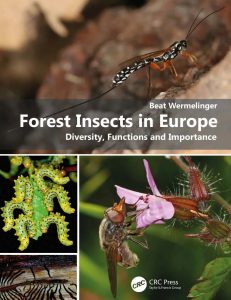
Forest Insects in Europe Diversity, Functions and Importance
By: Beat Wermelinger
Paperback | July 2021| £42.99 £49.99


All prices correct at the time of this article’s publication.