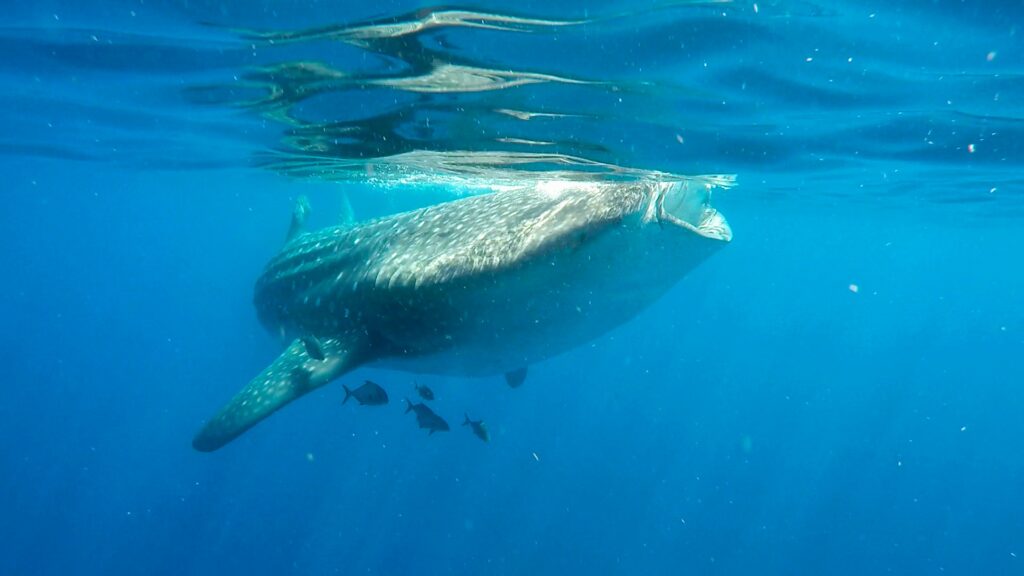
A whale shark was observed feeding at the seabed for the first time. This species usually filter-feeds on plankton at the sea surface; this unusual behaviour was filmed by an ecotourism guide. A new study, published in May 2023, proposes that whale sharks actively feed on benthic prey, either in deep water environments or where the abundance of this prey exceeds that of planktonic food sources.
Whale shark filter feeding at the surface. Image by Daniel Gillaspia via Flickr
Irish geneticists have discovered how some species may have been able to survive a mass extinction. Scientists at Trinity College Dublin unearthed a ‘dramatic evolutionary event’ in sturgeon and paddlefish populations. The species’ entire genetic makeup was ‘copied and pasted’ so that it had twice the genetic material it had before, providing more opportunities for mutations and evolution to occur. By strengthening their genetic mix, they might have been able to facilitate their re-establishment after a major mass extinction 200 million years ago.
Pollution
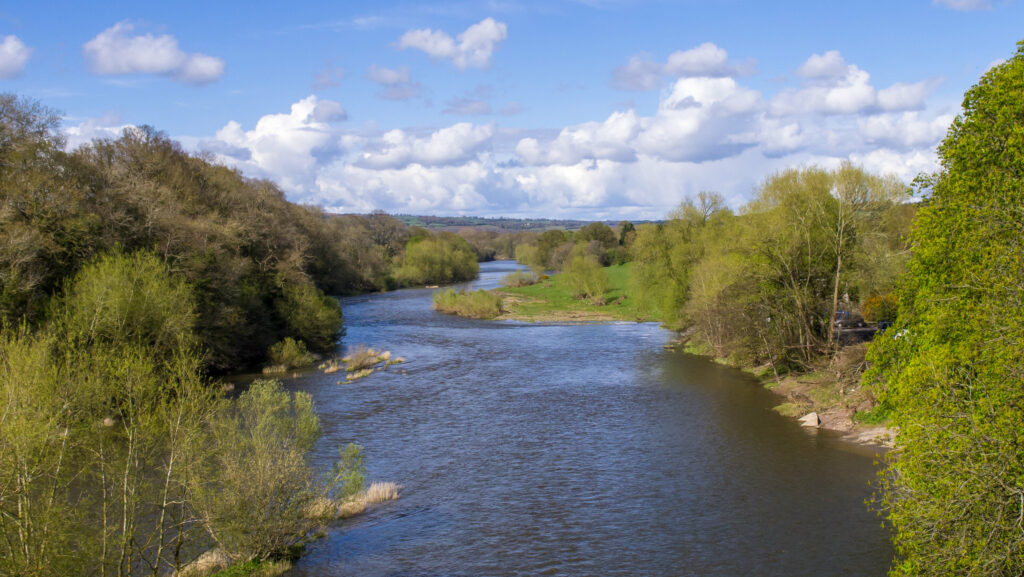
The River Wye has had its health status downgraded after a wildlife review by Natural England. The status changed from “unfavourable-improving” to “unfavourable-declining”, meaning that the river’s condition is worsening. The assessment showed that the river has experienced declines in certain key species, including Atlantic salmon and white-clawed crayfish. Previous studies linked this decline in condition to intensive chicken farming on the catchment.
The population of white-bellied heron in Bhutan continues to grow. Across 14 habitats, 27 individuals were recorded this year, four more than last year. This critically endangered species has fewer than 60 individuals worldwide and is found only in the Himalayan region in Bhutan, north-east India and Myanmar. As this is a top predator, its presence indicates a healthy ecosystem. Threats to this species and its habitat include fishing, local activities, natural resource extraction, development, ecotourism and timber and firewood.
The oak processionary moth, an invasive species, is thought to be spreading across south-east England. The government has introduced new legislation which aims to control the movement of oak trees in south-east England due to this rise in moth numbers. The toxic moths feed on the leaves of oak trees, affecting the health of oak trees by weakening them, making them more vulnerable to pests, diseases and drought.
Farmers are warning that England’s hedgerows are under threat from funding cuts. The transition to post-Brexit farming payments may mean that schemes to protect hedgerows could be lost. These habitats are vital for a number of species, including mammals, birds and pollinating insects, as they provide both food and shelter. The EU paid farmers under its subsidy scheme to keep hedgerows on their land, but they had to meet certain standards such as not ploughing to the base of hedgerows; not using fertilisers or pesticides within two metres of them; and not cutting hedgerows between 1st March and 31st August without good cause due to nesting birds. The government is ending these requirements by the end of the year.
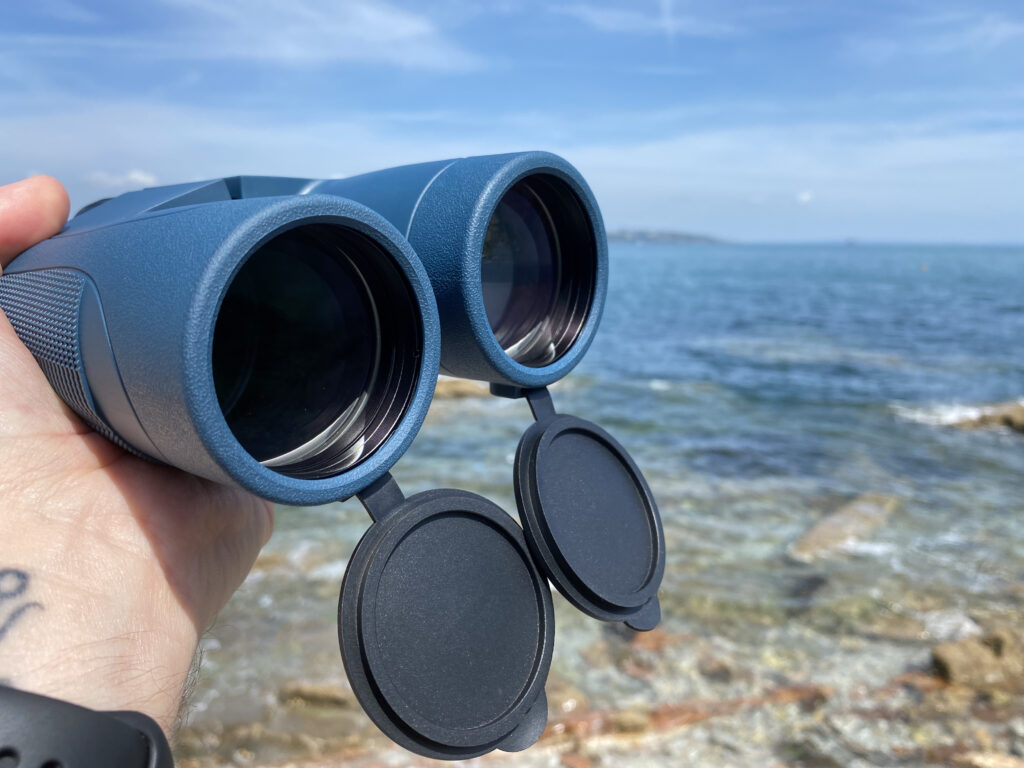
Choosing the right binoculars for either your hobby or work is something you should spend time on. While using binoculars on dry land sometimes has challenges with poor weather conditions, if you then wish to use a pair of optics out at sea, you should consider some additional points.
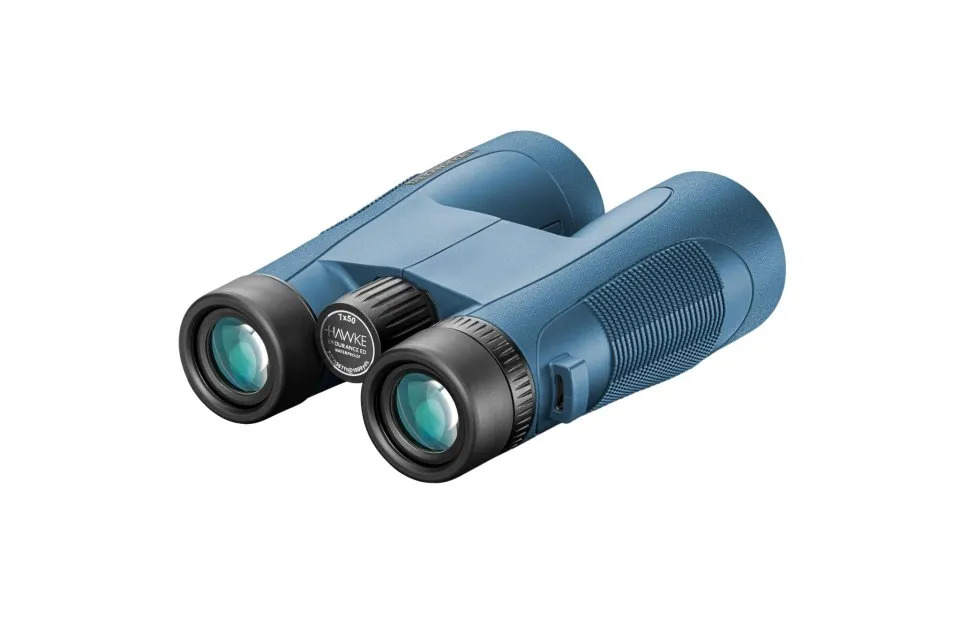
Wind, changing light conditions and weight are amongst the deciding factors on what makes a good pair of optics but add variable movement and changing landscapes to the list of elements to assess a pair of binoculars and you need to review your selection even more carefully. I’m very lucky to be able to have access to a boat for cetacean spotting and surveying. With that in mind, I decided to put the Hawke Maritime 7 x 50 binoculars through a test. But one thing that always makes it a challenge is the sea state, coupled with fast-changing light and weather conditions. Many of the points outlined below still form part of the normal considerations for use on land, but I’ve tried to extend the thoughts to the case of ‘at sea’.
What to look for in a pair of marine binoculars?
Crisp image
I have found that some binoculars are let down, not by the amount of light going through the lens elements, but by the overall quality of the image. While a bright image is important, chromatic aberrations can cause issues with the identification of surface or flying objects, especially when they are near the edge of the field of view. When the sea state is above 1 (calm or glass-like), there is more movement in the wave height and the amount of time you have to determine the object on the far side of the wave is reduced. Is it a bird, or a dorsal fin? At certain times of the year, it becomes even more of a challenge when you have adult guillemots on the surface of the water with their black and white bodies that can look like the dorsal fins of cetaceans.
This is also important with the large field of view. Maritime binoculars are all about the amount of vision you have. If you are a skipper on a boat and need to make decisions that affect the safety of your vessel, then seeing more of what is at a distance from you is critical. The choice of a BaK-4 Roof prism also plays into the quality of the image as this design of prism is reserved for higher-end products, and it shows with the quality of the image.
Brightness
The overall brightness of the image in all weather conditions is a big help. Timed survey periods for cetaceans rely on the confidence of the surveyor in deciding what they have seen. Whether the light is behind you or in front, the subject brightness needs to be enough to see markings, details of any dorsal fin damage (nicks, cuts), and for the assessment of age. Typically, the youngest calf will have fetal folds on its body, and a bright image will assist in making out those factors to allow assessment of age as they lose these folds after about six months. The Hawke Endurance ED Marine binoculars come in two sizes of front element, the larger giving a brighter image, but at the cost of weight (see below) with the larger binoculars being over 50 per cent heavier than the smaller version. I tested the 7 x 50 version which did not disappoint in brightness and, in my opinion, worth the cost in weight.
Wide field of view
The difference between the two main pairs of binoculars in the range from Hawke is dictated by size. The smaller version (not tested) is lighter in weight and contains a smaller front element (less brightness compared with their larger version) but with a greater field of view. This may be part of your decision for the selection as it is worth remembering that the amount of extra view may not be as much as you first thought. A useful tip to remember is that one degree of field of view equates to about 17.5 meters at a distance of 1000 meters. So the difference between the two versions of the maritime product is just under 23 meters of view!
Waterproof
The binoculars have been rated IP67. Technically they are waterproof and can be immersed in water for a short period of time without any problems. Hawke have given consideration to this by adding a set of float-assisted neck straps. Coloured bright yellow, it makes it easy to spot should you accidentally drop them over the side of the boat. The strap will keep them afloat. Needless to say, I didn’t test this benefit! It is also worth keeping a cloth with you for wiping away the salt water as, no matter how durable a pair of binoculars can be, sea spray will eventually damage the product.
Weight
The 7 x 50 binoculars compared with many others are no heavier than the average. However, my view on weight is reflected by the circumstances of use. If you intend to use them on a boat, and the conditions are less than calm, then holding them with one hand while using your other hand for stability is a great test. Long periods of time holding them in one hand can start to strain the wrist. Using the neck strap is important.
Conclusion
I found the 7 x 50 binoculars to be a joy to use. Overall, the specifications have been well thought through, and provide the majority of what you would need to survey. They even produce a version with a compass built in, which I can imagine would be a further benefit for recording the sighting direction when surveying. They are comfortable to hold and generate a bright image, making it easy to identify the subject matter. It should also be noted that Hawke provide a lifetime warranty on product defects, which I feel is an outstanding part of the manufacturer’s services.
The Hawke Endurance ED Marine Binoculars can be found here. Our full range of Hawke Optics binoculars can be found here.
If you have any questions about our range or would like some advice on the right product for you then please contact us via email at customer.services@nhbs.com or phone on 01803 865913.
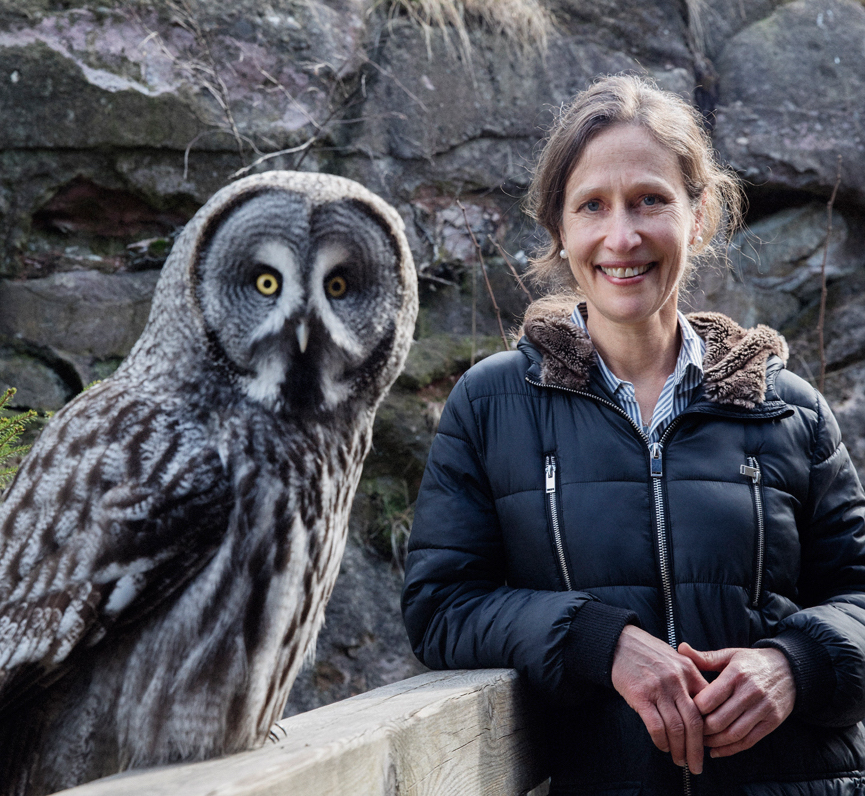
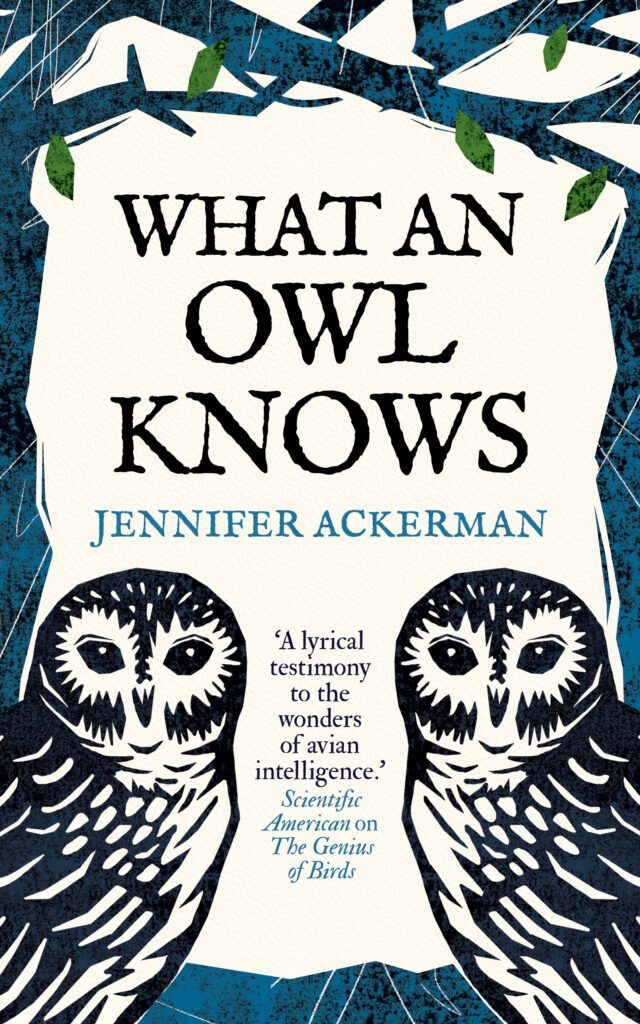
In What an Owl Knows, Jennifer Ackerman provides us with a magical and captivating glimpse into the lives of owls. Covering all aspects of their biology, ecology and evolution, the book takes us on a wonderful journey into their lives and those of the people who study them. Through her prose, facts and stories, we discover just why it is that these birds have been enthralling humans for so long, and why they are so intricately interwoven into our culture, art and language.
Jennifer Ackerman is an award-winning writer who wrote for National Geographic for seven years and has written extensively for many publications, including the New York Times, Wall Street Journal, Scientific American and Smithsonian Magazine. She is well known for her ornithology books including The Bird Way and The Genius of Birds, both of which celebrate the brilliance of birds through the light of new and continuing research into their biology, ecology, behaviour and cognition.
We were thrilled to chat with Jennifer about her most recent book, What An Owl Knows, as well as about owls’ reputation for wisdom, the incredible research that is shedding more light on their lives, and the mysteries that still remain.
Your most recent books, The Bird Way, The Genius of Birds and, to some extent, Birds by the Shore, have all focused on various aspects of bird behaviour and cognition. What inspired you to focus on owls for What An Owl Knows?
I wanted to focus in on a family or group of birds and take a deep dive into their biology and behaviour. I love birds, all birds. But owls? They’re unique in the bird world, night hunters with eerily quiet flight and extraordinary senses. When I started to think about writing a book about owls, they made my head sizzle with questions. What makes an owl an owl? How did owls get to be the way they are, so different from other birds? Why are they active at night? They have a reputation for wisdom, but are they in fact smart? I wanted to explore these questions and find out: What do we really know about owls? Quite a lot, it turns out. We’ve been studying them for a long time. But only lately have there been the advances necessary to solve some of the mysteries that have been around for centuries. Which made it a very good time to write this book.
Everywhere we look in the world, owls are intrinsically tied up in human art, culture and language. What do you think it is about them that captivates us so much?
It’s true, humans have been obsessed with owls for tens of thousands of years. Among the oldest examples of cave art ever discovered is an etching of an owl in Chauvet Cave in France 36,000 years ago. Now, all over the world, owls appear in stories and as symbols, sometimes of wisdom, beneficence and good fortune, and sometimes as emblems of evil and omens of death. I think it’s a combination of things that makes these birds so powerful. We see ourselves in them, with their round heads and big forward-facing eyes. Some species are cute, baby-like. But they’re also so different from us, creatures of the night, fierce in their hunting, so mysterious and uncanny. It’s this whole package of cute and brutal, familiar and strange, that makes these birds so exciting and sometimes, so troubling.
You mention near the beginning of the book that research into owls has, until relatively recently, been fairly sparse. What research techniques or tools do you think have allowed more progress to be made in recent years?
We have new “eyes” in the field—infrared cameras to see what’s going on with owls at night, radio tagging to track their movements and drones to explore remote owl habitats and peep into nests. New advances in satellite telemetry are illuminating the movements of owls over short and long distances. Remote acoustic monitoring—placing tiny audio recorders over large landscapes to listen in on owls—has helped us understand their populations and offered a window into their social lives. Nest cams have revolutionized the study of how owls raise their young, offering a 24-7 intimate look at interactions that would otherwise be impossible to observe. This technology is advancing new discoveries and also confirming observations by banders and other researchers who have been working in the field for decades.
Owls have long been associated with wisdom, although more recently, scientific studies have taught us that they aren’t as intelligent as previously imagined, especially in comparison to other birds such as corvids or parrots. Do you think this is accurate or simply a reflection of our tendency to view intelligence from a human perspective?
The science of understanding the minds of other animals is still in its infancy, and we still tend to view intelligence through our own lens. But there’s a growing awareness that there are different kinds of intelligence, different ways of knowing in the animal world that are hard to conceive of and hard to measure. On the question of owl intelligence, the science has been swinging back and forth. It’s true that owls may not be smart in the same ways that parrots and corvids are smart (and in the same ways we are smart). But they do have large brains for their body size, just as these other bird families do—and also, perhaps, ways of knowing that go beyond ours. People who train raptors used to consider owls not as bright as other birds, especially other raptors. But now that they’re beginning to understand the subtleties and complexity of owl behaviour and knowledge, they’re changing their tune. In their stories and in my conversations with other owl experts, I found plenty of good examples of intriguingly clever behaviour among owls.
What an Owl Knows delves deep into the science of owls and covers their adaptations, communication, courtship and breeding, as well as the lives of the people studying them. Following the incredible amount of research that you undertook, are there any questions or mysteries about owls that remain unanswered for you?
So many mysteries remain. We still have a lot to learn about basic things, like how many owls are out there and the details of how they’re moving around from season to season. Questions about their communication and their inner lives still abound. When one owl hoots or squawks or chitters at another, what is it really saying? How much information is packed into an owl’s vocalizations that we might be missing? When an owl is on a night hunt, what does it actually see and hear? And what is really going on in an owl’s mind?
What was the most fascinating thing you learned while researching this book?
I have to pick just one? Ok. I loved learning that burrowing owls—comical little owls that nest in the burrows of other animals like prairie dogs, woodchucks and armadillos—adorn the outside of their burrows with all sorts of weird and wonderful “treasures”: cornstalks and corncobs, bits of wood, bones, moss, swatches of fabric, bison dung, coyote scat, even pieces of concrete. Why? Why in the world would they expend energy on this sort of apparently frivolous decorating?
Finally, are you able to tell us what you are working on next?
I do have another book in the works, but I’m going to be owly about that and keep it a secret…
What an Owl Knows by Jennifer Ackerman is published by Oneworld Publications in July 2023 and is available from nhbs.com.
30 Days Wild is the UK’s biggest nature challange. Run by the Wildlife Trusts, this annual event is taking place between 1st – 30th June 2023. The event is suitable for people of all ages and backgrounds and aims to connect people with nature and increase their appreciation of the natural world by asking them to do one wild thing a day for the entire month. A five year review of 30 Days Wild participants found that people felt happier and healthier from taking part, with the effects lasting for at least two months afterwards.
This event has continued to grow, with the majority of participants in 2021 starting that the pandemic made them value nature more. Over two million people have taken part over the last nine years. Last year alone, over 500,000 people took part in the challenge, with popular activities including wildlife-watching, planting wildflower seeds and listening to birdsong.
Key themes of 30 Days Wild
For the first time, each week of 30 Days Wild will have a different theme. These are:
Tune into the senses
Movement and play
Learning and discovery
Helping nature
Emotional connection to nature.
These themes will take you on a week-by-week adventure, helping to guide you through the challenge to reach the 30 day target.
How to get involved
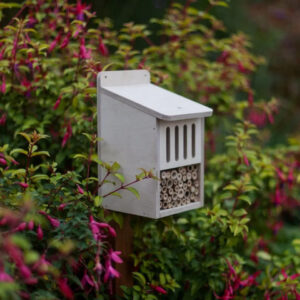
Bug Box Kit – an easy-to-assemble insect hotel
There are a number of easy ways to get involved in 30 Days Wild. The ten most popular activities in 2020 were: listening to birdsong, exercising outdoors, eating or drinking outdoors, identifying wildflowers, planting wildflower seeds, going on a bug hunt, hugging or admiring a tree, making a wildlife home such as a bird box or bee hotel, going barefoot on the grass and sketching, drawing or painting nature. Other ways to get involved include reading a nature book, exploring a reserve, having a plastic or waste free day, watching a sunrise or sunset, switching to a more sustainable household product, going litter picking or taking a nature photo.
If you’re looking for some inspiration for activities during the month, why not check out some of our guides?
If you’re interested in catching a glimpse of some bats in June, this guide includes the equipment you might need, the best times and places to go, and a general guide of what to do.
Hedgehogs are abundant in urban and suburban areas but are facing some serious threats to their populations. Now is a great time to look for hedgehogs, particularly if your garden is hedgehog friendly. This blog includes ways to improve the attractiveness of your garden to hedgehogs, tips for watching hedgehogs and some great books for further reading.
Owls are unable to digest certain parts of their prey, including teeth, bones, fur or feathers. These parts are regurgitated as a pellet, which can be very interesting to dissect. This guide provides information about where to find pellets, how to identify the species of owl the produced it, how to dissect a pellet and how to identify the contents.
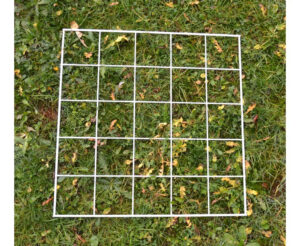
For those interested in exploring the plant life in their garden or local green space, especially right after No Mow May, this guide can help you. Quadrats are square frames which can be used to survey plants, to gain an estimate of total number of species, species richness, plant frequency and percentage cover.
While the ocean may still be very cold, snorkelling is a great way to experience many of the amazing species that inhabit our oceans. This guide includes advice on planning a trip, the equipment and method, and several species you might see along our coasts.
Beachcombing involves searching along the shoreline for interesting, valuable or even usable objects. It is a simple activity that you can do anytime you are at the beach and is a great way to learn more about your local coast. Its also a great way to help nature if you help to clear any plastic or fishing waste you come across.
While late autumn and winter are the more ideal times for planting trees and hedgerows, you can still get involved at this time of the year. Check out our article where we provide tips for the first time tree-planter and point you towards heaps of helpful information to ensure that your trees and shrubs get off to the best start.
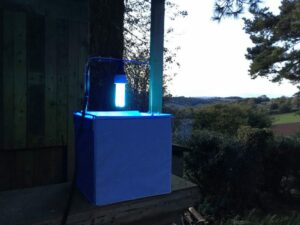
Moth trapping is a wonderful way to discover the species of moths that visit your garden. This blog includes guidance on the best time for moth trapping, where to put your trap and anything else you might need to know.
Rockpooling is an educational and enjoyable wildlife activity that introduces you to a diverse and colourful world of creatures, usually hidden beneath the waves. This guide includes information on how to plan a trip, which equipment and methods you should use, common rock pool inhabitants and recommended reading.
This is an excellent activity for children of all ages to introduce them to a wide range of plants, insects and amphibians, but its also perfect for adults who want to connect with nature. Our guide includes tips on what you’ll need, when and where to go, what to do and some great book and equipment suggestions.
Your garden can be a wonderful oasis for wildlife if you provide the right habitats and food. In this two-part series, we look at how to attract wildlife to your garden by including plants for pollinators and providing food for birds and mammals, and how to create nesting or overwintering habitats.
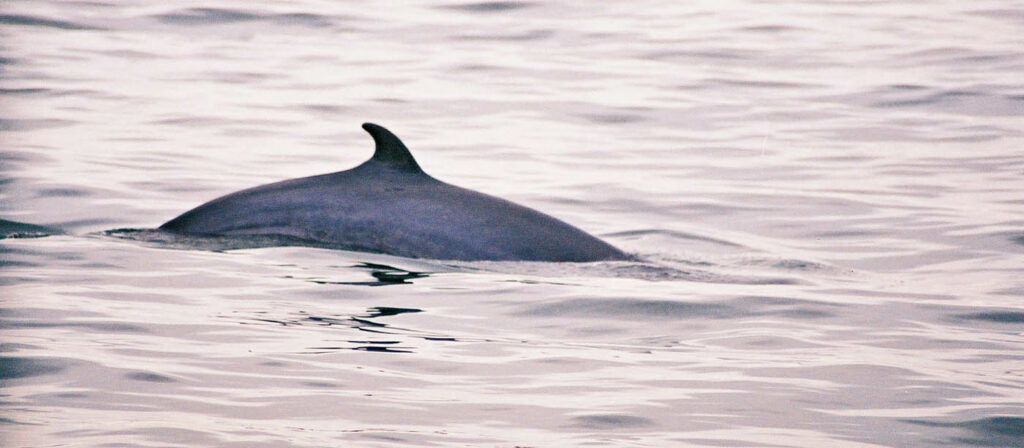
Catching a glimpse of a whale or dolphin whilst visiting the coast is a uniquely memorable experience and a few hours spent whale and dolphin watching is fun for all age groups. Our blog will help you know when and where to watch cetaceans, how to get started and where to submit any sightings.
You can sign up for 30 Days Wild on the Wildlife Trusts website, where you’ll receive a free downloadable or postal pack full of activities, games, wildflower seeds and a calendar to help you plan out your activities. There are also packs for businesses, schools and care homes.
Let us know in the comments what you plan to do for 30 Days Wild!
Recommended reading
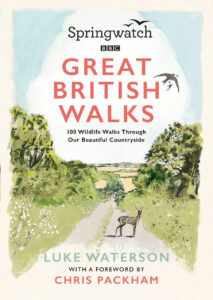
Springwatch: Great British Walks: 100 Wildlife Walks Through Our Beautiful Countryside
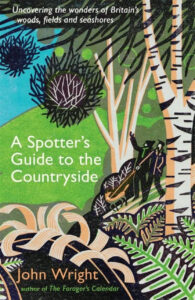
A Spotter’s Guide to Countryside Mysteries: From Piddocks and Lynchets to Wtich’s Broom
Master of Field Arts
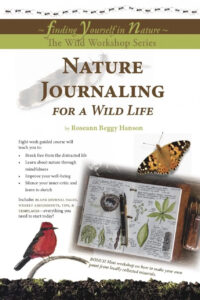
Nature Journaling for a Wild Life
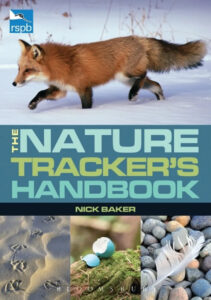
RSPB The Nature Tracker’s Handbook
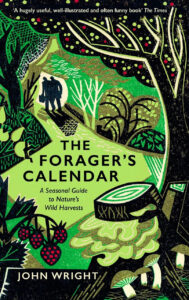
The Forager’s Calender: A Seasonal Guide to Nature’s Wild Harvests
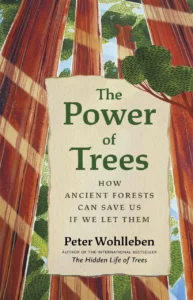
The Power of Trees: How Ancient Forests Can Save Us if We Let Them is forester Peter Wohlleben’s follow-up to his New York Times bestseller, The Hidden Life of Trees. Throughout this eye-opening book, Wohlleben describes how trees pass knowledge and their ability to survive climate change down to future generations. He is also unsparing in his criticism of those in positions of economic and political power who plant trees solely for logging and virtue-signaling, while continuing to ruthlessly exploit nature.
Peter Wohlleben
The Power of Trees is an impassioned plea for the preservation of nature’s incomparable biodiversity, not just for the sake of the trees, but also for all of us. Author Peter Wohlleben kindly agreed to answer our questions, discussing topics such as what inspired him to write this latest follow-up, the most effective ways to battle misinformation and his current and future projects. His new book was published by Greystone Books in April and is available at nhbs.com.
After your highly successful book, The Hidden Life of Trees, what inspired you to write this follow-up?
Research into trees and forests is progressing rapidly. Almost every week, something new and surprising is discovered. Also, I am seeing for myself the way trees in the forest are reacting to climate change. And not all the news is bad. Trees react and learn, they adapt, which gives us hope that they will be around for a long time.
Nach der Veröffentlichung Ihres erfolgreichen Buches, ‘The Hidden Life of Trees’, was hat Sie dazu inspiriert einen zweiten Teil herauszubringen?
Die Forschung zu Wald und Bäumen schreitet rasend schnell voran. Fast wöchentlich gibt es überraschende neue Erkenntnisse, zudem beobachte ich selbst in den Wäldern die Reaktion der Bäume auf den Klimawandel. Und es gibt nicht nur schlechte Meldungen: Bäume reagieren und lernen, passen sich an und machen so Hoffnung, dass es sie auch noch lange geben wird.
In Chapter 1 ‘When Trees Make Mistakes’, you make a very interesting point about how trees growing in a community can support one another through stressful periods, while ones growing away from woodland are ‘on their own’. Given the increasing fragmentation of our woodland habitats, do you think this lack of a network between trees will exacerbate the impacts of climate change?
That’s right. We urgently need larger forests. In Germany, for example, the forest is divided into about 2 million fragments. This reduces the trees’ ability to cool the landscape and create rain clouds. This is why when we rewild landscapes, as the nations of the world agreed to do in Montreal, we should pay attention to creating large contiguous natural areas.
Im ersten Kapitel, ‘When Trees Make Mistakes’, machen Sie eine sehr interessante Beobachtung, dass Bäume, die in Gemeinschaft wachsen, sich gegeseitig in stressigen Zeiten unterstützen können, während jene die nicht in Gemeinschaft leben, ‘alleine’ sind. Wenn man bedenkt, dass der Lebensraum Wald immer mehr zersplittert wird, glauben Sie, dass die Abwehsenheit einer solchen Gemeinschaft einen Einfluss auf die Auswirkungen des Klimawandels haben kann?
Richtig – wir brauchen dringend größere Wälder. In Deutschland etwa ist der Wald in rund 2 Millionen Fragmente zergliedert. Die Fähigkeit, die Landschaft zu kühlen oder Regenwolken zu erzeugen, leidet darunter. Deshalb sollten wir bei der Renaturierung der Landschaft, wie sie in Montreal von den Nationen der Welt beschlossen wurde, darauf achten, große zusammenhängende Naturgebiete zu schaffen.
Wood and wood-derived products are so integrated into our ways of life, from building materials to toilet paper, and it is often seen as the more environmentally friendly, ‘sustainable’ option compared to material such as concrete. Do you think it’s possible for us to move towards less destructive forestry practices and still be able to use this material at such a large scale, or will usage need to be adapted as well?
To harvest wood, we need forests, that’s pretty obvious. At the moment, however, the question we always focus on is how we can satisfy our demand for wood, without giving much thought to how the forest itself is going to survive. We need to move the survival of the forest front and center in our discussions. Only then will we be able to answer questions about how much timber can be harvested without damaging the ecosystem too much. Trees, after all, produce biomass to meet their own needs and not the needs of sawmills.
Wälder und deren Produkte sind so sehr in unsere Lebensweise integriert, von Baustoffen bis hin zum Toilettenpapier, welche oftmals als umweltfreundlichere und nachhaltigere Optionen im Gegenzug zu Materialen wie Beton gelten. Ist es Ihrer Meinung nach möglich, dass wir uns weniger zerstörerische Praktiken in der Forstwirtschaft aneignen können und dennoch Materialien in dem gleichen Ausmaß verwenden können wie bisher, oder muss dies auch angepasst werden?
Um Holz zu ernten, brauchen wir Wald – eine Binsenweisheit. Doc aktuell stellen wir immer zuerst die Frage, wie unser Bedarf nach Holz befriedigt werden kann und weniger, wie der Wald überlebt. Deshalb muss das Überleben des Waldes ins Zentrum unser Bemühungen gestellt werden. Erst anschließend können wir die Frage beantworten, wie viel Holz geerntet werden kann, ohne das Ökosystem zu sehr zu beschädigen. Denn die Bäume produzieren die Biomasse ja für ihre Zwecke, nicht für das Sägewerk.
COP26 in 2021 produced a pledge signed by over 100 nations to halt and reverse deforestation by 2030, though it only refers to net deforestation, with forest loss being replaced ‘sustainably’. Why do you think the value of ancient woodlands is so often overlooked when policies surrounding climate change are made?
Honestly, I don’t know. Way back around 1800, the world-renowned naturalist Alexander von Humboldt described the importance of forests for cooling landscapes and creating local rainfall. Modern satellite research confirms that old-growth forests are especially good at doing this. And yet, these days, forests are viewed mainly in terms of carbon storage. That’s far too narrow a view.
Bei COP26 in 2021 unterzeichneten über 100 Nationen das Versprechen die Entwaldung bis 2030 einzustellen bzw, rückgängig zu machen, jedoch geht es lediglich um die Netto-Entwaldung und den nachhaltigen Ersatz von bereits abgeholzten Wäldern. Warum werden alteingesessene Waldlandschaften Ihrer Meinung nach oft außer acht gelassen, wenn es darum geht Richtlinien zu erstellen?
Ich weiß es ehrlich gesagt nicht. Schon Alexander von Humboldt, der weltweit berühmte Naturwissenschaftler, hat um 1800 die Wichtigkeit der Wälder für die Kühlung der Landschaft und die lokalen Regenfälle beschrieben. Moderne Satellitenforschung bestätigt, dass gerade alte Wälder dies besonders gut können. Doch aktuell wird Wald überwiegend unter dem Gesichtspunkt der Kohlenstoffspeicherung betrachtet. Das ist viel zu kurz gesprungen.
Part 3: ‘Forests of the Future’ mentions that climate change is often blamed for the impacts of mismanaged forests. What do you believe are the most effective ways to combat this misinformation?
The only thing you can do is to push back. And that is exactly what motivates me in my work. I educate the public about what is really going on so they can decide for themselves what needs to be done. That is why I write books and travel to give presentations, and why I have established a new course (social and ecological forest management) at Eberswalde University for Sustainable Development. My goal is to create an emotional connection between people and trees. Trees make people happy!
Teil 3: In ‘Forests of the Future’ sprechen Sie davon, dass der Klimawandel oft für die Auswirkungen von schlecht geführten Wäldern verantwortlich gemacht wird. Was sind Ihrer Meinung nach die effektivsten Methoden um die Verbreitung solcher falschen Informationen zu vermeiden?
Da kann man nur gegenhalten. Das ist genau der Grund für meine Motivation: Die Bevölkerung über die wahren Hintergründe zu informieren, damit sie selber entscheiden können, was zu tun ist. Deshalb schreibe ich Bücher, deshalb reise ich zu Vorträgen, deshalb habe ich einen neue Studiengang an der Hochschule Eberswalde initiiert (sozial-ökologisches Waldmanagement). Mein Ziel: Menschen und Bäume emotional zu verbinden. Bäume machen glücklich!
One of the main solutions that a number of people are beginning to promote is the stepped back approach of allowing nature to regenerate without serious hands-on management. In a world where people often want to see governments taking action to help nature, do you think this method would be accepted by the public?
There’s no quick fix. People want to help. They want to actively participate in making everything better. But our activities lie at the heart of the problem. It’s difficult for us to step back and simply observe. Nature has been healing itself for hundreds of millions of years and it does this better without any help from us. The solution is to elevate the art of observation. If you visit the same places for years and take photographs, you see how the landscape recovers and changes for the better. This gives people hope and makes them happy! It’s the best cure for “climate depression”.
Eine der Hauptlösungen, die mehr und mehr Aufmerksamkeit bekommt, ist es, der Natur die Möglichkeit zu geben sich selbst zu regenerieren ohne größere Eingriffe. Kann Ihrer Meinung nach in einer Welt, wo Menschen von der Regierung Hilfe für die Natur erwarten, solch eine Methode öffentlich akzeptiert werden?
Das ist ein langer Weg. Menschen wollen helfen, wollen aktiv umgestalten, um alles besser zu machen. Doch unsere Aktivitäten sind ja Kern des Problems. Sich zurücklehnen und zuzuschauen, wie die Natur es seit Hunderten von Millionen Jahren immer noch besser macht, ist schwierig. Der Ausweg: Wir sollten das Beobachten thematisieren. Wer immer wieder dieselben Orte über Jahre hinweg aufsucht und auch Fotos macht, sieht, wie sich die Landschaft erholt und positiv verändert. Das macht Hoffnung und macht glücklich! Es ist das beste Mittel gegen die “Klimadepression”.
Do you have any current projects or plans for the future that you could tell us about?
I’m still writing books of course and I work nationally and internationally with our non-profit organization to prevent illegal clear-cutting and bring back old-growth forests. I also work at our forest academy almost every day (www.wohllebens-waldakademie.de) to tell people more about the wonder of trees. Forests are endlessly fascinating and you never run out of things to discover–I am still learning something new every day.
Haben Sie zukünftig Projekte oder Pläne, die Sie hier gerne besprechen möchten?
Ich schreibe natürlich weiter Bücher, kümmere mich national und international mit unserer gemeinnützigen Organisation um die Verhinderung illegaler Kahlschläge und die Rückkehr der Urwälder. Daneben arbeite ich fast täglich in der Waldakademie (www.wohllebens-waldakademie.de), um Menschen das Wunder der Bäume näher zu bringen. Wald ist so faszinierend, dass es unendlich viel zu entdecken gibt – ich lerne also jeden Tag immer noch dazu.
Answers translated from German by Jane Billinghurst.
The Power of Trees: How Ancient Forests Can Save Us if We Let Them was published by Greystone Books in April 2023 and is available from nhbs.com
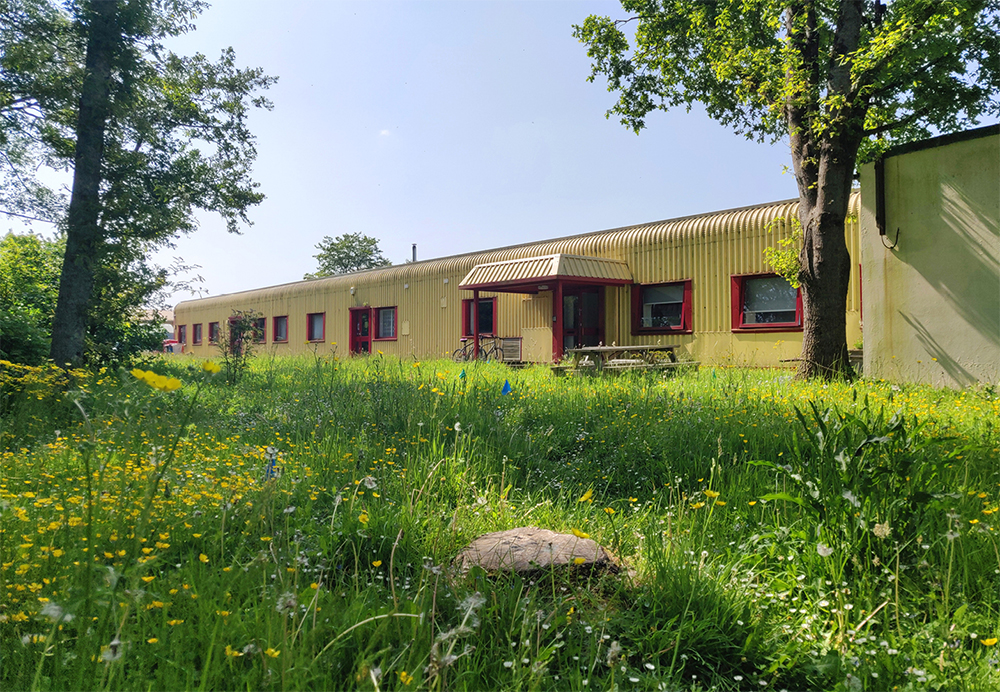
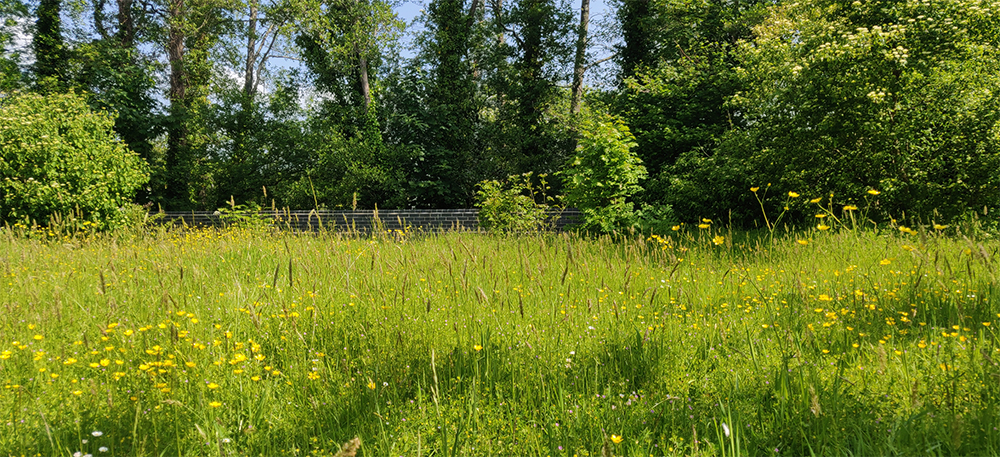
In Spring 2023 NHBS have, for the third year running, participated in Plantlife’s #NoMowMay initiative. We’ve requested that the grass areas around our premises are spared from mowing for the duration of the month of May, allowing a host of flowering plants to expand and in some cases complete their flowering cycle.
May is a vital time in the lives of many flowering plants, as they grow up in a rush after the winter months of dormancy in the soil to meet the pollinators upon whom they rely for regeneration. In our gardens and municipal green spaces, we tend to keep lawns tamed and green by regularly mowing and clearing out flowering plants in favour of a neat and uniformed low-cut grass. This has benefits for us in some of our recreation activities, but it wreaks havoc on our ecosystems. If pollinating invertebrate species can’t find the flowers they rely on, they disappear from an area, which also has a knock-on effect on the species that need the invertebrates as a food source, and the flowering plants that need them to spread their pollen and reproduce. Over time, this fragments habitats and drives down both biodiversity and abundance of species.
So, by committing to #NoMowMay, no matter what size of a green space you have, you offer real potential for reconnection between plants and their pollinators, which in turn supports a greater number of birds, bats and other mammals large and small, including us!
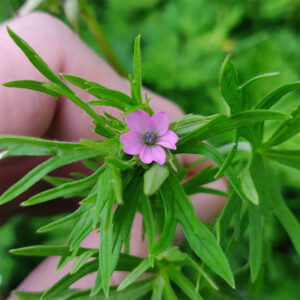
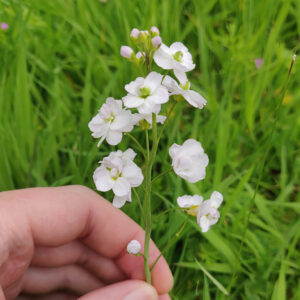
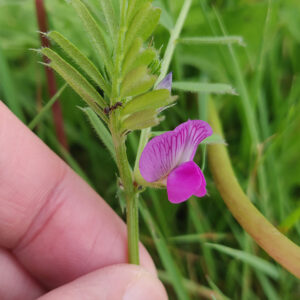
This year, after quite a wet spell of late winter weeks with cold winds blowing through, May arrived with a warm embrace of pleasant sunshine that supported a quick growth of many flowering plants. Early flowers here were the Cut-leaved Crane’s-bill(Geranium dissectum), Common Vetch (Vicia sativa) and Cuckooflower(Cardamine pratensis), that spread rigorously through the grass along with a matt of Creeping Buttercup (Ranunculus repens). As soon as mowing ceased Daisies (Bellis perennis) and Germander Speedwell (Veronica chamaedrys) flowered throughout, alongside Dandelions(Taraxacum officinalis), Spotted Medick (Medicago arabica) and Herb-robert (Geranium robertianum). Many of the species present this year are listed in our species tally from last year (See our No Mow May 2022 blog here for a more comprehensive plant list).
Cut-leaved Crane’s-bill
Cuckooflower
Common Vetch
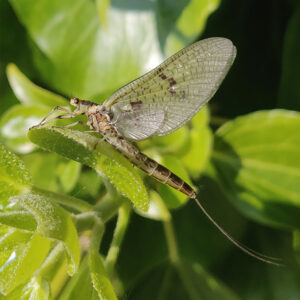
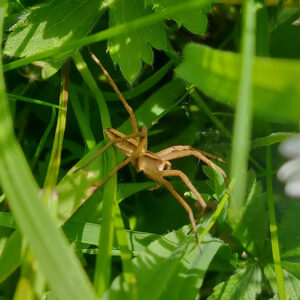
This year, it’s been a real wonder to witness some more of the invertebrate life across our May meadow. In the still warm sunshine, we’ve seen a fair few bumble, honey and solitary bee species dashing by, some impressive wasps and flies (including scorpion flies) and, owing to our riverside location, we’ve started seeing Mayflies and Damselflies in the last week or so. There’s been some fleeting glimpses of spiders sunning themselves on the walls and walkways and a beautiful Nursery Web spider (Pisaura mirabilis) touring the vegetation.
Mayfly
Nursery Web Spider
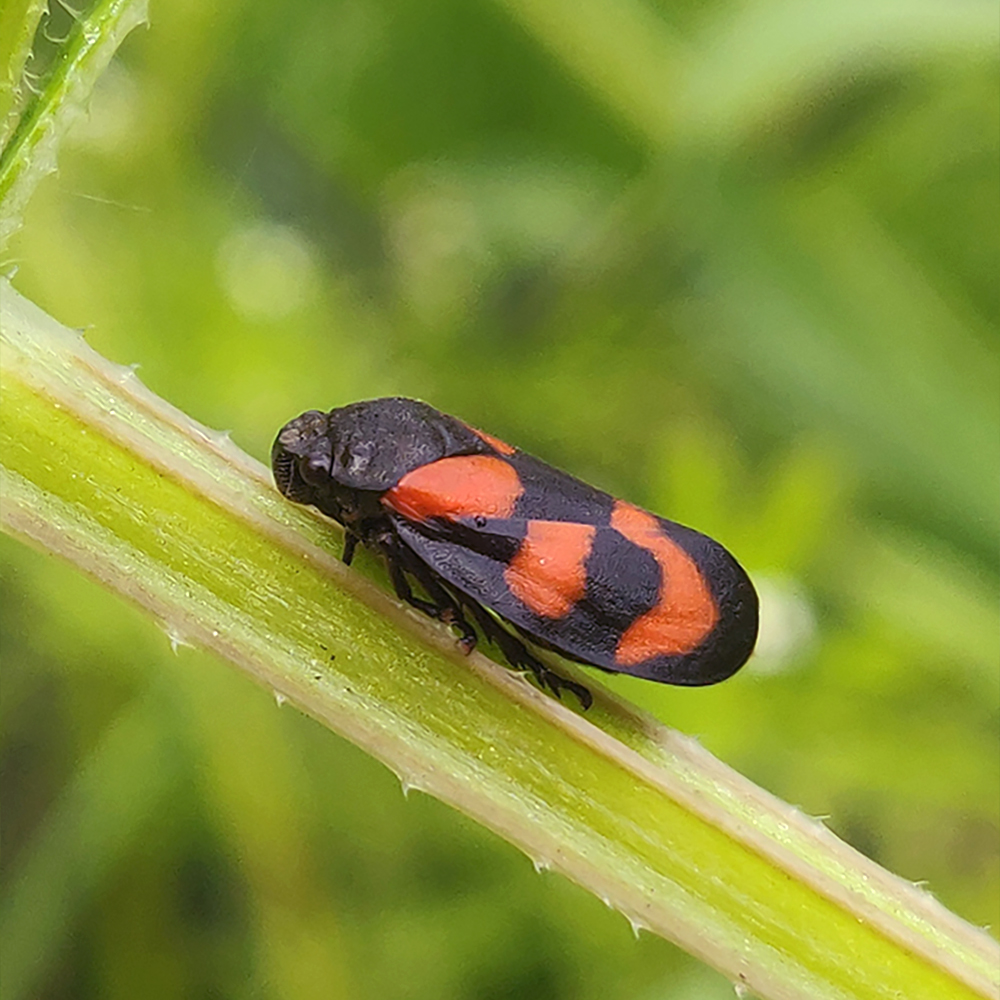
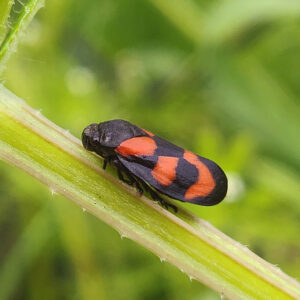
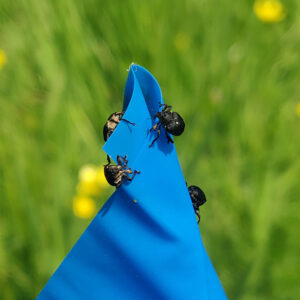
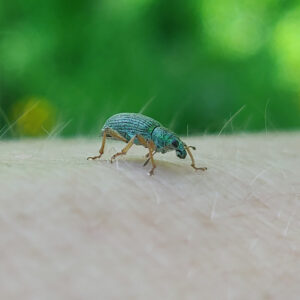
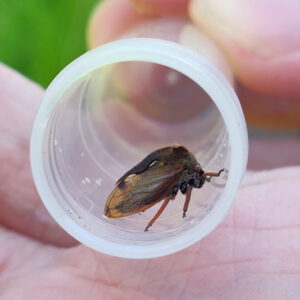
Along the edges of the plot here where trees and shrubs tower up, surrounded by Cleavers (Galium aparine), Brambles and Docks, we’ve found a few small green weevils (that we’re struggling to ID beyond the subfamily of Entiminae) and Red-and-black Froghoppers(Cercopis vulnerate) – plus, a short distance away we were delighted to encounter an incredible Horned Treehopper(Centrotus cornutus)! There’s also been a regular meeting of Iris Weevils (Mononychus punctumalbum) on the blue marking flags we had put out to highlight points of particular interest.
Red-and-black Froghopper
Iris Weevils
Green Weevil species
Horned Treehopper
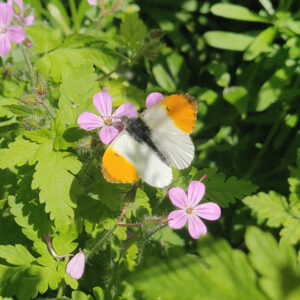
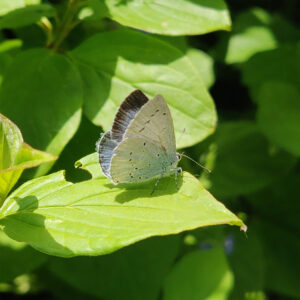
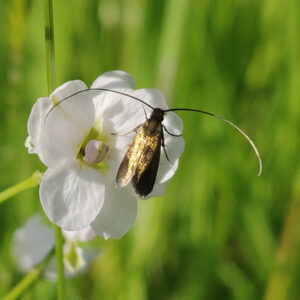
We’ve had regular visits from Orange-tip butterflies(Anthocharis cardamines),Holly Blues’(Cauchas rufimitrella), Peacock (Aglais io) and Green-veined White Butterflies (Pieris napi) throughout the month, and, when the afternoon sun has been particularly strong, a handful of beautiful Meadow Long-horn moths (Cauchas rufimitrella) have gathered in a shimmering dance around the blooming Cuckooflowers. We’ve also been treated to some short appearances of a Burnet Companion moth(Euclidia glyphica) as they quickly nipped between the vetch flowers.
Orange-tip Butterfly
Holly Blue
Meadow Long-horn Moth
We’re hoping that we can leave the plants a little longer into June again this year, as there’s still some remarkable species yet to flower, and it’s such a delight to see so many invertebrates thriving alongside the plants in this wayside patch. Suffice it to say if this place had kept to the same mowing schedule as some other local verges, there’d be little or no opportunity for the plants or their pollinators to proliferate or regenerate, and that’s without even considering the benefits to us humans of allowing and encouraging this dynamic ecosystem. Small contribution as it may be in the grand scheme of things.
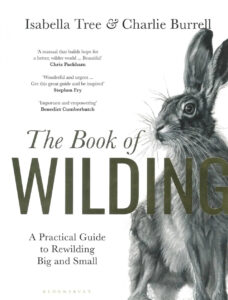
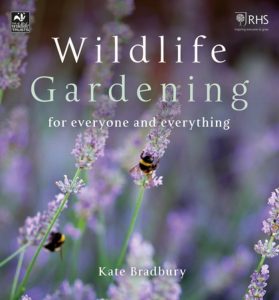
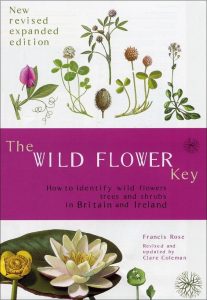
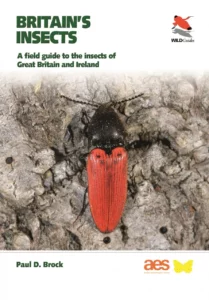
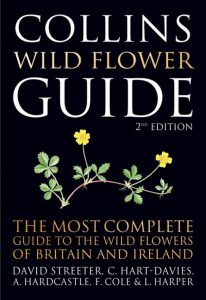
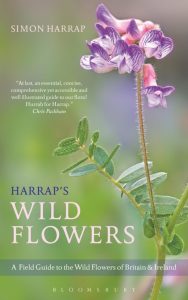
We hope you’ve been inspired to join in with Plantlife’s #NoMowMay this year too, or perhaps through June, and next summer too! We sell a wide range of handy books for identifying wild plants and animals, and there’s a growing number of books that are helpful resources for gardening for wildlife!
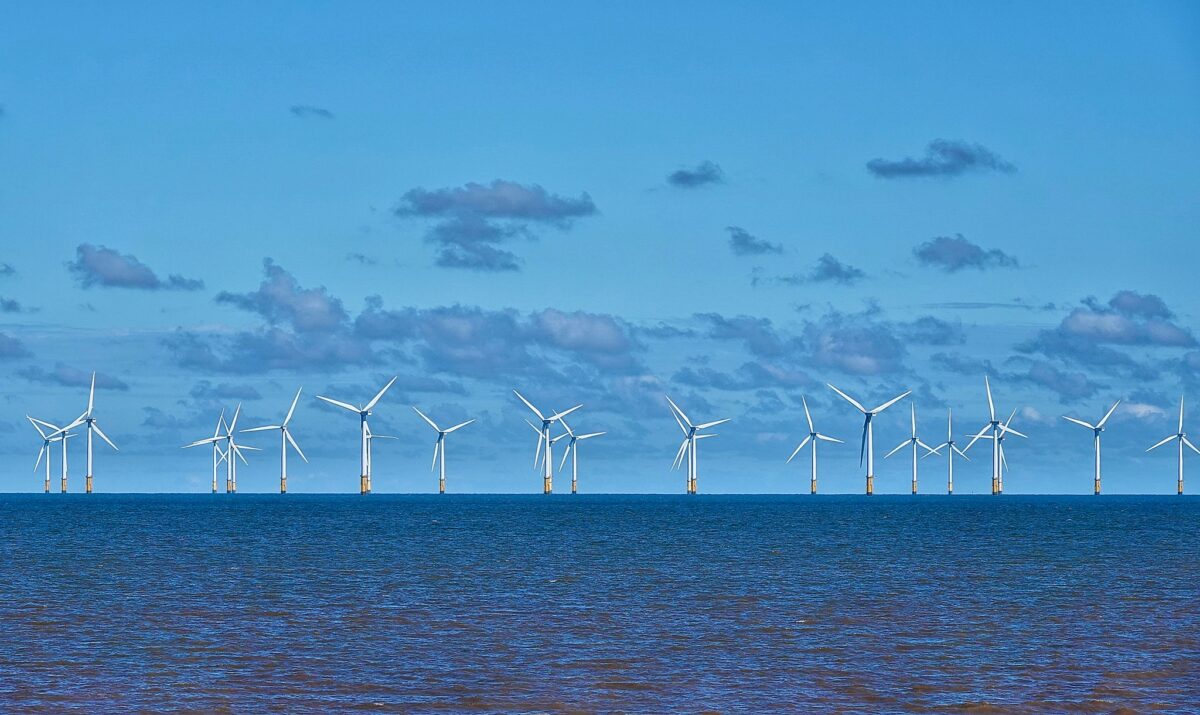
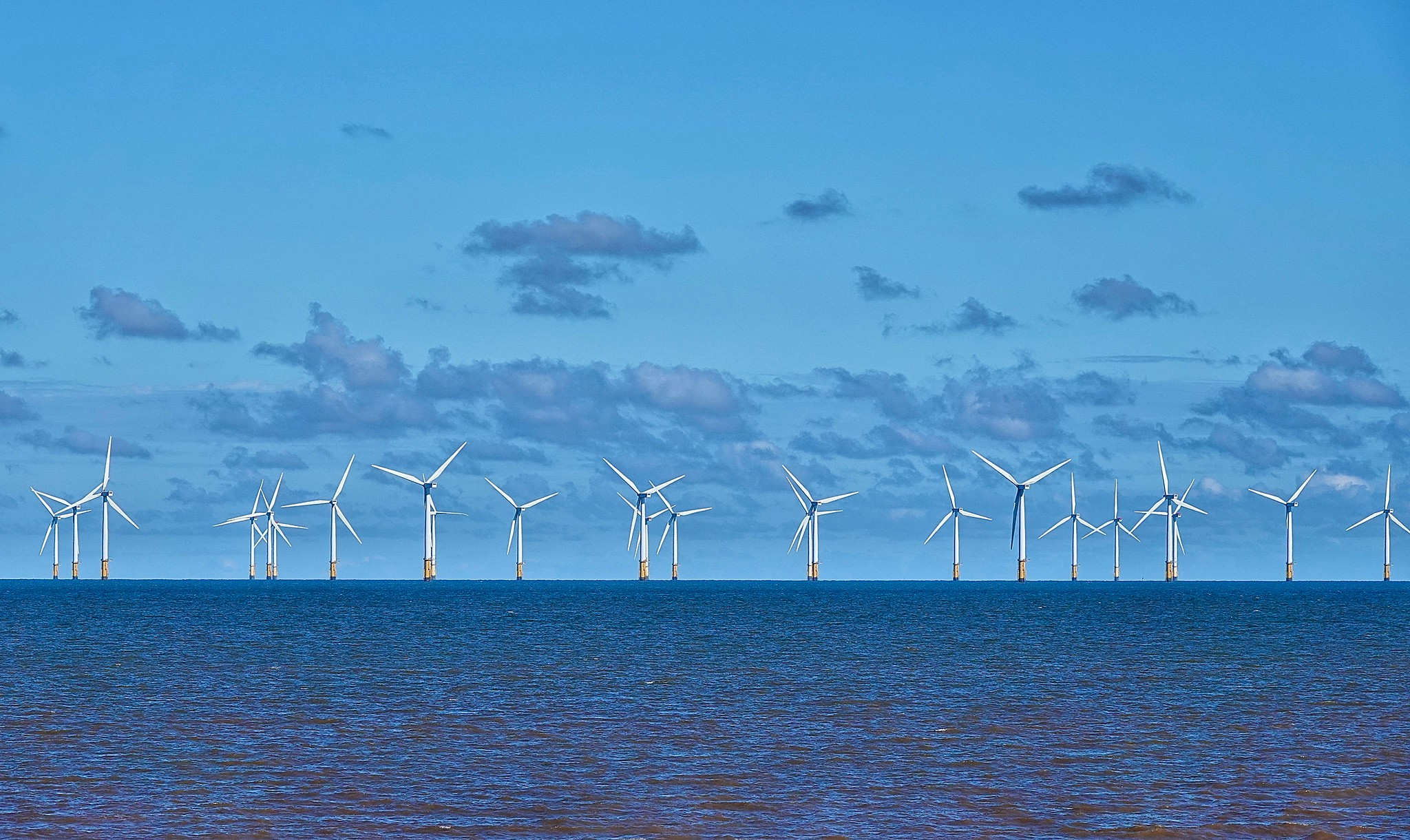
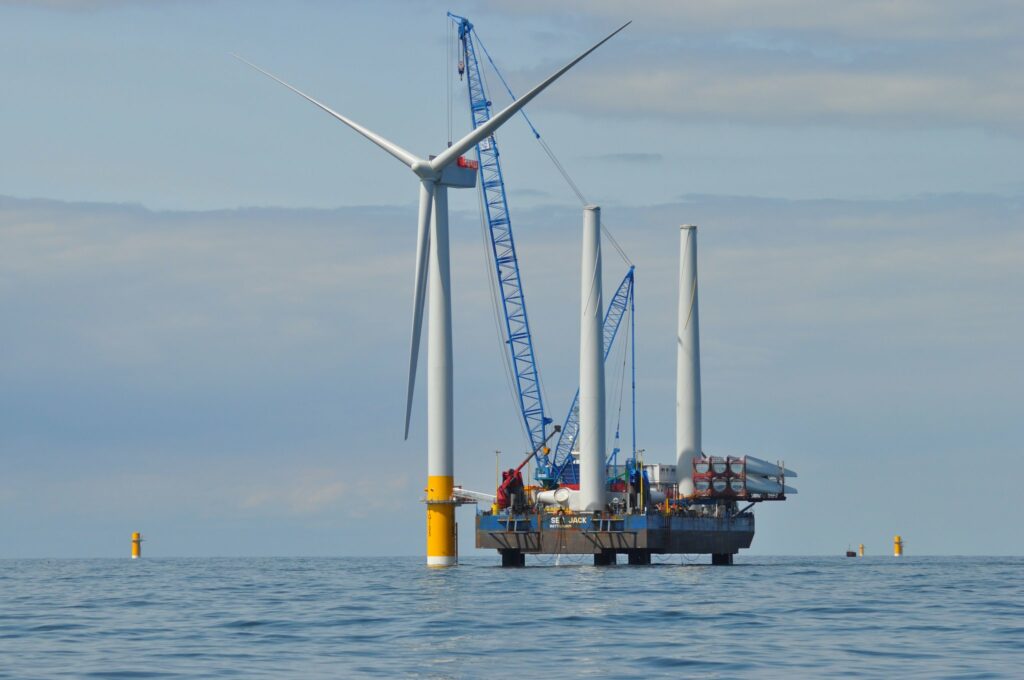
Offshore wind farms (OWFs) are areas with multiple turbines, often located in relatively shallow water just off the coast. The energy produced by the force of the wind is clean and renewable but, often, such climate change solutions come with trade-offs. Research around these areas has shown that they can impact surrounding habitats and ecosystems both positively and negatively.
Climate change prevention vs biodiversity protection
Policies and strategies for fighting climate change can sometimes ignore or under-emphasise biodiversity protection. For example, a pledge made at COP26 in 2021 to halt net deforestation by 2030 does not actually prevent the cutting down of forests, but instead requires that forest loss should be replaced ‘sustainably’. However, replacing primary forests with new growth has negative consequences for biodiversity, as ancient woodlands are highly complex ecosystems. New growth is less able to support the same level of biodiversity and it would take decades for an area to develop back into a climax community. Therefore, while this pledge may help to fight climate change by potentially stabilising or even increasing global forest cover, it would allow for the continued negative ecological impacts of deforestation.
Wind farms face similar dilemmas. They produce clean and renewable energy, without the negative impacts on the climate of traditional energy sources such as coal and gas, but they have been shown to impact the surrounding environment.
Negative impacts of offshore wind farms
Two phases can potentially cause disturbance to wildlife: the construction phase and the operation phase. Some species may be impacted during the construction phase but are able to recover and are unaffected by the general noise of the operation phase, but some are impacted by both, thus creating long-term changes in the ecosystem. Additionally, wind turbines do not have an infinite lifespan, and may need replacing as frequently as every 20-25 years. While this may not involve a full replacement, it would involve some level of construction and therefore disturbance.
The impacts of wind farms can be through collisions, displacement, noise, destruction of habitat, change in hydrology and more. One new report, however, found that seabirds off the UK coast are better at avoiding wind turbine blades than previously thought. Researchers monitored how birds behaved in Aberdeen Bay for two years using radar and cameras. The results showed the birds adapted to the rotor blades from approximately 120 meters, becoming increasingly precisely adapted the closer they came to the rotors. During the two-year study, there wasn’t a single collision between the birds and the rotor blades. However, collisions are not the only way wind farms can affect wildlife.
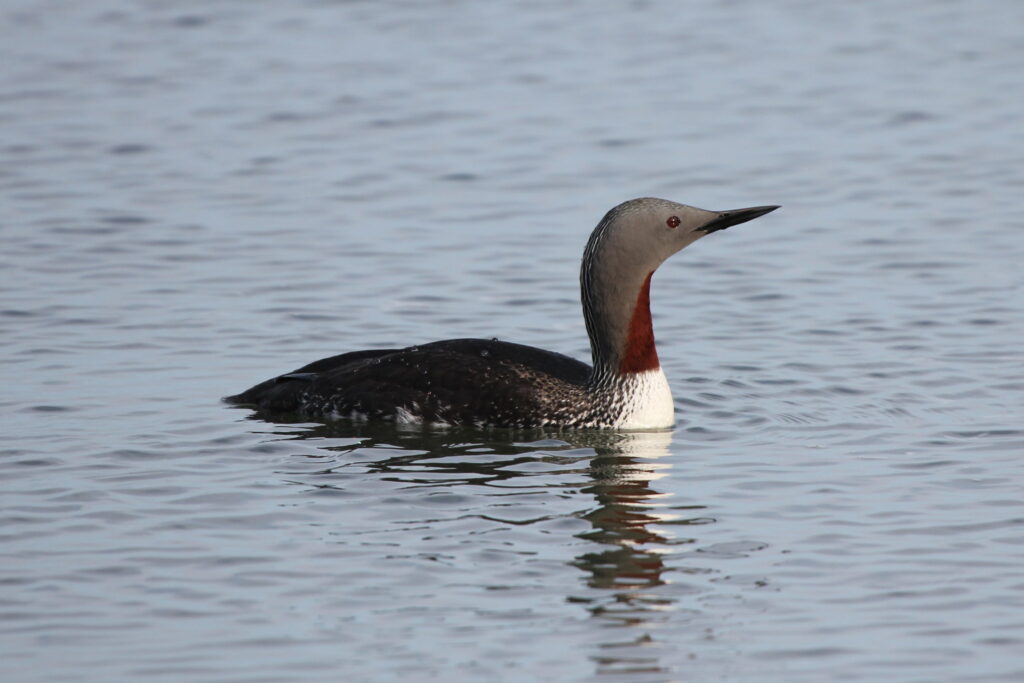
A recent study has found that populations of red-throated divers decreased by more than 90% in areas where OWFs were built. The data, gathered by German scientists, looked at population numbers in the North Sea before and after five OWFs were built and found that numbers were up to 94% lower within half a mile of the turbines after they were installed. One farm in particular showed a 99% decline in population numbers. The impact is also more widespread, with an average decline of almost half of bird numbers up to six miles away from the turbines. The cause behind this decline is thought to be due to the effect turbines have on their hunting techniques. Their formerly large foraging area has been split into smaller units by these offshore farms, restricting their movements when foraging for highly mobile prey.
Red-throated divers are not the only species that are being affected by OWFs. A study assessing the vulnerability of marine populations to offshore wind farms in 2013 identified a number of other seabirds that are potentially at risk, including gulls, white-tailed eagles, northern gannets, skuas and common scoters. More recent studies highlight the impacts on long-tailed ducks, common eiders, razorbills and common guillemots, such as general avoidance, changes in migration patterns and lower abundance around wind farms. The increased energy cost of avoiding wind farms could potentially impact survival and reproductive success, depending on the length and frequency of the flight, as well as the characteristics of the species.
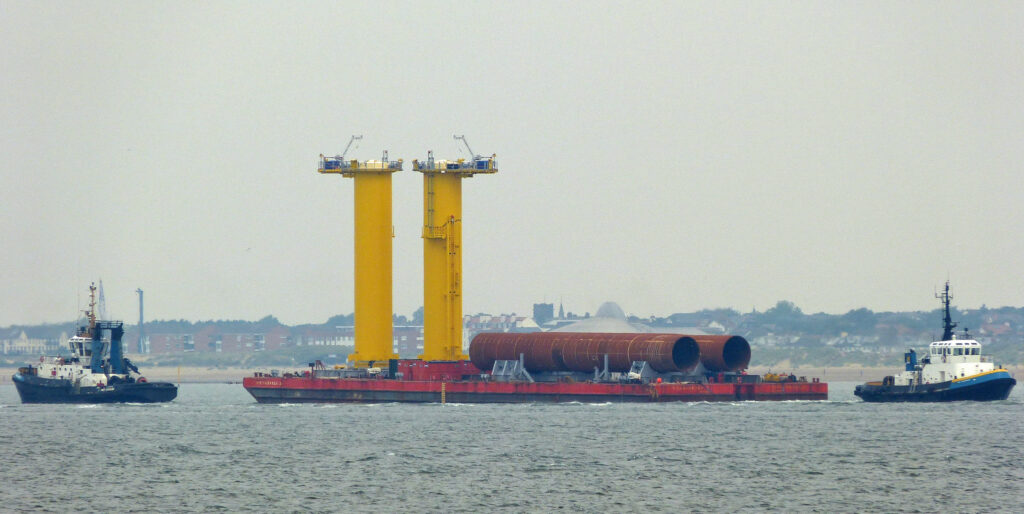
While birds are often the focus of studies into the environmental impacts of OWFs, numerous studies have found that marine mammals such as porpoises, whales and dolphins, as well as fish and marine invertebrates, are affected. Many types of offshore wind turbines need foundations that are placed deep into the seabed. By drilling the sea floor, any benthic marine habitats in the surrounding area could be destroyed, while the displaced sediments can hang in the water column impacting filter feeders and photosynthetic organisms. Once the sediment settles, it can also smother many bottom-dwelling organisms, preventing them from feeding.
Furthermore, the noise pollution from the construction can threaten marine organisms, as it interferes with the communication of species such as porpoises, dolphins and whales. These species rely heavily on their hearing for orientation, hunting and communication between individuals. Prolonged exposure to loud noise, which even the normal operation of turbines can produce, leads to hearing loss and stress, increasing their vulnerability to diseases, while also combining cumulatively with the impacts of other pressures such as pollution and reduce food availability. Fish are also affected by this prolonged exposure.
Stress from these pressures leads to behavioural changes, and affects general movement, feeding patterns and migration. It can also impact fecundity and mortality rates. Due to this, as well as changes in the physical or chemical characteristics of the habitats surrounding wind farms, ecosystem structures may change because of alterations in species composition or abundance. This can impact the functions of the ecosystem, having widespread impacts on the surrounding environment, as well as the industries that rely upon it, such as fisheries.
Wind farm pieces from Cammell Laird by Andrew via Flickr
Positive impacts of offshore wind farms
Wind turbines and their foundations, though destructive to construct, provide structures that become artificial reefs for corals and other sessile aquatic organisms such as sponges, seaweeds, mussels and anemones. This increase in the distribution and abundance of certain species, such as invertebrates, can attract other species that are higher in the trophic level, such as fish.
Certain farms also ban fishing, which can reduce pressures within the boundaries of the farm. This, along with the ecosystem supported by the artificial reef system, can provide a haven for fish that are usually heavily overfished. This increase in food availability can, therefore, have a positive impact on many species in higher trophic levels, such as seabirds, but the impact varies from species to species and often from farm to farm.
Advantages of onshore vs offshore wind power
Onshore wind farms are cost-effective, as they’re one of the least expensive forms of renewable energy and are far less expensive than offshore wind power. They are also easier to construct and maintain, unlike offshore farms, where higher wind speeds, strong seas and other accessibility issues can make maintaining these farms more challenging. However, offshore wind farms are more efficient, as higher, more consistent wind speeds mean that fewer turbines are needed to produce the same amount as onshore farms. Additionally, there is more space to construct farms offshore than onshore, with a reduced effect on local people.
What are the solutions?
As the world moves towards carbon net zero in an effort to fight climate change, wind power is going to be more heavily relied upon, meaning the construction of more wind farms. With the construction of these structures in the ocean, there will always be some negative impacts, but there are things that can be done to mitigate some of these. A balance needs to be found between efforts to meet net zero and protecting our environment.
Continuing to monitor and assess the impacts of existing wind farms can inform the ecological strategies of future builds. By improving our understanding of how these farms impact the environment and ecosystem, future projects can be adapted to reduce these impacts. This research needs to be properly funded and shared globally, with stringent legislation that is updated in response to findings. These studies should be rigorous and consistent, avoiding underestimations that could allow the continued threat to the environment but steering clear of overestimations which could hinder further development of clean energy through wind farms.
Greater Gabbard offshore wind farm by Department of Energy and Climate Change via Flickr
Using data from fisheries can indicate where research is needed, as an increase or decrease in catch around wind farms suggests ecological changes. However, this would mean only the impacts that affect commercial fish would be investigated and impacts on other, non-commercial species may be overlooked. Therefore, other monitoring methods are also needed, which will involve funding from both private and government sources.
In the UK, Natural England has called for new OWFs to leave nature in a better state than before its construction, avoiding any irreparable damage to the environment. The approach, published in June 2021, set out how these farms can play a vital role, not only in tackling climate change, but also in nature recovery. Similar to Biodiversity Net Gain, which requires new developments on land in England to ensure that habitat is 10% better after building than before, Natural England is seeking to ensure that new OWF projects ‘build in’ plans that will enhance nature and protect the environment from the pressures mentioned above. The approach outlines the objectives and actions that Natural England will focus on, in partnership with others such as Defra’s Offshore Wind Enabling Actions Programme. These include:
Aiming for each development to leave nature in a better state.
The advanced introduction of strategic, to-scale and evidence-based measures that will compensate for environmental harm.
Monitoring to inform stronger, evidence-based impact assessments, promoting the use of environmentally sensitive design, construction and operation.
The development of an environmental sensitivities map that is easy-to-use, so that planners and developers can make sure OWFs and their cables avoid causing irreparable damage to the environment.
Other mitigation options include the arrangement of turbine clusters, as certain patterns can minimise barriers to movements, such as creating corridors within the farms to allow birds to pass through rather than having to extend their flight to go around extensive concentrations of turbines. Advances in technology have also given rise to options such as floating wind farms, which would reduce the impact on the sea bed, as well as potentially reducing the construction phase; and multi-purpose interconnectors, which would allow multiple offshore farms to be connected to the shore, rather than individual wind farms, which would reduce the impact of cable laying.
Other renewable energy options
Other renewable energy options include hydropower, solar power, biomass and geothermal energy. Solar power is an important source of renewable energy and can be placed on areas such as roofs, to reduce the space needed, but there are environmental implications for large-scale solar energy production, including aluminium demand. Hydropower, such as wave and tidal power, has future potential but is not yet widely employed commercially.
These could also have ecological impacts, however. For example, large-scale wave energy converters could cause changes in water velocities, which may impact sediment transport, coastal erosion and the increase of sediment deposition. Additionally, barriers such as dams radically change the typography and environment of rivers, with widespread ecological implications. Burning biomass, often from agricultural waste, releases carbon dioxide. While the plants that are grown as the source of the biomass can capture almost the same amount of CO2, the burning smoke can also contain harmful pollutants such as carbon monoxide, as well as producing ash which can contain high concentrations of various heavy metals such as lead and cadmium, which would need proper disposal. Geothermal energy produces both water and air pollution, such as arsenic, mercury, nickel, methane, ammonia and carbon dioxide. It also produces hazardous waste that would require safe disposal and requires a large amount of water for purposes such as cooling.
It is clear that all renewable energy comes with some negative environmental implications. However, the pollution and greenhouse gases produced are far less than non-renewable energy sources such as fossil fuels. Fossil fuels do substantially more harm than renewable energies, therefore the world must continue to expand and improve its renewable energy endeavours, while focusing on reducing and mitigating their negative environmental impacts.
Summary
Climate change strategies often overlook the protection of biodiversity, with wind farms producing clean and renewable energy but having serious impacts on the environment and ecosystems surrounding them.
Both the construction phase and the operation phase of offshore wind farms (OWF) cause disturbances, such as population declines, changes in general movement, feeding patterns, migration, fecundity and mortality rates.
OWFs also have positive impacts, creating structures that form artificial reefs, and increasing the abundance of certain species such as corals, mussels and anemones, which then attract species in higher trophic levels. Certain farms also ban fishing, creating havens for commercially important fish.
A balance needs to be found between the effort to meet net zero through creating more clean, renewable energy and the protection of our environment.
Continuing to monitor and assess the impacts of existing windfarms, plus stringent legislation, can help improve the ecological strategies of future farms.
Natural England has developed an approach that would require new OWFs to leave nature in a better state than it was before construction, avoiding any irreparable damage to the environment. The objectives of this approach include the advanced introduction of strategic and evidence-based measures that will compensate for environmental harm and the development of an easy-to-use environmental sensitivities map, which will help planners and developers make sure OWFs avoid causing irreparable environmental damage.
All renewable energy sources come with some negative environmental implications but fossil fuels are far worse. Therefore it is important for renewable energies to expand, with a focus on reducing environmental impacts.
There are eight species of corvid in the UK, five of which belong to the Corvus genus. They are intelligent birds, with many studies finding species demonstrating self-awareness and tool-making abilities. Their brain-to-body mass ratio is only slightly lower than ours and equal to cetaceans and non-human great apes.
Corvids occur worldwide, except for the polar ice caps and the southern tip of South America. Certain species are a common sight in our urban areas, having adapted to the proximity of humans. Some surveys have even found that fitness and reproduction have increased due to human development. Crows and ravens have been shown to have high reproduction rates and a positive association between annual survival and proximity to human development.
The crow family feature heavily in mythology and folklore, often as omens of ill fortune or death, though magpies can also be considered a herald of fortune. This is thought to have derived from their scavenging behaviour, feeding on carrion at battlefields. They were considered by some to be ‘soul guides’, there to carry to dead into the afterlife. Ravens feature in Scandinavian mythology, as the god Odin had two ravens that would tell him secrets they’d heard. This communication also features in Anglo-Saxon history. This is most likely due to the ability of many corvid species to mimic sounds in their environment, including human speech. They do this by using their two ‘syrinxes’, vocal organs located at the base of the bird’s trachea, which is made of ossified cartilage, muscles and vibrating membranes. As corvids have excellent memories, they can be taught a wide range of words and sentences.
All species are listed as green by the Birds of Conservation Concern 4, with the Eurasian Jay being upgraded from its previous amber status.
Carrion crow (Corvus corone)
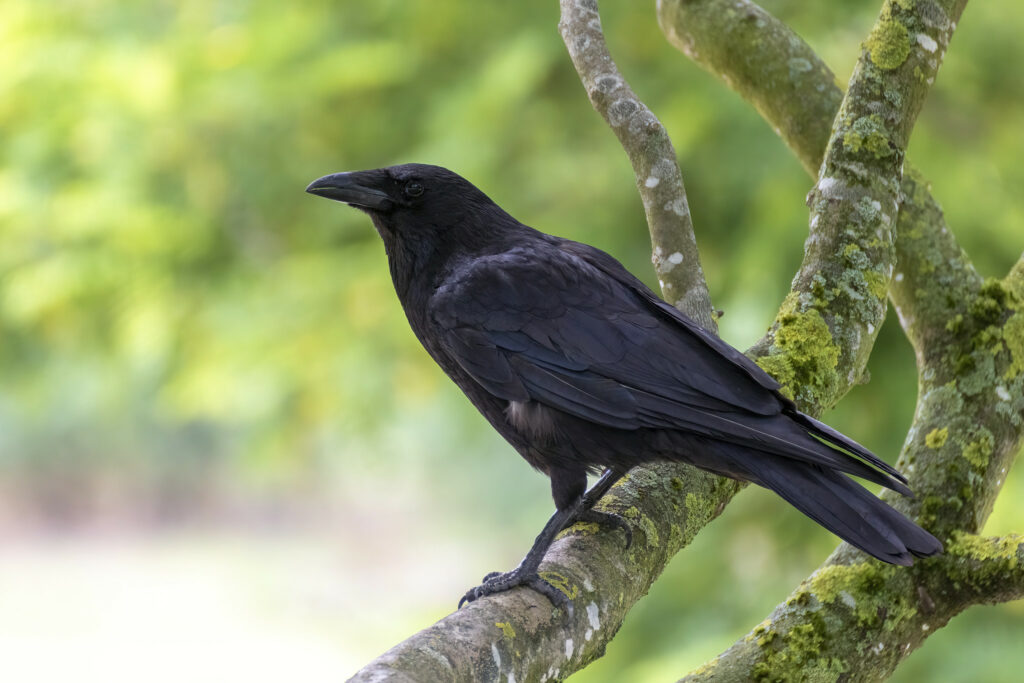
Distribution: Common and widespread, although less common in northwest Scotland. They are found across many habitats, including woodland, farmland, heathland and urban areas. Wingspan: 84–100cm What to look for: An all-black species, they have a shiny, thick black beak that is of medium length, and black legs. Their black plumage has a glossy sheen. They are fairly solitary and are most likely seen alone or in pairs, but they can occasionally form flocks.
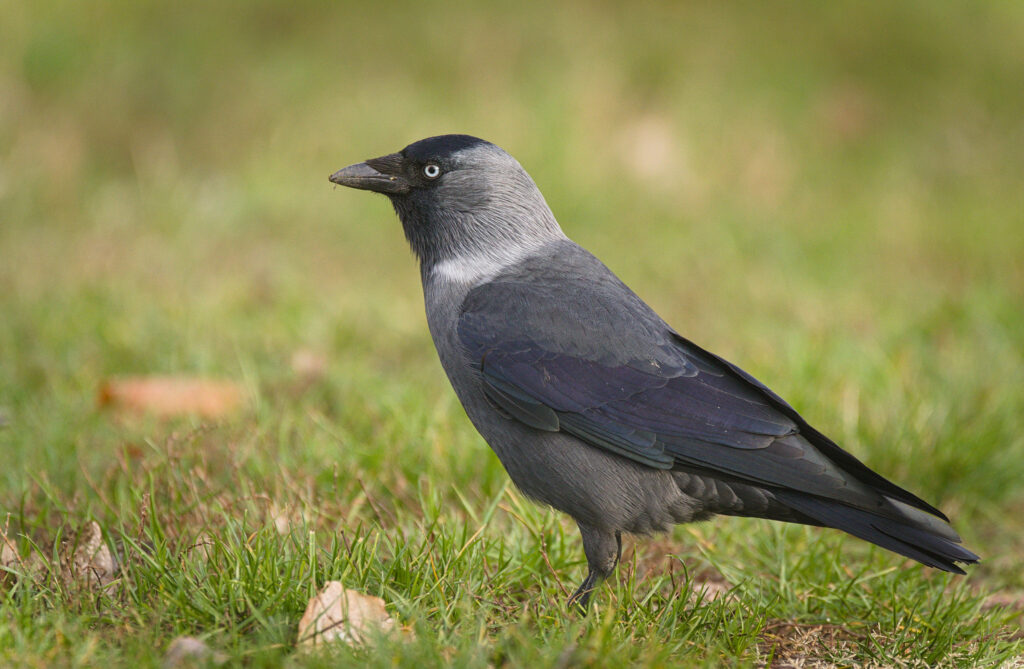
Distribution: Common and widespread, except for parts of the Scottish Highlands. Wingspan: 64–73cm What to look for: The jackdaw is a black species with a distinctive silvery patch on the back of its head. It has pale eyes that are quite easy to see. Their beaks are shorter than carrion crows, though both have an extended patch of feathers on the top of their beak.
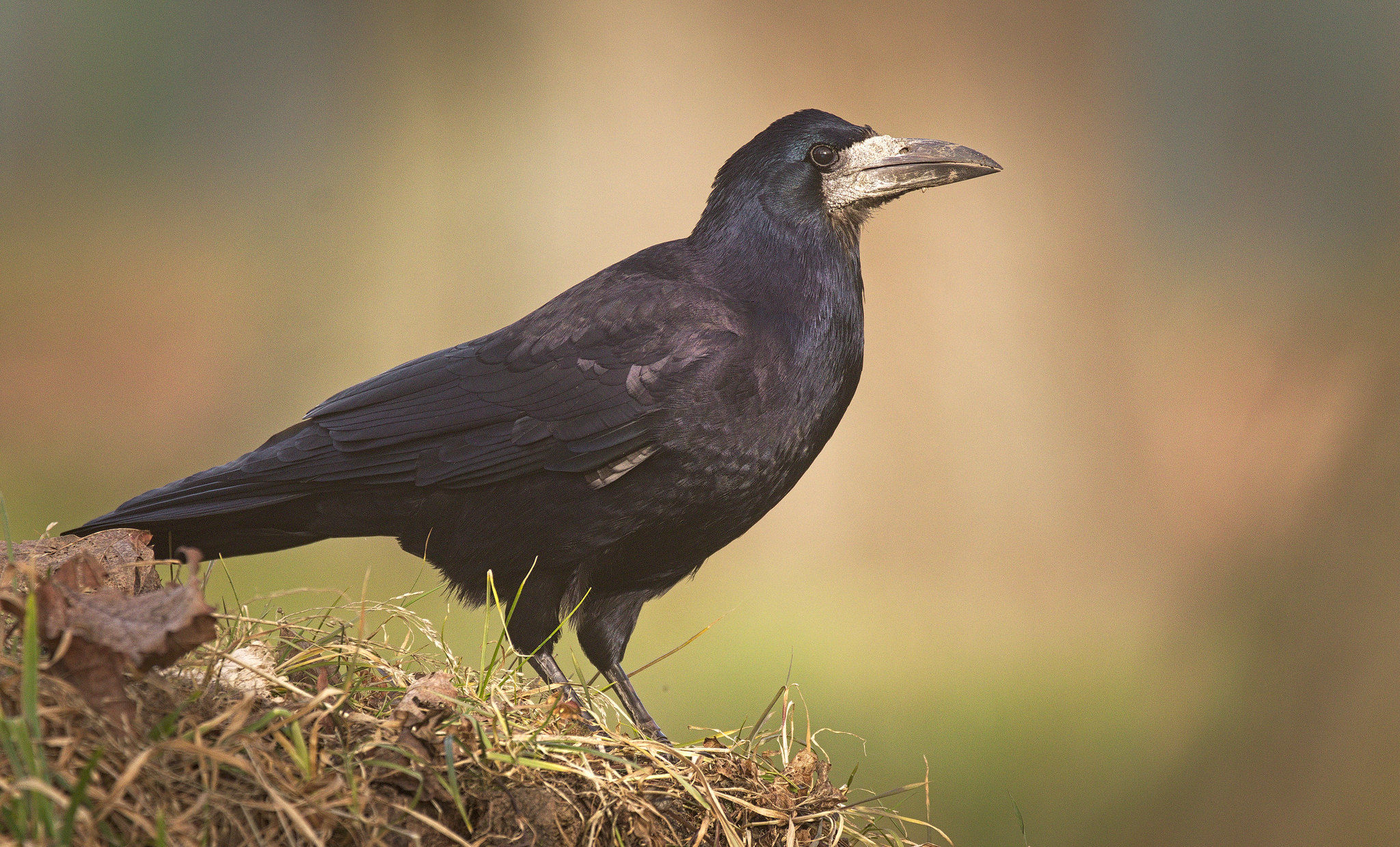
Distribution: Widely distributed across most of the UK, although less widespread in Scotland and mostly absent from far northwest Scotland. They are mostly seen in open fields but can be found along roadsides and occasionally in parks and villages. They mainly avoid the centre of larger towns and cities. Wingspan: 81–99cm What to look for: This species is black, with a distinctive bare, greyish-white face and a peaked head. Rooks also have a thinner, paler beak than other corvids, such as carrion crows. This beak darkens towards the tip. Juveniles do not have a bare face, therefore can resemble other all-black corvids such as crows, but they can be distinguished by their peaked head.
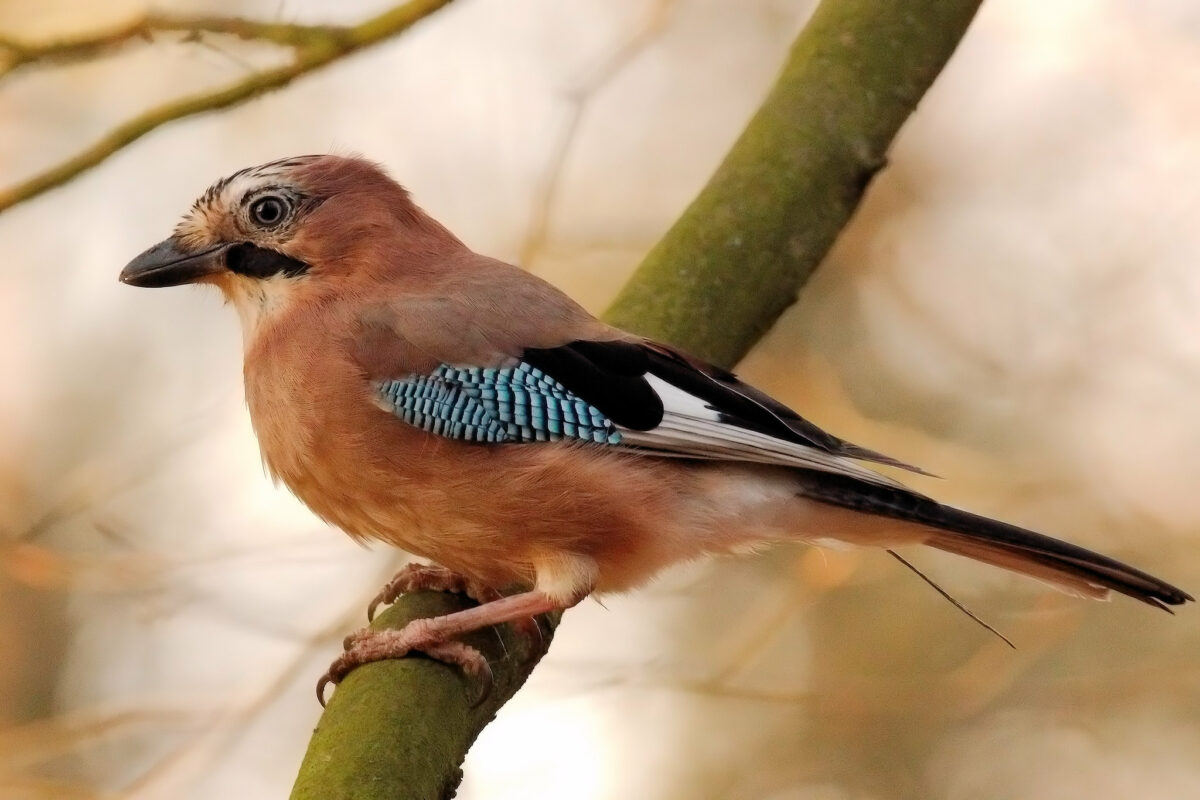
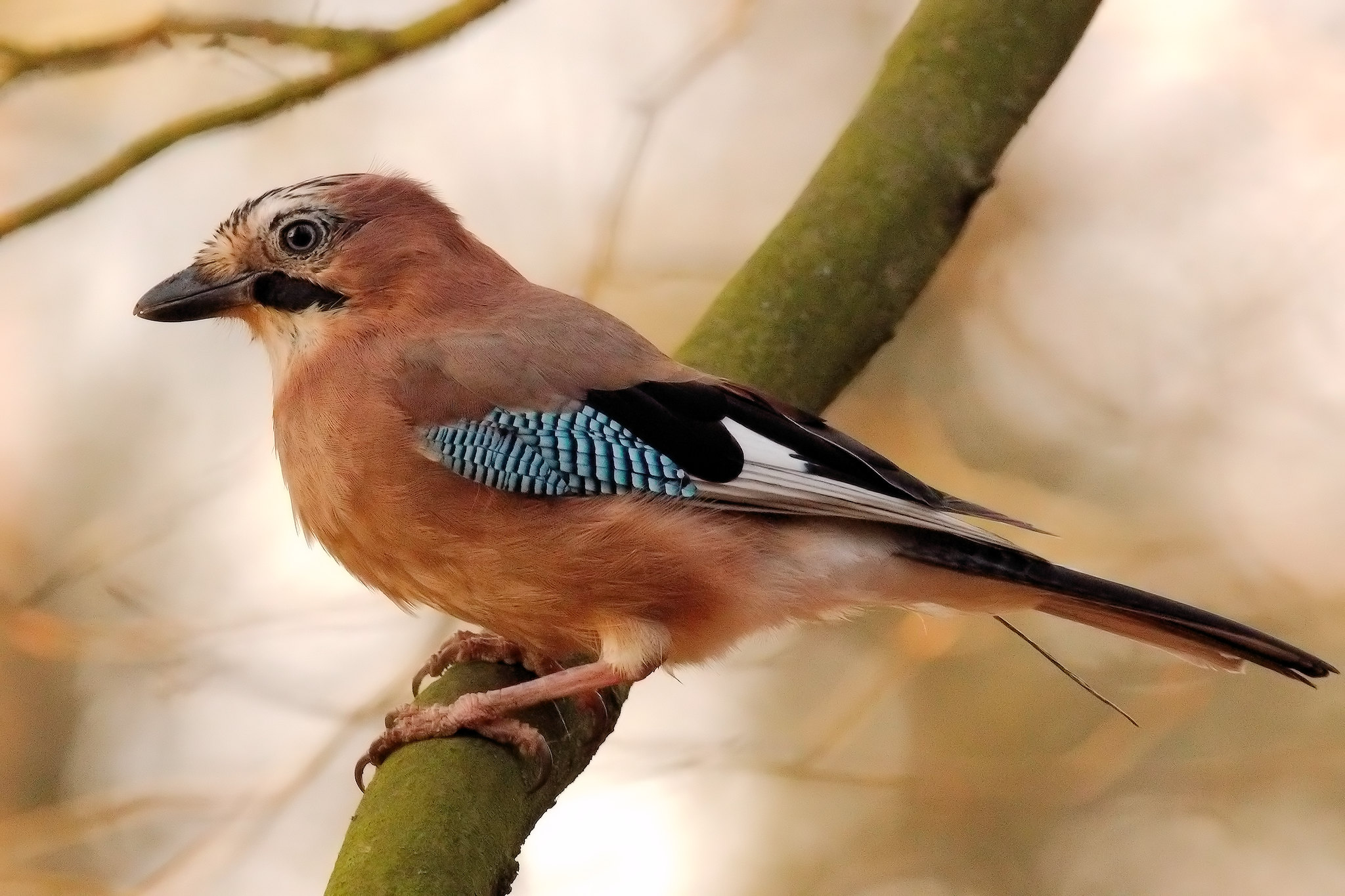
Distribution: Widespread across England, Wales and Northern Ireland, present in parts of Scotland except in the north. Wingspan: 52–58cm What to look for: This colourful bird is a light brown to pinkish-grey, with a pale throat and prominent black moustache stripes. Their forehead and crown are pale with dark stripes. The upper surface of their wings is white and black, with a distinctive bright blue patch patterned with black bars. Their tail is white or pinkish underneath but their upper tail feathers are mainly black.
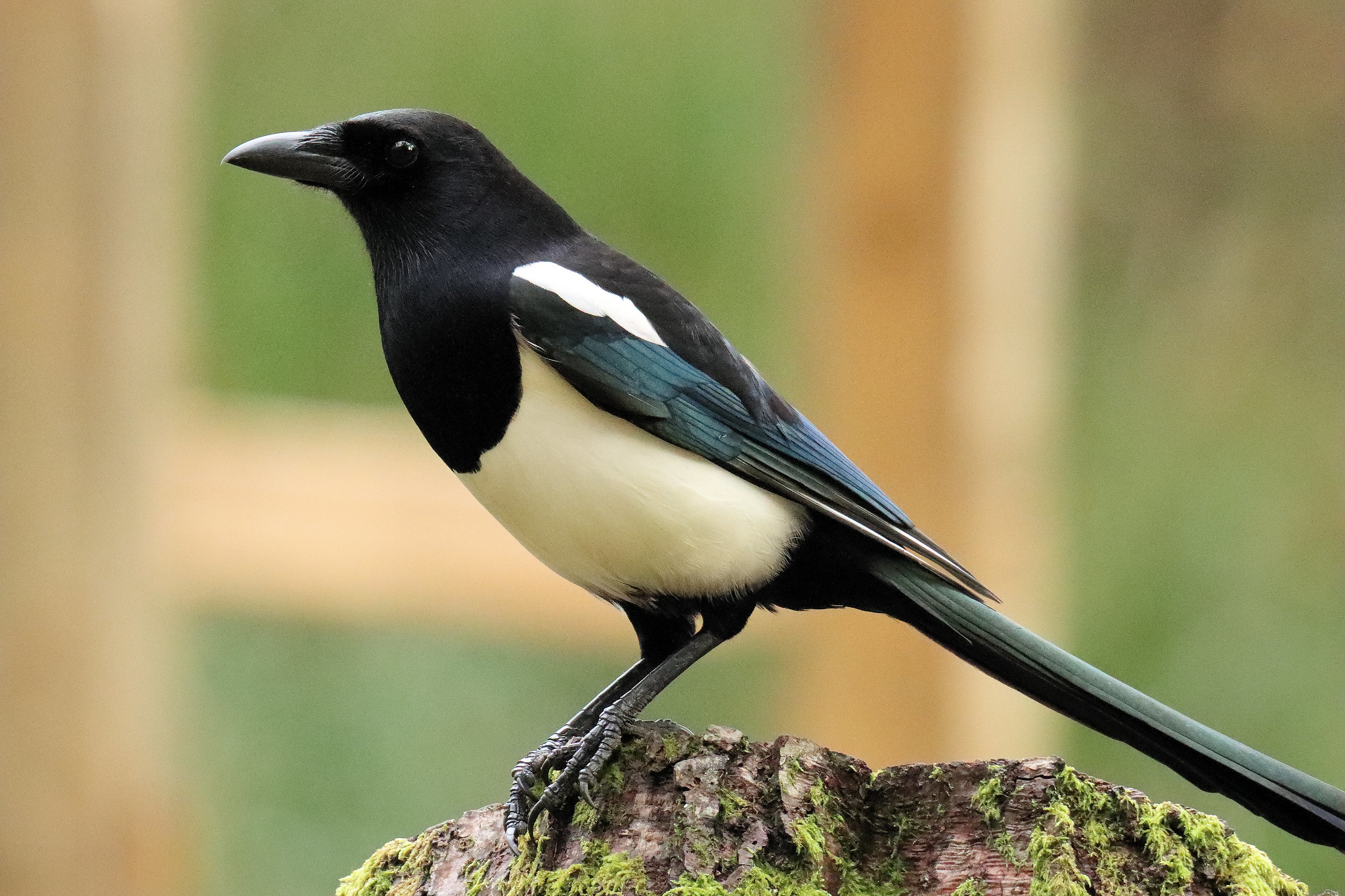
Distribution: Widespread across the UK, except the highlands. Wingspan: 52–62 cm What to look for: This species has a distinctive black and white plumage, with a purple-blue shine to the wings and a green shine to the tail. They have a black beak, black legs and black leg feathers. Did you know? Magpies have long been associated with folklore in many countries, with a wide range of beliefs. Magpies have been thought to signal death, bad luck, good luck, fortune-telling and happiness. They are also the centre of the well-known ‘one for sorrow’ nursery rhyme where the number of magpies signals different events and occurrences. Depending on the version, gatherings of magpies can signal a birth, funeral, wedding, gold, silver, the gender of a child and even the devil.
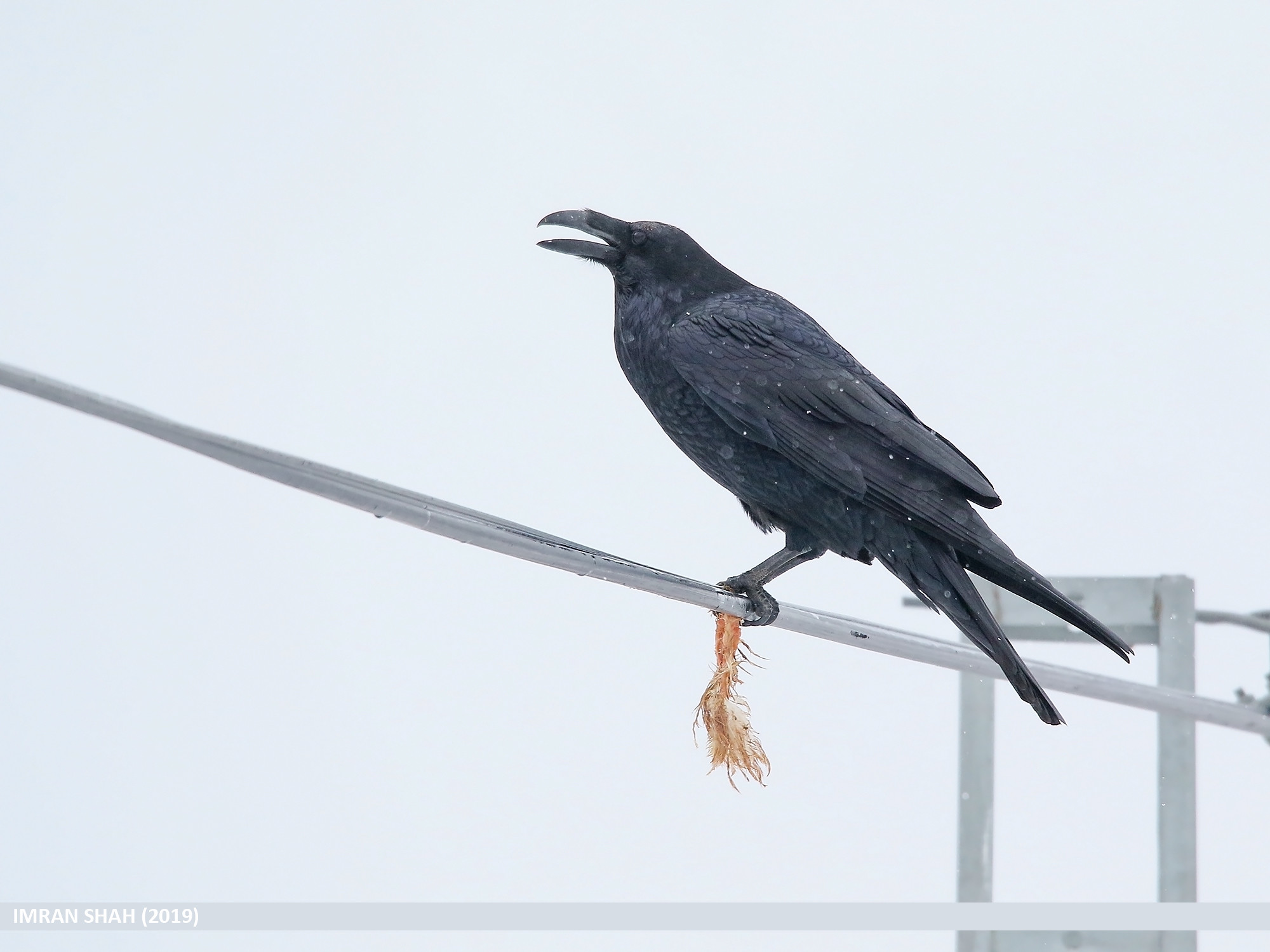
Distribution: Widespread across Wales, Northern Ireland and the West of Scotland and England. They are found across a number of habitats, including woodland, farmland, upland and marine habitats. Wingspan: 115–150cm What to look for: This is the largest member of the crow family, with an all-black plumage, a large bill and long wings. Their necks are thick, with a shaggy appearance. They have a diamond-shaped tail, best seen in flight. They closely resemble the carrion crow, except for their much larger size, but they can resemble raptors such as buzzards in flight.
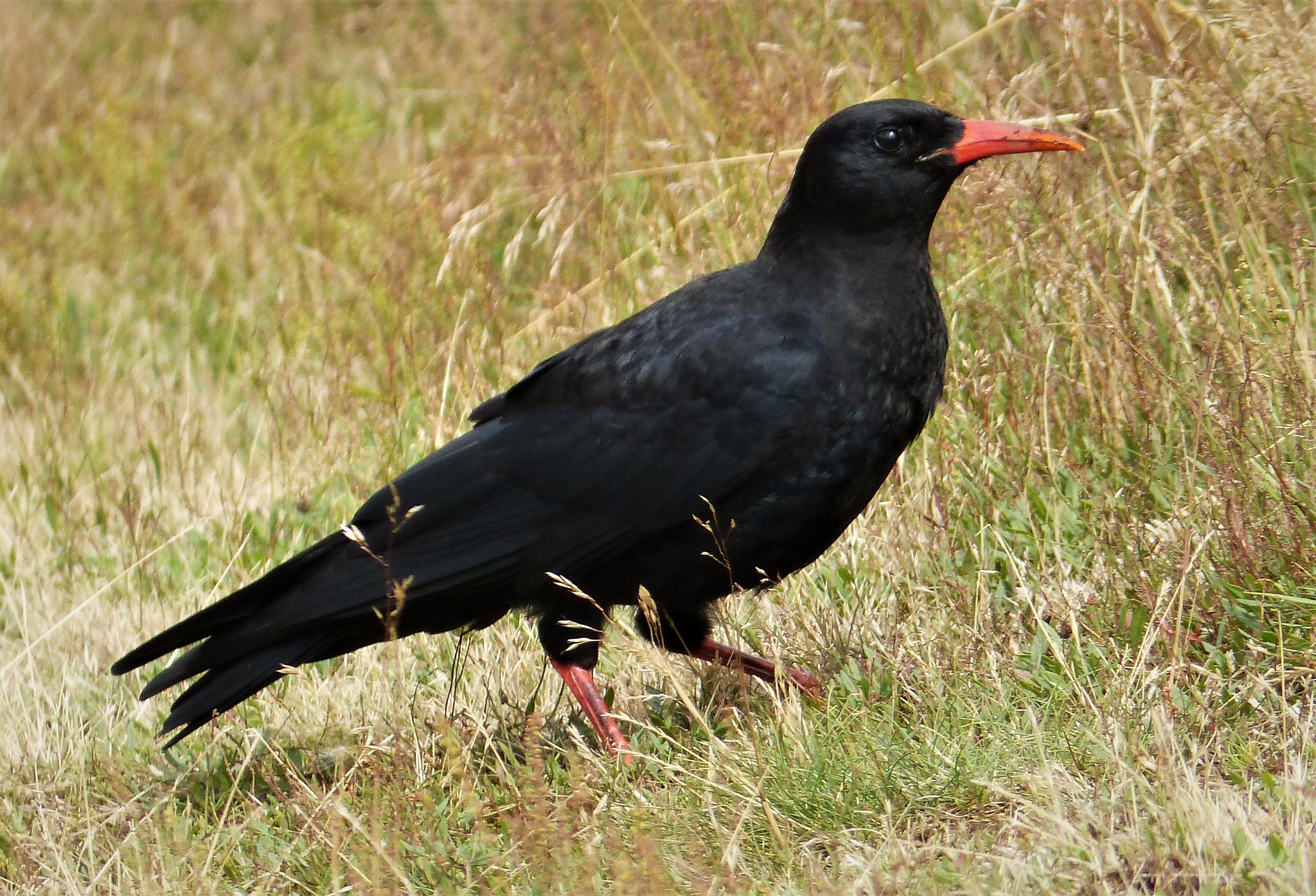
Distribution: Small, isolated populations along the west coasts of Wales, Cornwall and Ireland, as well as the Isle of Man. Wingspan: 73–90cm What to look for: Choughs have a blue-black plumage with a green sheen to their wings and tail. They have a slender, red bill that curves downward. Its legs are red with black claws. Juveniles have an orange bill and either pink or grey legs. Did you know? In 2002, a pair of choughs raised young in Cornwall for the first time in more than 50 years. They continued to nest successfully for over a decade, raising 46 chicks in total. In 2022, the population reached 200 birds, with 25 pairs successfully raising over 70 young.
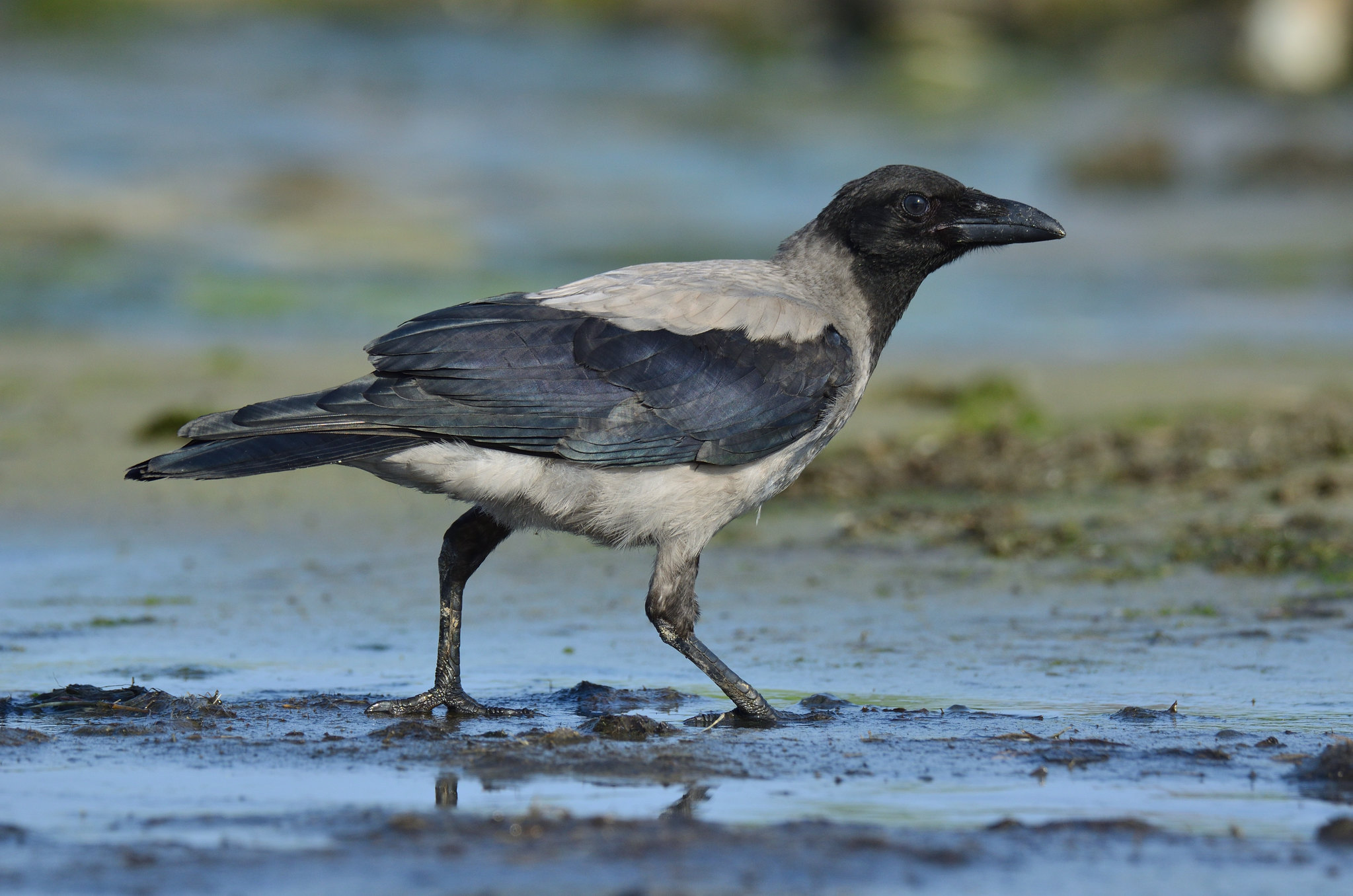
Distribution: Present in Northern Ireland, north and west Scotland, and the Isle of Man. In winter, it is present on the eastern side of England. Wingspan: 93–104cm What to look for: This species has an ashy-grey plumage, with a black head, throat, tail, wings and thigh feathers. It has a black beak and legs, with dark brown eyes. Did you know? The hooded crow was thought to be the same species as the carrion crow until 2002 when they were given full species status.
Marzluff, J. M., and Neatherlin, E., 2006. Corvid response to human settlements and campgrounds: Causes, consequences, and challenges for conservation. Biological Conservation, 130(2), pp. 301-314
Møller, A. P., 2010. The fitness benefit of association with humans: elevated success of birds breeding indoors. Behavioral Ecology, 21(5), pp. 913-918
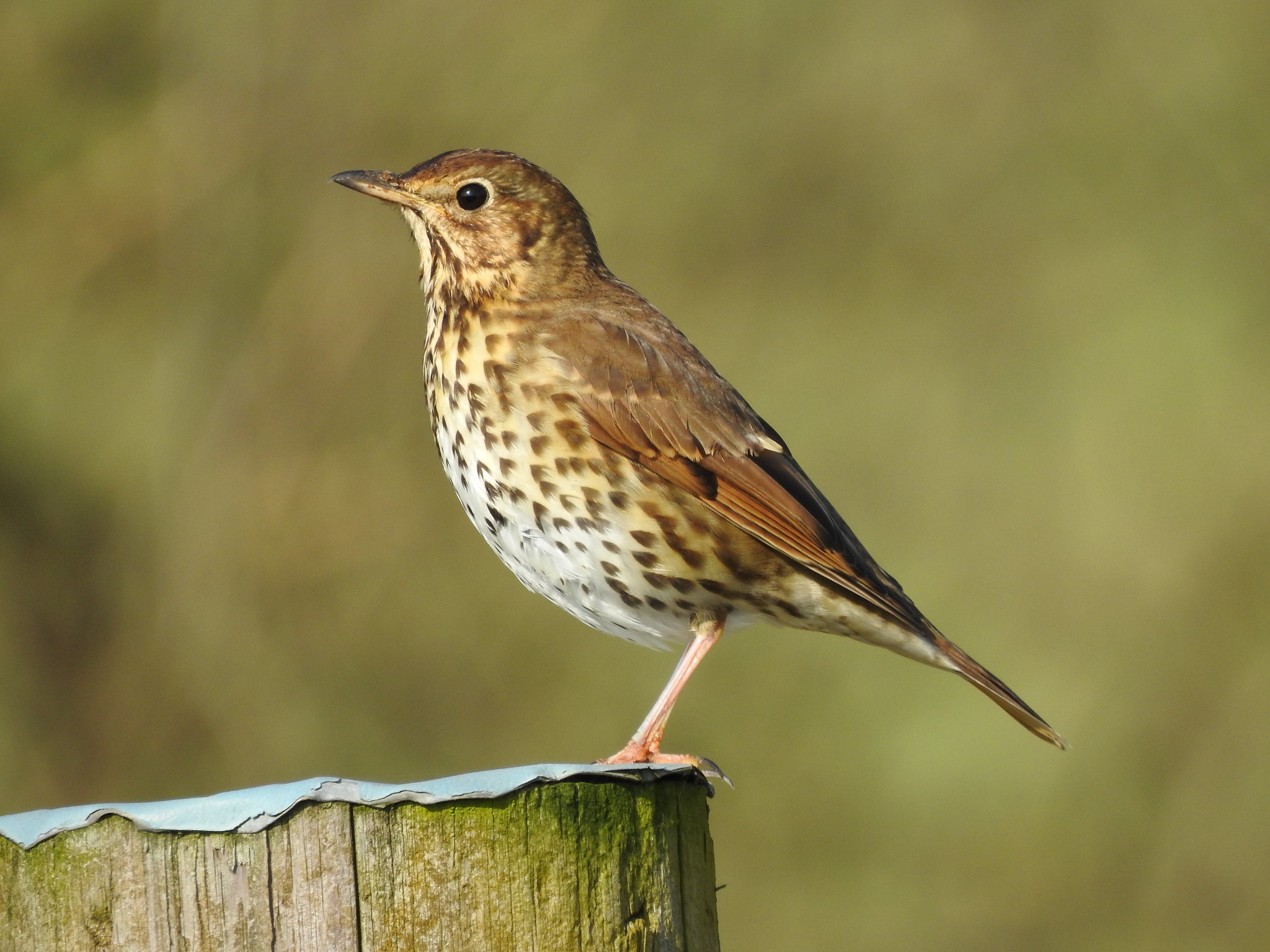
Thrushes are passerines in the family Turdidae. They are found worldwide. The family was once much larger before biologists determined that the former subfamily Saxicolinae (chats) were Old World flycatchers rather than thrushes. Some thrushes are permanently resident in warm climates, while others migrate to higher latitudes during summer, often over considerable distances. There are four species that regularly breed in UK as well as two winter visitors that also occasionally breed here.
These small to medium-sized ground living birds feed on mainly on insects, other invertebrates and fruit. They generally inhabit wooded areas, creating cup-shaped nests that are sometimes lined with mud. They lay between two to five speckled eggs, with two or more clutches a year.
All the thrushes listed below are protected under the Wildlife and Countryside Act 1981, including their eggs and nest sites, with several included on the UK Red or Amber List. Song thrushes have even been designation as a Priority Species under the UK Post-2010 Biodiversity Framework.
Blackbird (Turdus merula)
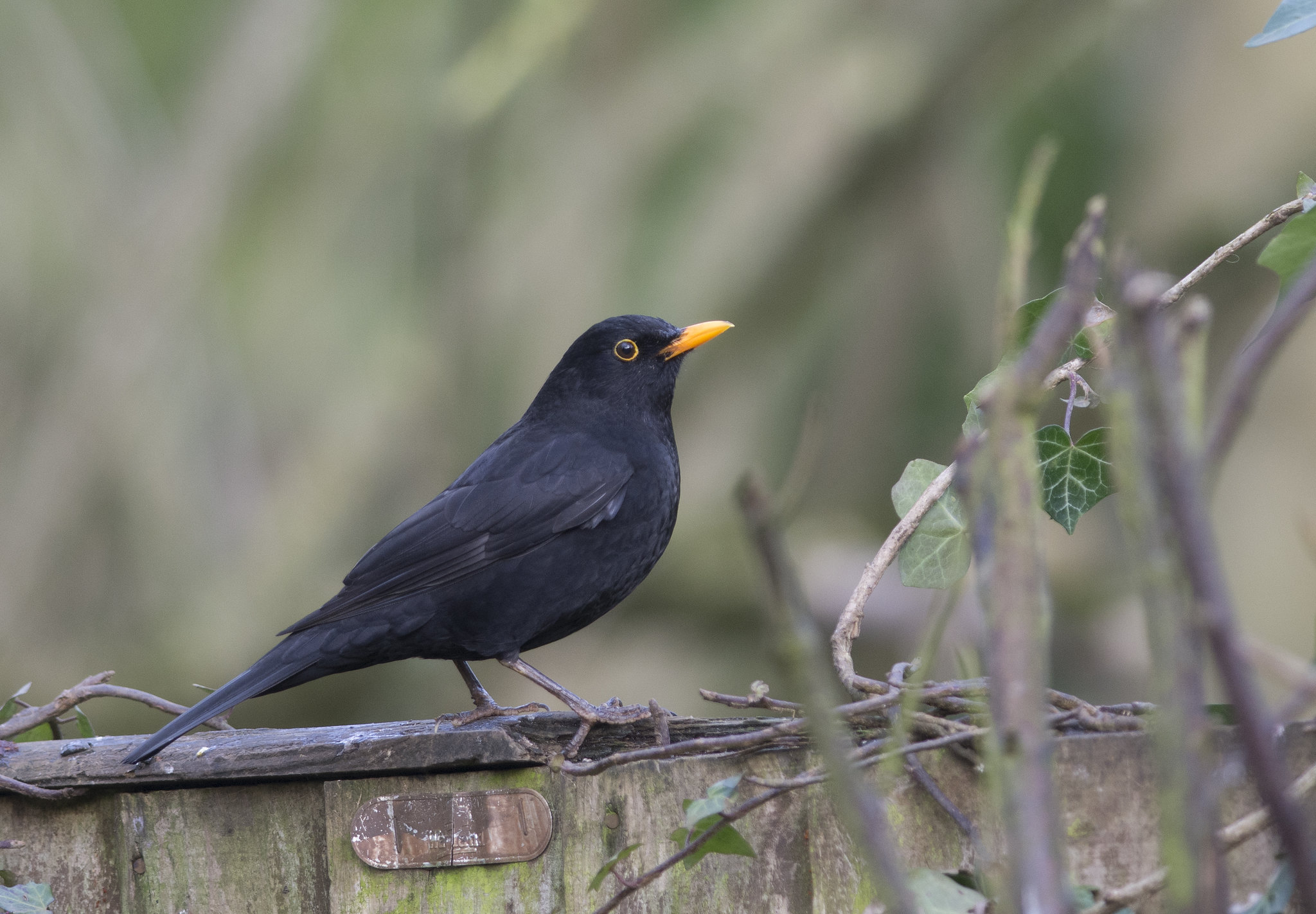
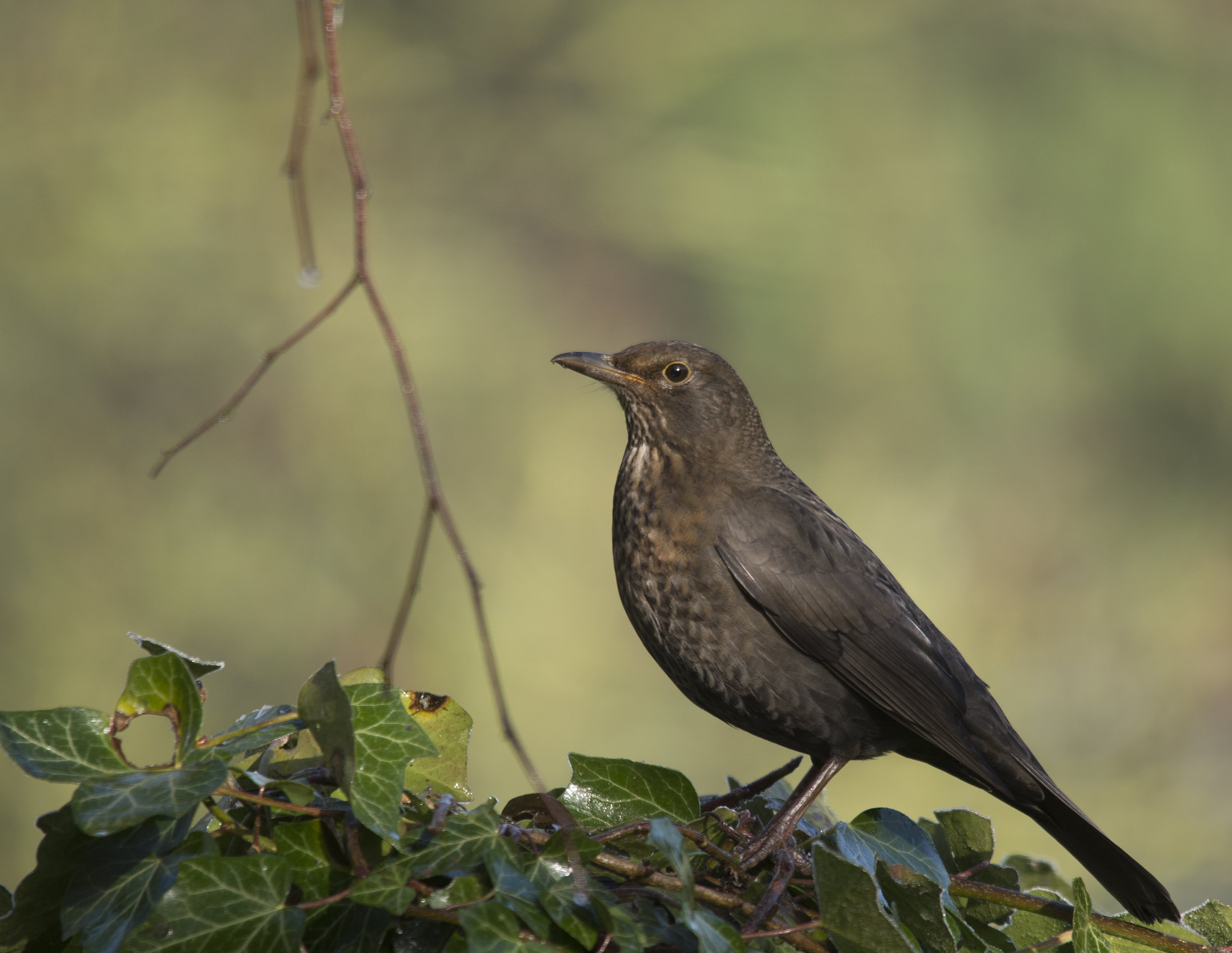
Distribution: This is the most common and widespread thrush, present all year round. BoCC5 status: Green Wingspan: 34–38cm What to look for: Males and females look different, with males being all black, with bright yellow eye-rings and beaks, while females are a redish-brown, with a speckled appearance and duller yellow eye-rings and beaks. The female’s beak can also be dark brown.
Male blackbird by Jacob Spinks via FlickrFemale blackbird by Jacob Spinks via Flickr
Fieldfare (Turdus pilaris)
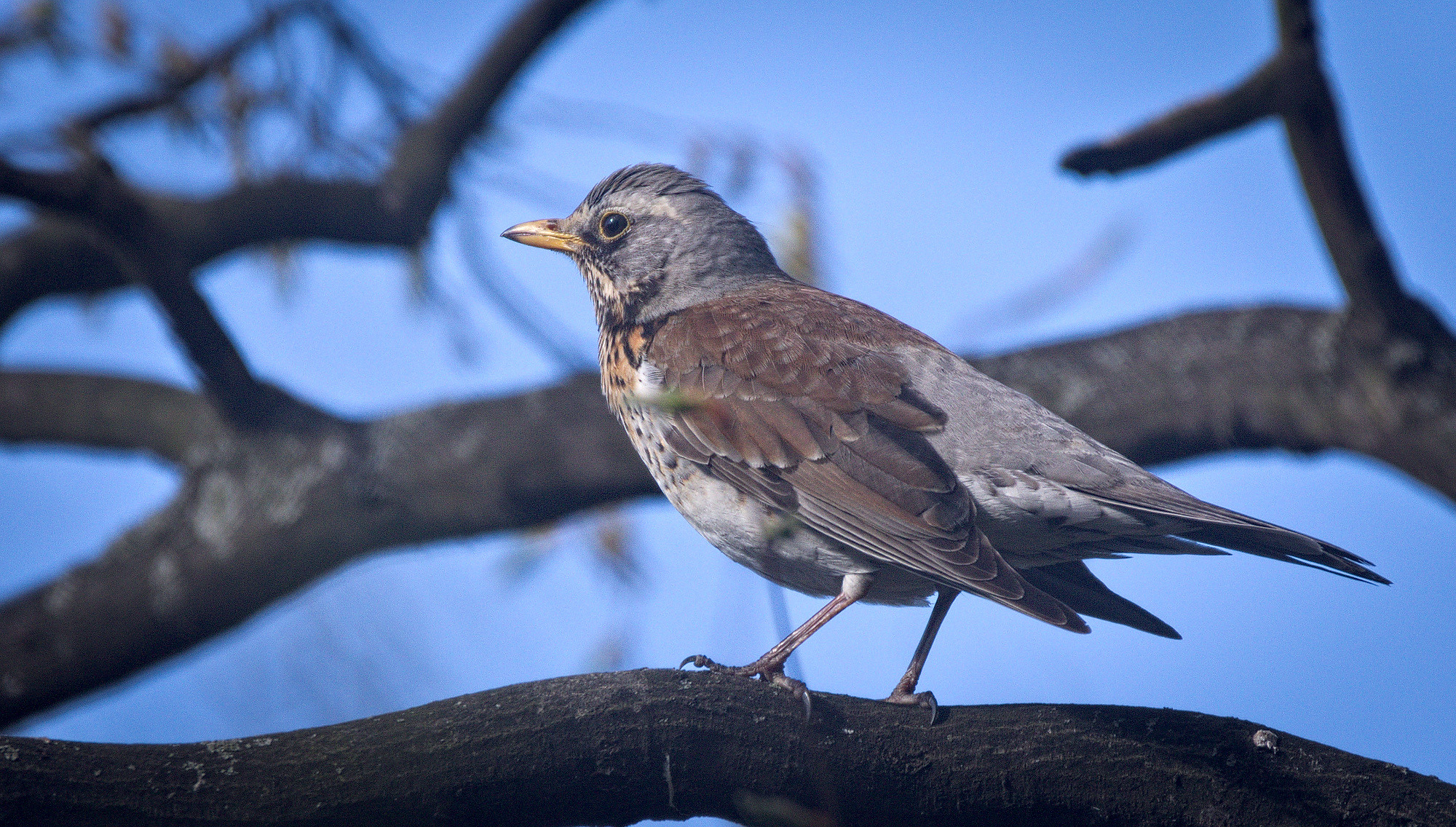
Distribution: These are winter birds, with only a few remaining to breed in the UK all year round. BoCC5 status: Red Wingspan: 39–42cm What to look for: This is a slight larger bird, with grey heads, necks and rumps, though they have a dark strip across their eye to their orange and black beak. Their backs are dark brown and their tails are black, with a tinged orange throat and a paler, puff coloured breast. They are speckled with dark markings, which are larger on their breast. Their underside is pale.
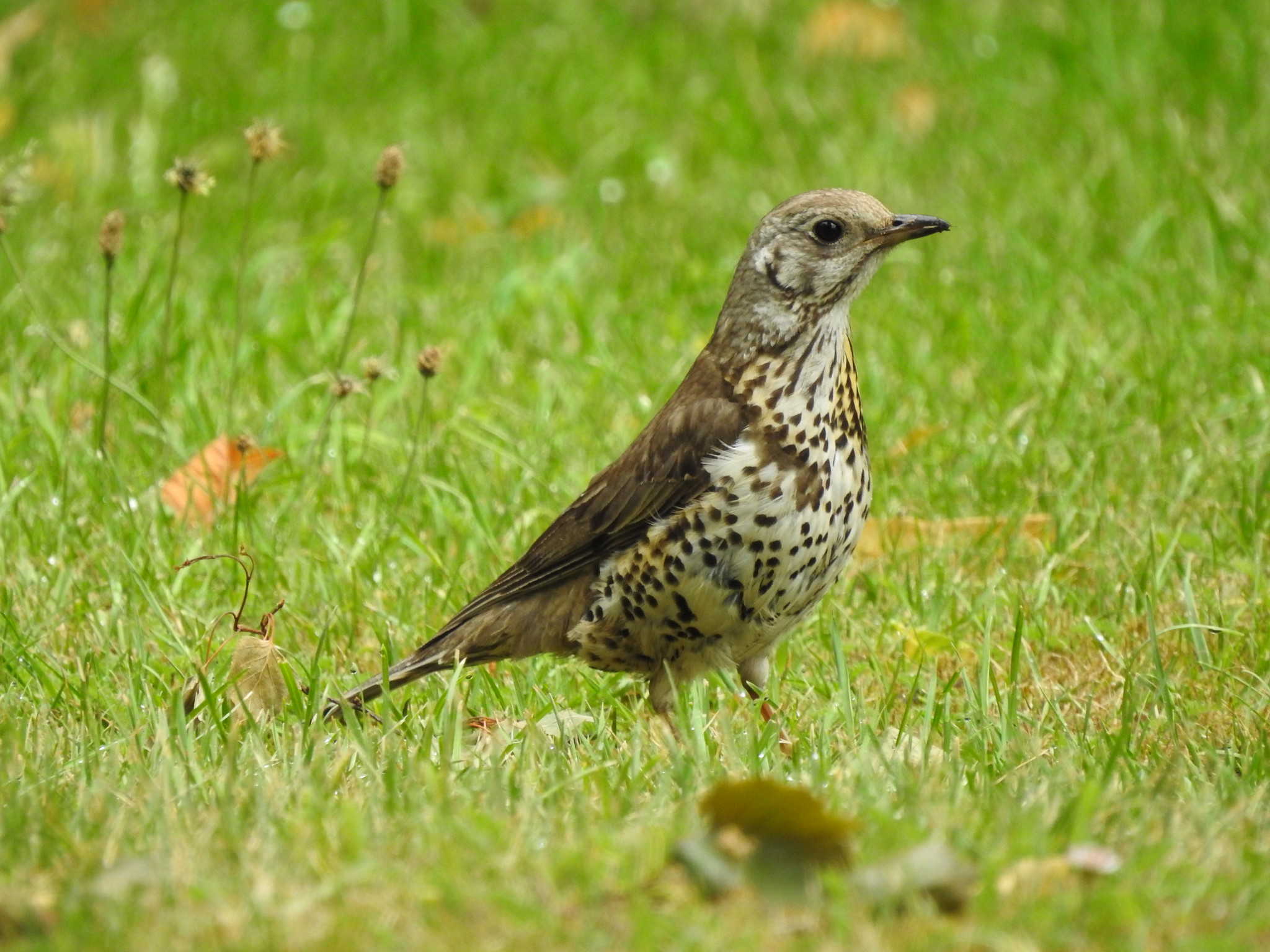
Distribution: Widespread, across the whole of the British Isles throughout the year. They are absent in parts of the northern and western isles of Scotland. BoCC5 status: Red Wingspan: 42–48cm What to look for: This is the largest of the thrushes, with a dark brown back and paler underside and throat that is speckled with dark brown. It has a pale eye-ring, cheeks and lores. They stand quite upright and have orange legs and an orange and dark brown beak.
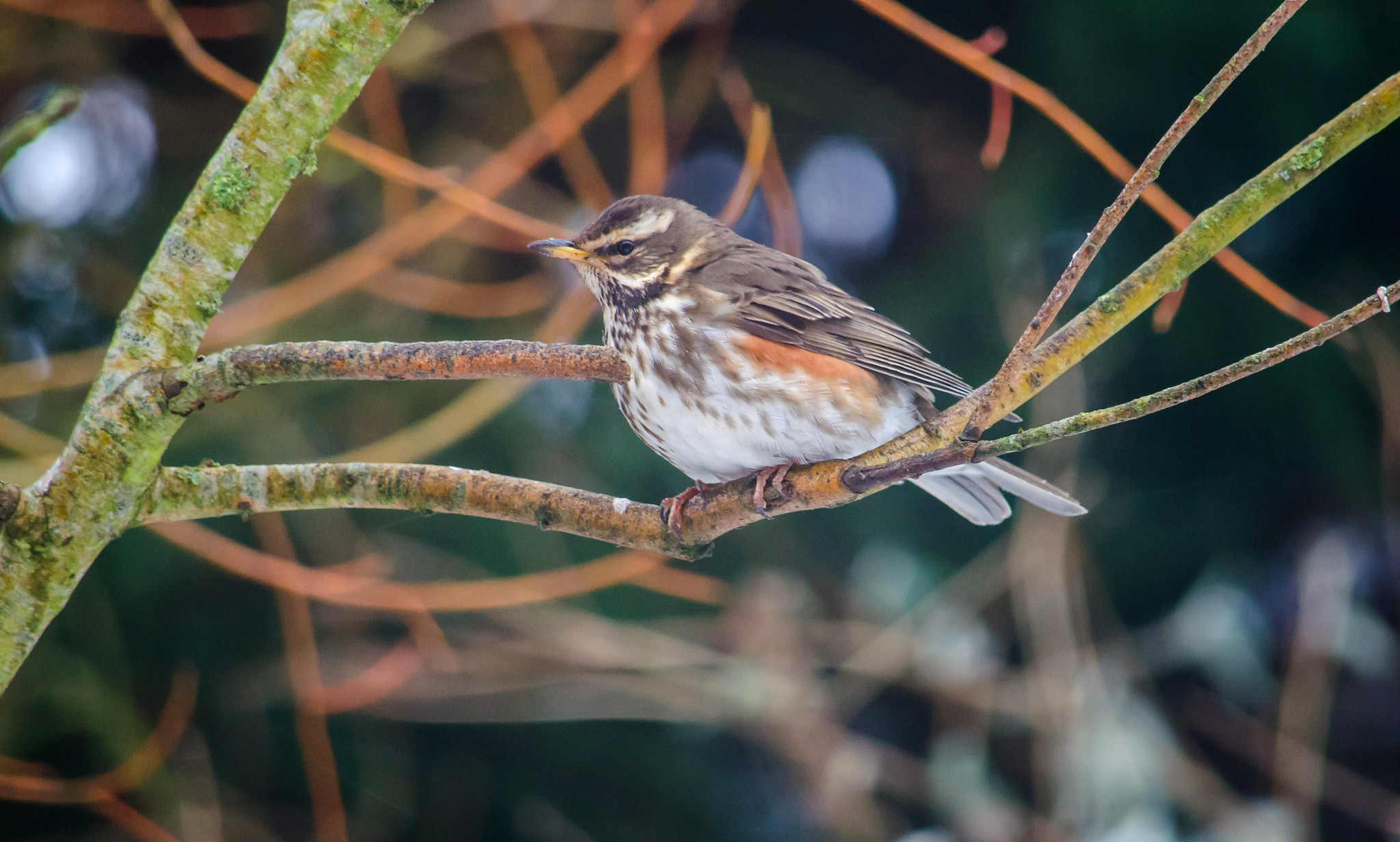
Distribution: This is a winter visitor, arriving from late September onwards and leaving again in the summer. They’re found across the UK, except for parts of North Scotland. BoCC5 status: Amber Wingspan: 33–35cm What to look for: This species is the smallest thrush that regularly visits the UK, similar in appearance to the song thrush. Their distinctive feature, however, is the bright orange-red patch on their sides under each wing, as well as the pale stripe over their eye.
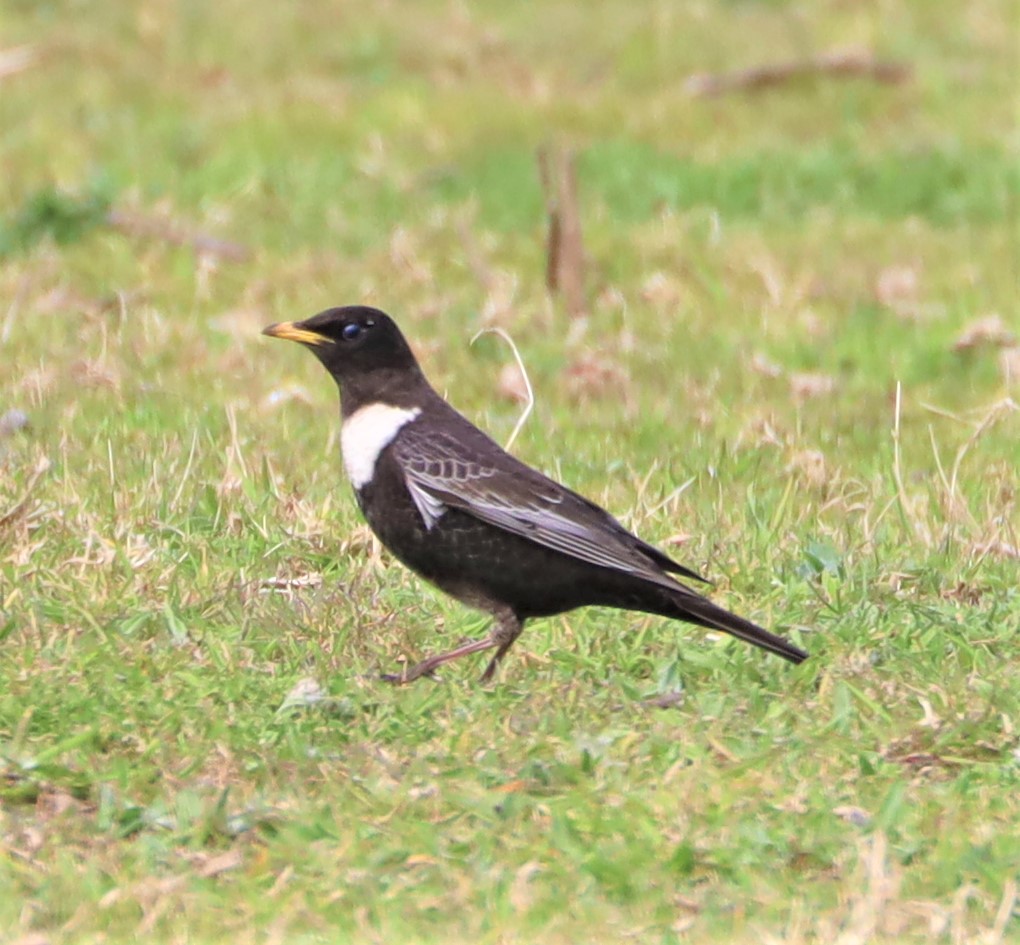
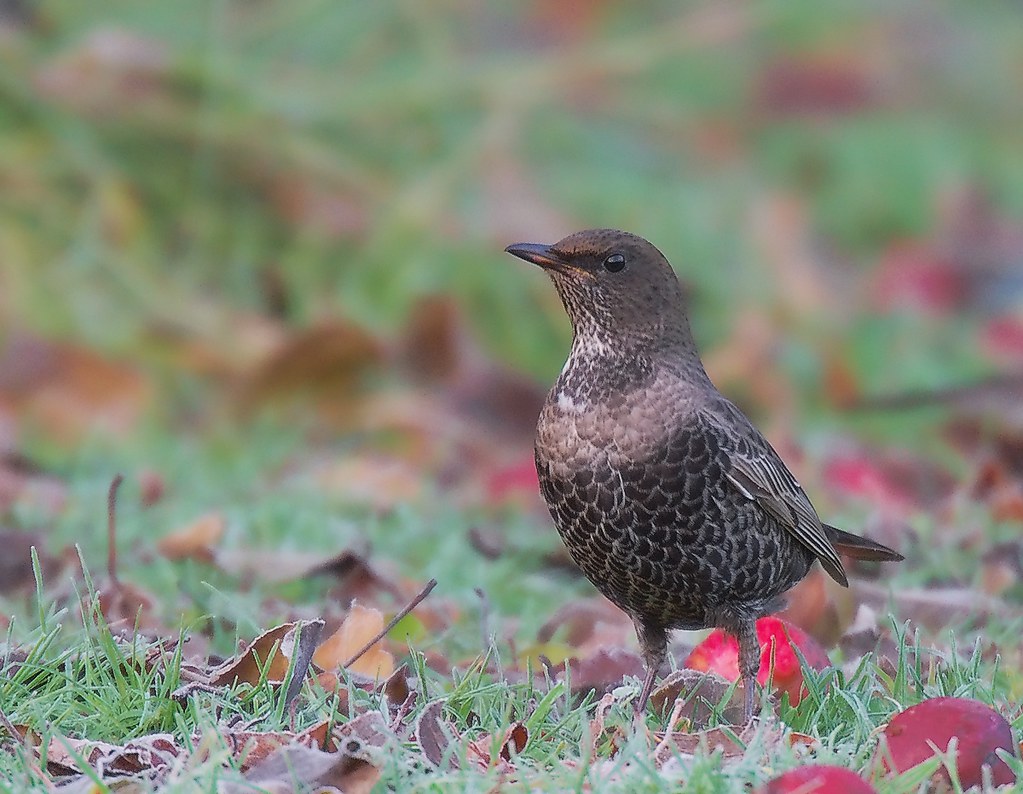
Distribution: Summer visitors are found in the uplands of Scotland and northern England, as well as parts of north west Wales and Dartmoor. During spring and autumn, when they migrate, they may be spotted along the east and south coasts of the UK. BoCC5 status: Red Wingspan: 38–42cm What to look for: Males are black, with a pale panel on their wings and a bright white band across their breast, resembling a bib. Females are similar but their colouration is much less striking, looking like a ‘washed out’ version of the male. Both have an orange and black beak and black legs. Their wings and underside feathers have pale outlines, and some can have white patches on their heads.
Male ring ouzel by Nick Goodrum via FlickrFemale ring ouzel by Stefan Berndtsson via Flickr
Song Thrush (Turdus philomelos)
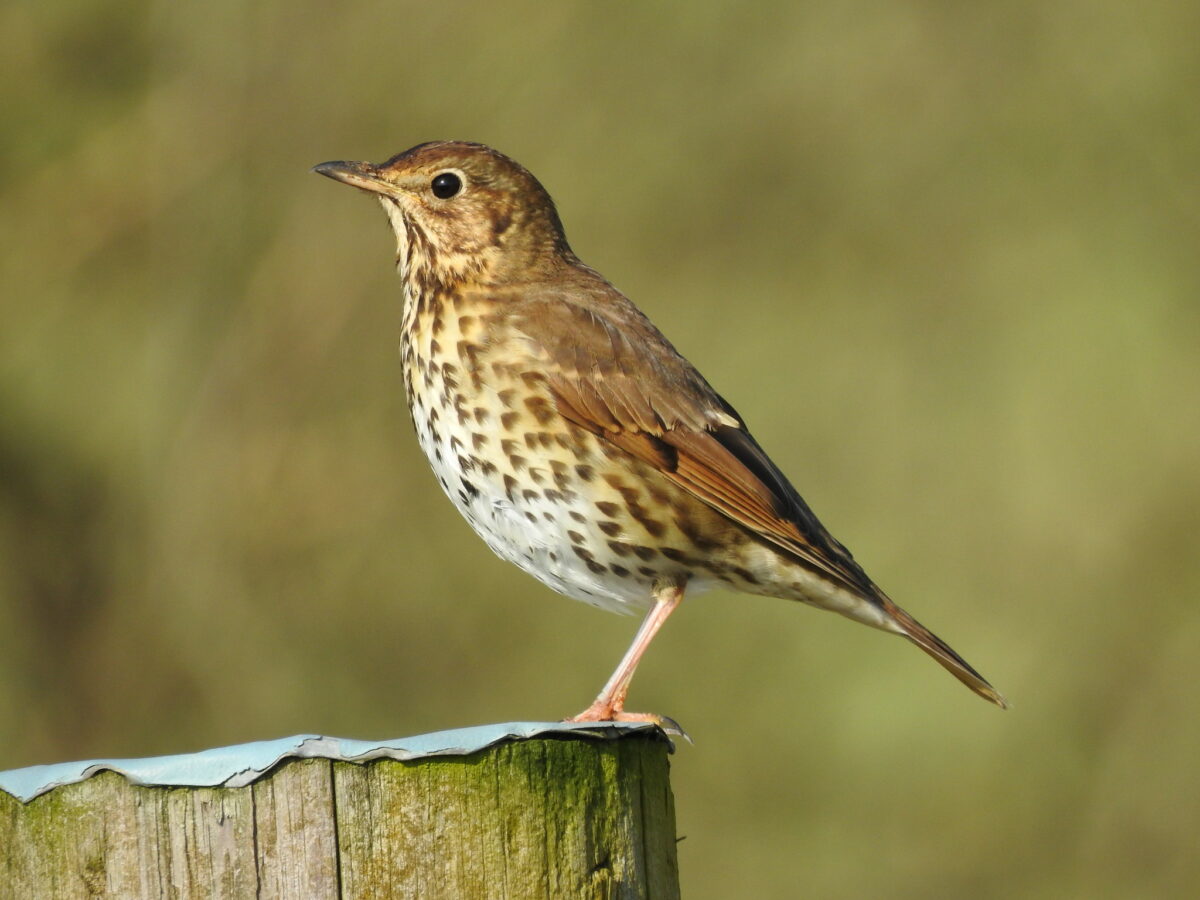
Distribution: Found across the UK, through missing from parts of Northern and Southern Scotland. BoCC5 status: Amber Wingspan: 33–36cm What to look for: This, other than the blackbird, is probably the most well known member of the thrush family. They are a small bird, browner than the mistle thrush, with smaller speckles. Their sides and cheeks are yellowish, with a paler underside, eye-ring, undertail and legs. Their beaks are yellow and black. Did you know? The male song thrush copies other birds’ songs, creating a repertoire that it sings on repeat, often to reinforce territories and attract mates.
15-million-year-old giant wombat skeletons have been uncovered in Australia. A new paper analysed the various features of these fossil bones to reveal the overall size and shape of the animal, its lifestyle and surrounding environment, as well as what kind of movements the animal was capable of. The research showed that this species, known as Nimbadon, spent some of its time suspended from tree branches like a sloth, grew in periodic spurts and had opposable thumbs. They are currently studying the enamel microstructure of Nimbadon’s teeth to determine its diet.
A program to plant 20 million trees in Australia prioritised cost-saving over gains for the environment, according to new research. Beginning in 2014, the program was aiming to improve native vegetation, support a richness of plant and animal species and reduce greenhouse gases. However, funding decisions were largely driven by ‘value for money’ considerations, with projects where the cost per tree was less than A$5 far more likely to be funded than projects where a tree cost more than A$10, undermining the benefits for both threatened species and the climate.
Extinction risk
A lack of large prey in Nepal may be the reason behind the rise in human-tiger conflicts. The wild tiger population has nearly tripled in the past 12 years but this has led to an increase in conflicts, with tigers in Bardiya National Park frequently preying on livestock in nearby settlements. Tigers in Parsa National Park, however, have access to large prey such as wild water buffalo and guar wild cattle, and researchers found no traces of livestock in their diet.
Trapping is holding back the speed of bird recovery in the Harapan Forest, Sumatra, Indonesia. A new study has found that the decade of protection and natural regeneration has helped bird populations increase in this forest, but wild trapping is preventing the full results of reforestation efforts. 45.1% of 122 bird species showed a notable population increase from 2009 to 2018, but 16.2% faced intensified trapping pressure.
Climate change
For the first time, wind is now the main source of UK electricity. In the first three months of 2023, wind turbines generated more electricity than gas, with a third of the country’s electricity coming from wind farms. There was also a record period for solar energy generation. While there is still a long way to go, this is a step in the right direction to meet the UK’s aim for all its electricity to have net zero emissions.
Frogs in Puerto Rico are croaking at a higher pitch due to global heating. The coqui frog appears to be decreasing in size due to the warmer temperatures, which is causing their croaks to become more high-pitched. Researchers are warning that if the trends continue, the temperature could become too high for certain amphibians to survive.
A new report claims that the UK could unlock £70bn a year in renewable energy. Generating more green electricity to meet the UK’s climate targets could create an additional 279,000 jobs, supporting a total of 654,000 jobs. If Britain’s clean electricity generation increased 50% above its current projections for 2050, it could be capable of exporting £17bn of green electricity to Europe annually. This could attract trillions in global private investment, doubling the £35bn a year economic benefit forecasted for its current path. To do this, government policymakers must remove barriers hampering the UK’s green energy ambitions, such as making sure the UK has enough batteries to store its renewable electricity and retrofitting commercial buildings to improve the UK’s energy efficiency.
Conservation
A Cornish farm is launching a project to triple the UK’s temperate rainforest. The Thousand Year Trust is being launched this year by a veteran who is now transforming his 120-hectare hill farm on Bodmin Moor into the largest rainforest restoration project in England and Wales. Working with local farmers, landowners and other charities to identify land suitable for this habitat, the charity has the ultimate aim of tripling Britain’s surviving rainforest to 1m acres over the next 30 years.
Seabird conservation is mostly working, according to a comprehensive new data set. Researchers compiled a data set of 851 seabird restoration events over the last 70 years, spanning 551 locations and targeting 138 seabird species. Forty-nine events used translocation, while 802 used social attraction, such as decoys, bird sound recordings and other devices aiming to lure birds to a new place. While the result of each project depended largely on the species and circumstances, most were successfully completed.
Policy
An unprecedented €2.2bn drought response plan has been approved in Spain. The package of measures includes €1.4bn in funds to tackle the drought and increase water availability, and €784m to help farmers maintain production and avoid food shortages. The €1.4bn will be spent on building new infrastructure, such as desalination plants, doubling the proportion of water that is reused in urban areas from 10% to 20% by 2027, and subsidising those whose irrigation water supplies would be reduced.