Author Q&A with David Wege: Mammal Tracks of Europe

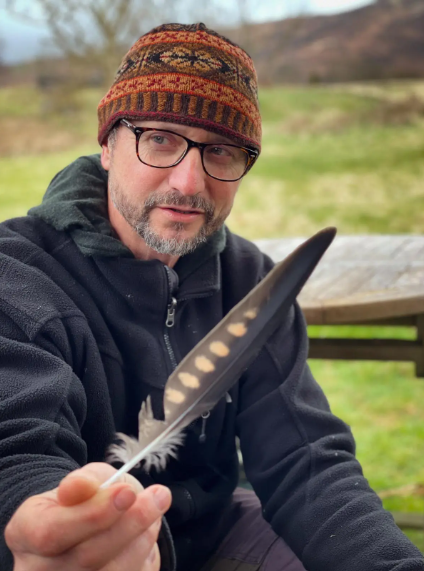
Author David Wege holding a feather for the camera
Author David Wege via Davidwegenature.uk

Passionate naturalist, author and illustrator David Wege has led an exciting 30-year career in international bird conservation. Now sharing the joy of tracking through teaching, he aims to encourage others to deepen their connection with the world around us.  

For his latest work, he has turned his attention to mammals and has created Mammal Tracks of Europe. After rediscovering his passion for tracking, David hopes to inspire others to engage with the art through his latest work. This book includes the tracks of 72 European mammals, with detailed drawings and portraits of each species.  

We recently had the chance to chat with David about how he first became interested in tracking, why he included Homo sapiens in his new mammal tracks field guide, what he’s currently working on and more.


This unique field guide features a broad selection of European mammals. What criteria did you use when choosing which species to include? 

I set out with the intention of creating a mammal tracks guide that anyone could take out into the field, anywhere in Europe, and identify the tracks they were looking at. This meant including all of Europe’s larger terrestrial mammals, including the Arctic species from Scandinavia (such as Wolverine, Arctic Fox and Muskox), and the species that have ranges just into the Mediterranean countries (like Crested Porcupine and Egyptian Mongoose). So, all larger European mammals that you are likely to find tracks of are featured. Even the domesticated species that, as trackers, we often find the tracks of such as cats, dogs, cows, sheep and Alpacas! The small mammals (such as the mice, voles and shrews) are not covered quite as well, but all species for which we have track photos are included. The end result, is a book with the tracks and trails of an incredible 72 European mammal species. 

Creating a book that anyone can use meant making it accessible to people right across Europe. So, each species is represented by a small portrait of the animal; is identified by its scientific name; and its common name is given in eight European languages. As well as helping people navigate the book quickly, I think the species portraits make sure that we keep the connection between tracks and the animal that made them. 

Tracking is increasing in popularity across Europe and is being used more and more as we rewild areas and reintroduce species in the region. My hope is that this guide will help encourage more people to connect with mammal tracks and engage with the conservation movement, wherever they are. 
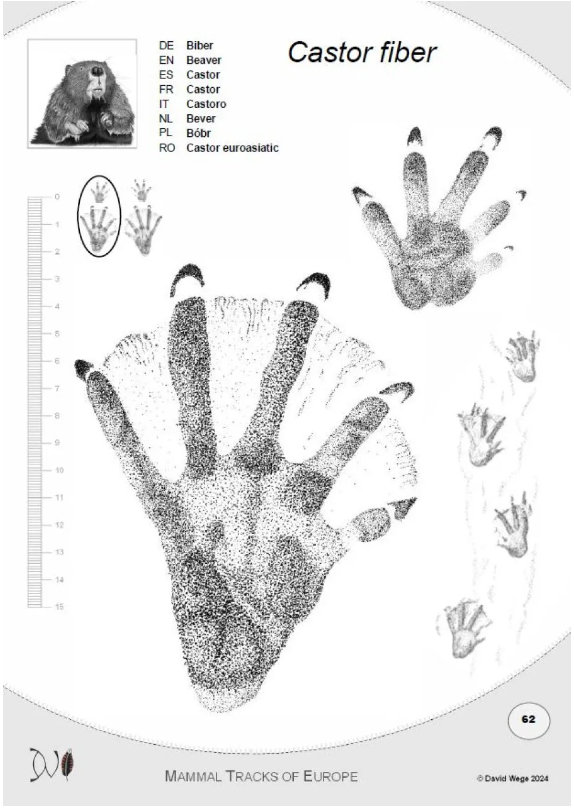
Castor fiber page from european mammal tracks, showing illustrations of footprints and a portrait of a beaver

Why did you choose to include Homo sapiens in the field guide, and why were these tracks presented first? 

Humans are part of nature. We’re mammals just like every other mammal in the book, so presenting human in exactly the same way as our mammalian cousins – as Homo sapiens, a species that also makes tracks – seemed important. Connecting with nature starts with us recognising our place within it, so human on Page 1 is a nod to our place as equals among other animal beings. There’s a practical aspect to this too. As a teacher passing on tracking knowledge to others, using our human hands and feet as a reference point for where toe pads, nails, palm pads, heels, carpal pads etc. are, is a great way for people to learn and relate to the track morphology of other mammalian beings. Human hands and feet (and the tracks they create) are a wonderful baseline against which we can start comparing the tracks of other species. 

Instead of written descriptions, the field guide uses drawings as a primary aid to identification. What challenges did you face in illustrating the guide? 

The guide really does have very little text and relies on drawings to do the talking – to be a graphic reference when you’re out in the field. I wanted to create precise representations of tracks for each species – to let the illustrations communicate all that was needed in a true to be used in the field field guide. A noble desire, and easily said, but there really are many challenges. The first of which arises from the fact that no two tracks in the mud, sand, clay or snow are the same, so which one is best to illustrate? To overcome this, I traced (electronically, on a tablet) as many track photos as possible to build up (as near as possible) a perfect average. This hopefully compensates for the vagaries of different substrates. Drawing from track photos means that those images need to be good too! They have to be taken from directly above, with not too much shadow, and with a scale or ruler in the photo. When you start drawing from photos it really makes you appreciate which are good (and useful/usable) and which are not. Once I had my good track photos, I started drawing trying to keep strictly to what I was seeing in the tracks. This has hopefully resulted in illustrations that allow people to pick out the identification features that are most noticeable to them. 

Another challenge is that some of the species I’ve illustrated are rare, or from parts of Europe I have not been tracking, so I have had to rely on track photos shared generously by other trackers. It is definitely harder to illustrate a track that you’ve never seen in the field yourself – it’s difficult to get a feel for the essence of it, but I think I’ve managed to create good representations of tracks for all the mammals. 
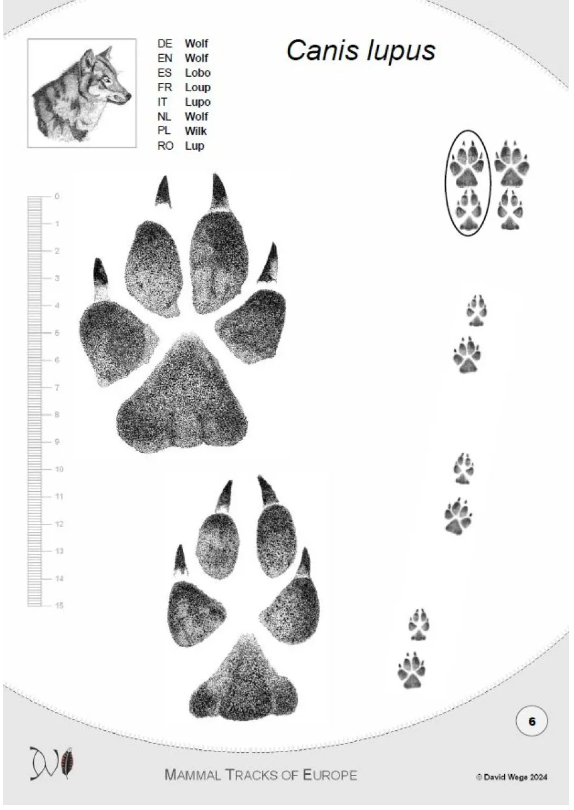
Illustration of a wolf footprint from mammal tracks of europe

Where did your initial interest in animal tracking come from, and how did you begin your journey into this field of study? 

I was totally hooked on tracking as a child when my parents gave me a book  Nature Detective by Hugh Faulkus. However, without a tracking mentor, I actively pursued my other passion of birds and birdwatching – a passion that I still have and that led me to a successful career in bird conservation with BirdLife International. Then, about ten years ago, I chanced upon a tracking mentor in John Rhyder (author of Track and Sign, and one of Europe’s foremost trackers), and have been learning from him and teaching with him ever since. We have just finished a book together titled Bird Tracks: a field guide to British species. Tracking just seems like a natural component of being in nature for me. Wandering in nature means intuitively noticing who was there, doing what and when, which birds are calling or singing, what plants are emerging or flowering (and so much more). Reading the tracks is just a part of this awareness, although I’m still learning how to balance an awareness of tracks on the ground with noticing birds up in the trees! 

What will be next for you? Are there any plans for more tracking guides? 

One of the many wonders of tracking (by which I mean reading and interpreting the tracks and signs that animals leave on the landscape) is that there is always more to learn. Animals constantly surprise and we’re often discovering new behaviours revealed in tracks and signs. I’m still learning but I also have the privilege of teaching the art and science of tracking to others. So, I will be spreading the tracking joy, with my book in hand, to people who can hopefully then use the skill to connect to nature, or apply their tracking skills to help monitor, conserve and restore wildlife. This book was designed as a resource for people across Europe, but I would like to see my track and trail illustrations used for local or national field guides that might then be accessible to a wider audience. Anything to help encourage nature connection through tracking. 
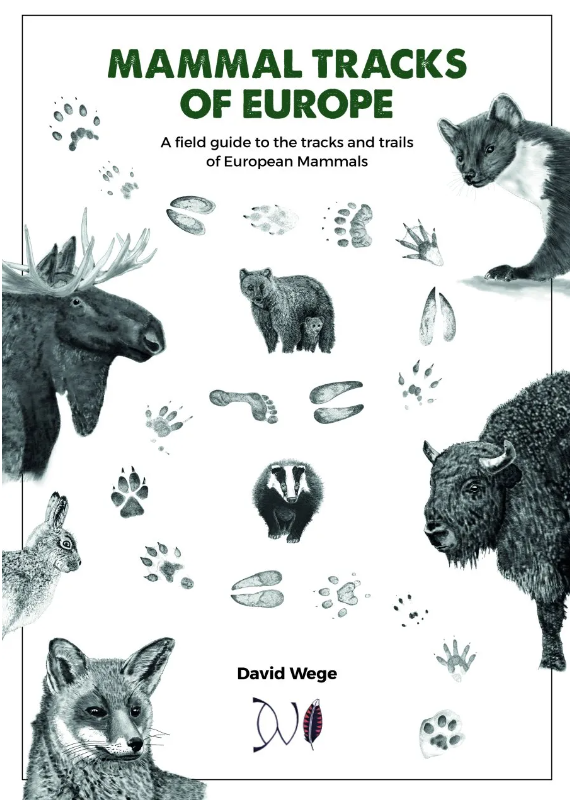
Front cover of Mammal Tracks of Europe. Shows illustrations of a fox, moose, bear and pine marten.

Mammal Tracks of Europe: A Field Guide to The Tracks and Trails of European Mammals is available on our online bookstore here.
 

The NHBS Guide to UK Reptile Identification

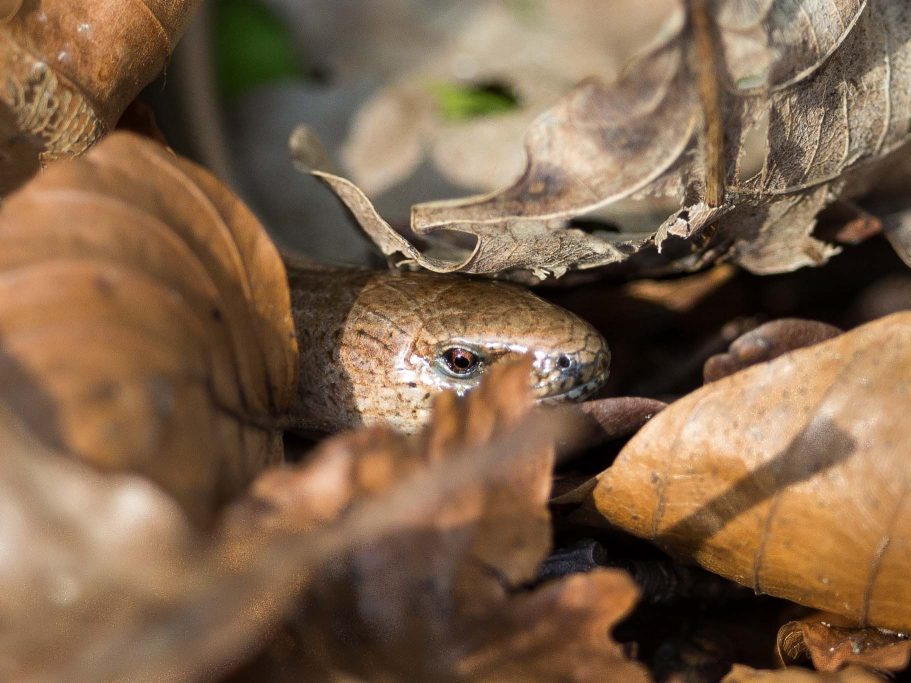
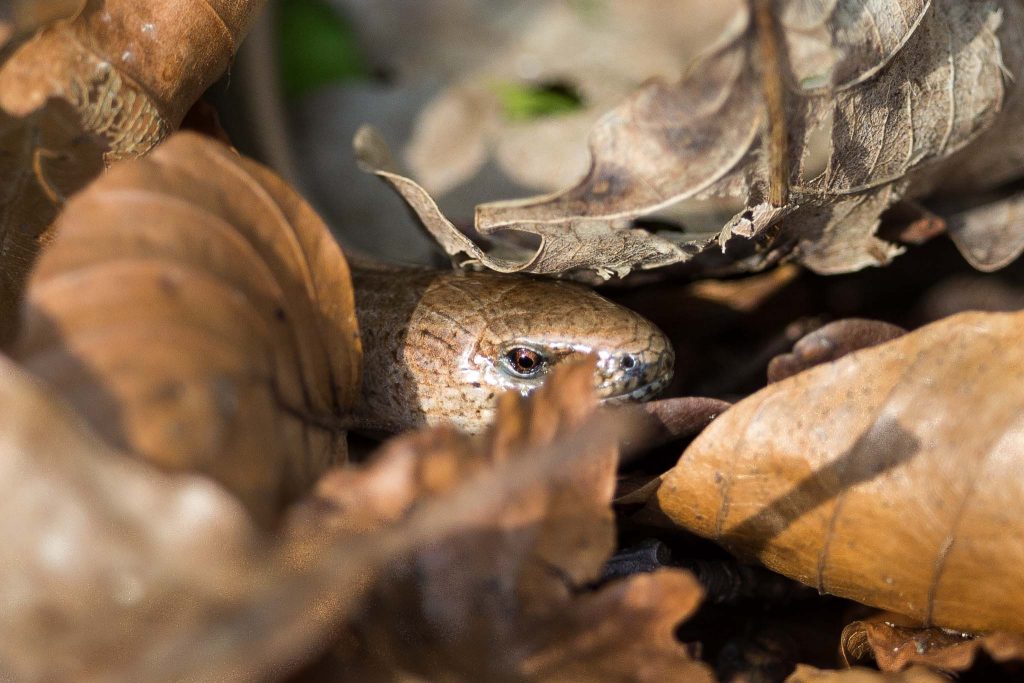
Slow worm image by Smudge 9000 via Flickr (CC BY-SA 2.0)

The UK is home to six native species of reptile – three snakes (adder, grass snake and smooth snake) and three lizards (common lizard, sand lizard and slow worm). In early spring, snakes and lizards begin to emerge from hibernation – if you are lucky you may catch a glimpse of one in your garden or when out walking in the countryside. (Interesting note: adders have now been recorded as being active during every month of the year in the UK, a behavioural change which is thought to be linked to overall warmer weather).  

This article aims to provide you with some of the key characteristics of each species which will help you to identify what you’re looking at. You will also find a list of field and identification guides at the bottom of the page which will give you lots more information about each species and help you with your ID.

Snakes

Snakes are part of the suborder Serpentes and, though they vary greatly in size and colour, their limbless, elongated bodies make their overall form very distinct (although some legless lizards, such as the slow worm, may often be mistaken for a snake). The skin of a snake is covered in scales and is a smooth, dry texture – this skin is shed periodically throughout the snake’s life. All snakes are carnivorous and many species have specialised skulls with extra joints enabling them to swallow prey much larger than their heads. Most species are non-venomous and either swallow their prey alive or kill it by constriction. 

All three snake species in the UK reproduce by producing eggs. However, both the adder and smooth snake incubate eggs internally whereas the grass snake lays them in rotting vegetation such as compost heaps. 

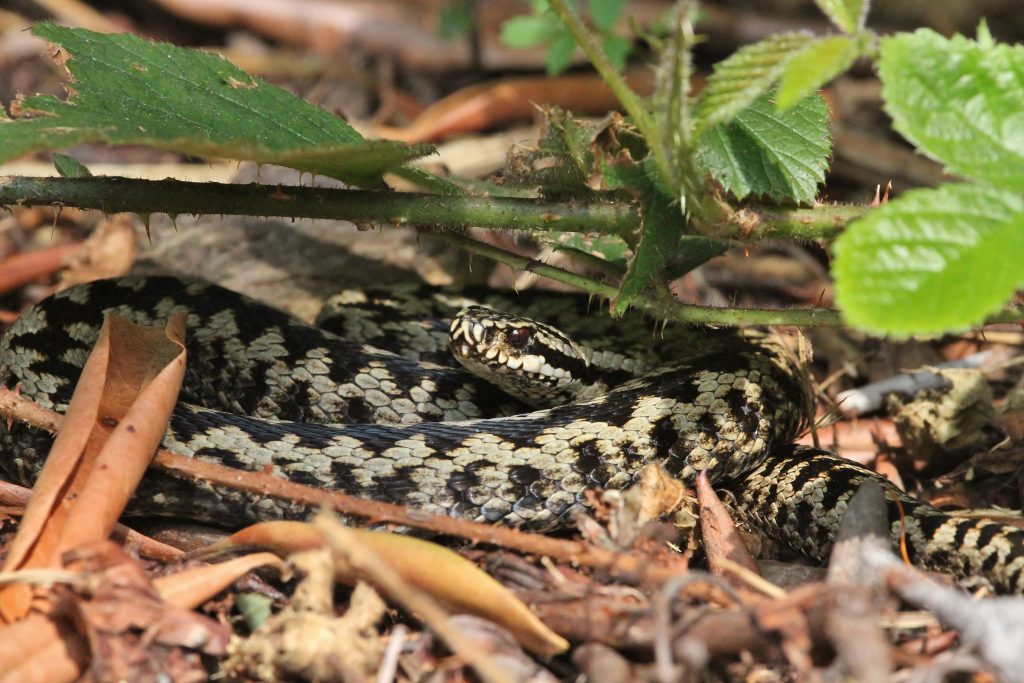
Adder (Vipera berus)

Adder image by Jo Garbutt via Flickr (CC BY 2.0)

• Size: 60-80cm in length.
• Colour: Greyish with a dark and very distinctive zig-zag pattern down its back. Red eye.
• Habitat: Prefers woodland, heathland and moorland but may also be found in grassland or on the coast.
• Interesting fact: The adder is the only venomous snake in the UK. However, bites are very rare as adders are reclusive and would prefer to retreat than confront a human. 

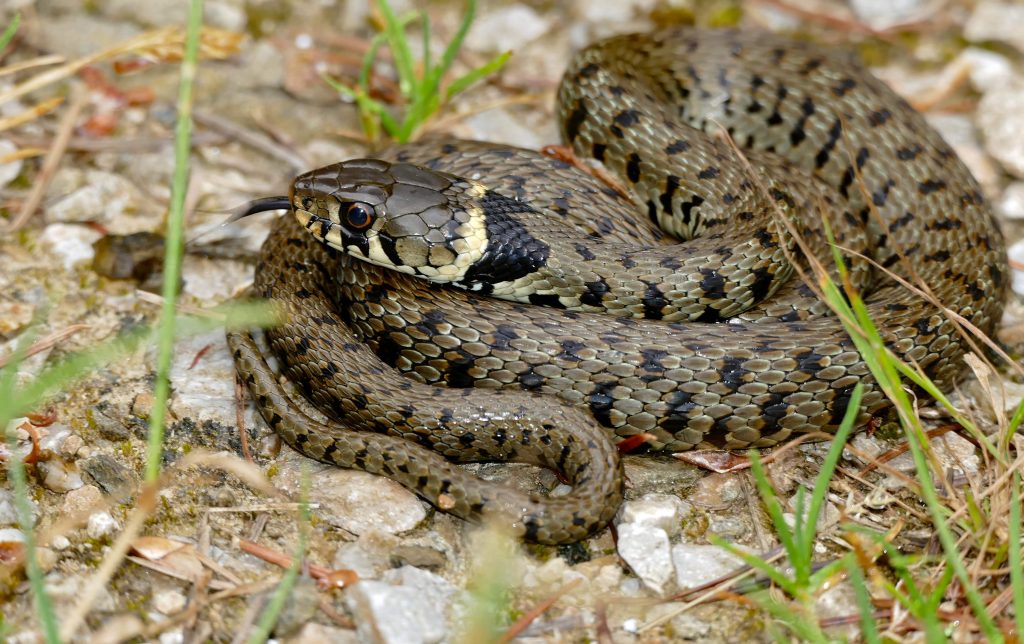
Grass snake (Natrix helvetica)

Grass snake image by Bernard Dupont via Flickr (CC BY 2.0)

• Size: 90-150cm in length.
• Colour: Usually greenish in colour, with a yellow and black collar, pale belly and dark markings down the sides.
• Habitat: Favours wetland habitats but can also be found in grassland and gardens, especially those with a pond.
• Interesting fact: The grass snake is the longest snake found in the UK.

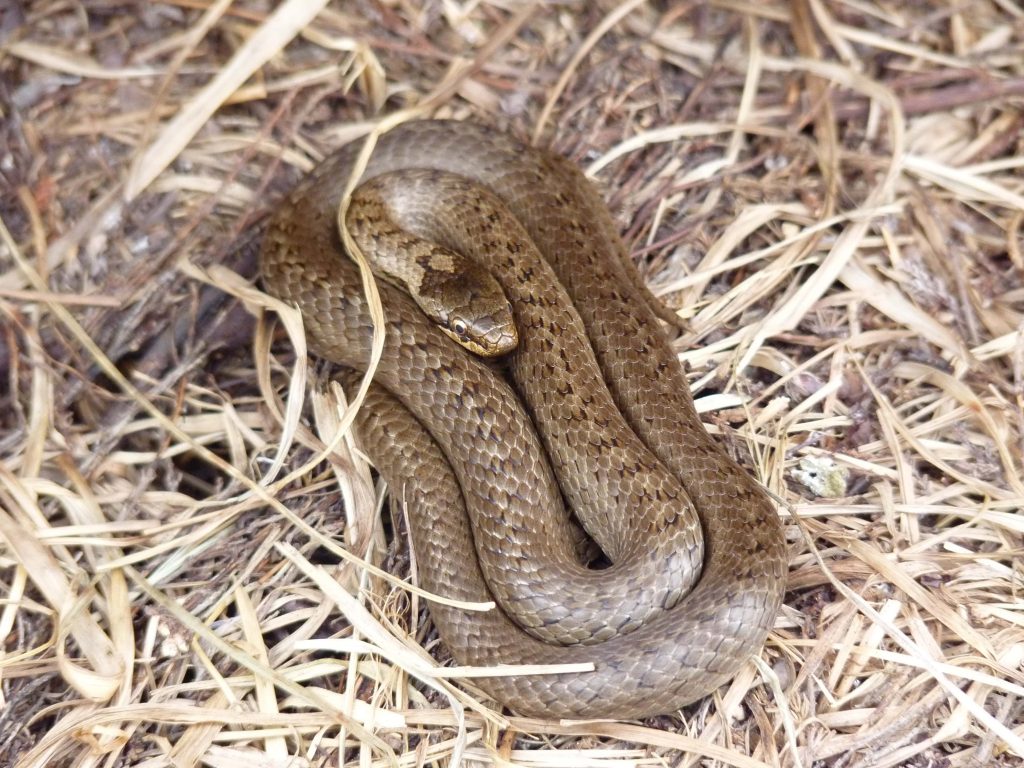
Smooth snake (Coronella austriaca)

Smooth snake image by Odd Wellies via Flickr (CC BY 2.0)

• Size: 50-70cm in length.
• Colour: Usually dark grey or brown in colour. Similar to an adder but with a more slender body and without the zig-zag pattern along its back.
• Habitat: Very rare. Mainly found on a few sandy heaths in Dorset, Hampshire and Surrey, although a couple of reintroduced populations exist in West Sussex and Devon.
• Interesting fact: The smooth snake is a constrictor, coiling around its prey to subdue it and crush it to death.

Lizards

Most lizards have four legs and run with a side-to-side motion. However, some, such as the slow worm, are legless. Lizards are mainly carnivorous and often employ a ‘sit-and-wait’ approach to catching prey. In the UK, lizards feed primarily on insects, molluscs and spiders.

Although all three species of UK lizard lay eggs, both the common lizard and slow worm incubate these internally, ‘giving birth’ in the late summer. Sand lizards lay shelled eggs that are buried in the sand where they are kept warm by the sun. 

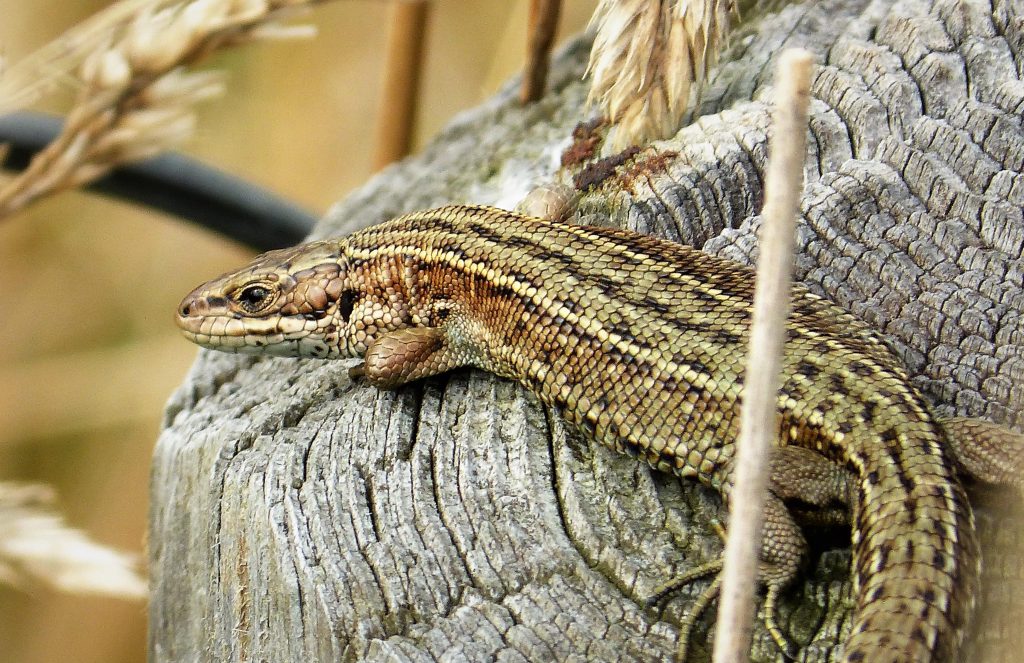
Common lizard (Zootoca vivipara)

Common lizard image by Gail Hampshire via Flickr (CC BY 2.0)

• Size: 10-15cm in length.
• Colour: Variable, but most commonly a brownish-grey, with rows of darker spots or stripes down the back and sides. Males have bright yellow or orange undersides with spots, while females have paler, plain bellies.
• Habitat: Heathland, moorland and grassland.
• Interesting fact: If threatened by a predator, the common lizard will shed its tail which continues to move – the lizard uses this distraction to make its escape. Although able to regrow its tail, the new one is usually shorter than the original.

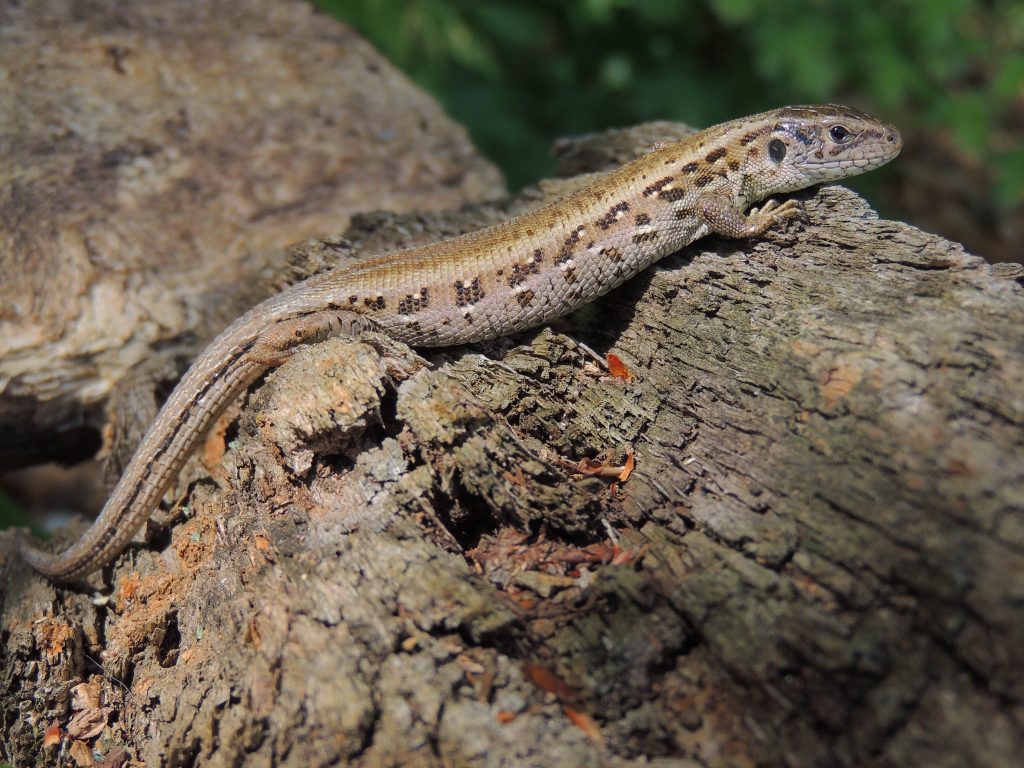
Sand lizard (Lacerta agilis)

Sand lizard image by xulescu-g via Flickr (CC BY-SA 2.0)

• Size: Up to 20cm.
• Colour: Female sand lizards are a sandy-brown colour, with rows of dark blotches along the back. Males have green flanks that are at their brightest during the breeding season, making them easy to spot.
• Habitat: The sand lizard is very rare and can only be found on a few sandy heaths in Dorset, Hampshire and Surrey with a few reintroduced populations in the south east, south west and Wales.
• Interesting fact: Sand lizards dig burrows for overnight refuge and hibernation. 

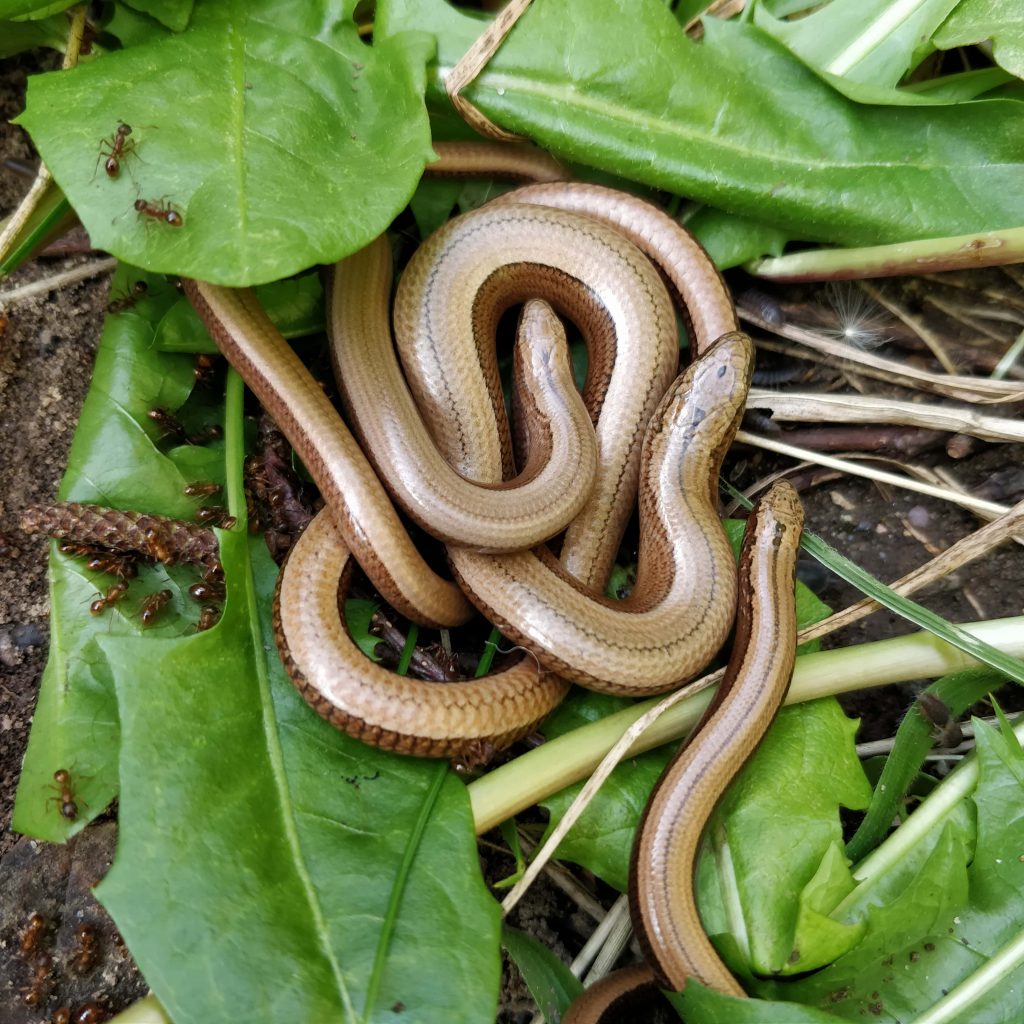
Slow worm (Anguis fragilis)

Slow worm image by Oliver Haines

• Size: 40-50cm.
• Colour: Smooth, golden-grey skin. The males are paler in colour and occasionally have blue spots. The females tend to be larger with dark sides and some have a dark line down their back.
• Habitat: Slow worms live in most of Great Britain apart from Northern Ireland and are also present on most of the islands in Scotland and the Channel Isles.
• Interesting fact: Although similar in appearance to a snake, the slow worm has eyelids (which snakes do not) and can drop its tail when threatened by a predator.

In addition to the six native reptiles, several species of non-native reptile can be found in the UK – these include the wall lizard, green lizard, aesculapian snake, European pond terrapin and the red-eared slider.

Recommended reading:

Amphibians and Reptiles
#206083
A comprehensive guide to the native and non-native species of amphibian and reptile found in the British Isles. Professor Trevor Beebee covers the biology, ecology, conservation and identification of the British herpetofauna, and provides keys for the identification of adult and immature specimens as well as eggs, larvae and metamorphs.

Britain’s Reptiles and Amphibians
#174837
This detailed guide to the reptiles and amphibians of Britain, Ireland and the Channel Islands has been produced with the aim of inspiring an increased level of interest in these exciting and fascinating animals. It is designed to help anyone who finds a lizard, snake, turtle, tortoise, terrapin, frog, toad or newt to identify it with confidence.


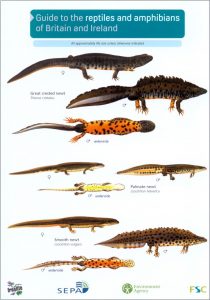
Guide to the Reptiles and Amphibians of Britain and Ireland
#113260
This laminated pamphlet is produced by the Field Studies Council and covers the 13 species of non-marine reptile and amphibian which breed in Britain, as well as the five species which breed in Ireland. These include snakes, lizards, frogs, toads and newts.


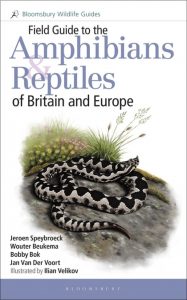
Field Guide to the Amphibians and Reptiles of Britain and Europe
#246563
This excellent field guide covers a total of 219 species, with a focus on identification and geographical variation. The species text also covers distribution, habitat and behaviour. Superb colour illustrations by talented artist Ilian Velikov depict every species.


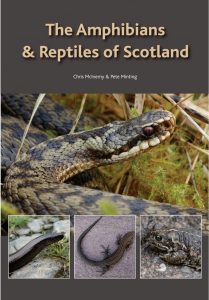
The Amphibians and Reptiles of Scotland
#235838
This book is designed to be an interesting and informative guide to the amphibians and reptiles that are found in the wild in Scotland. The authors have focused on those species native to Scotland, plus those which are non-native but are breeding in the wild.